Sign in to save

Bookmark this page so you can find it later.

Sign in to save

Bookmark this page so you can find it later.

Biogeochemical Cycles Explorer

Explore the major nutrient cycles that sustain life on Earth. Switch between carbon, nitrogen, phosphorus, and water cycles. View reservoir sizes, flux rates between compartments, and calculate residence times. Toggle human impact mode to see how industrial activity alters these natural systems.

Carbon Cycle Diagram

Photosynthesis120.0 Gt C/yrRespiration60.0 Gt C/yrDecomposition60.0 Gt C/yrSoil Respiration60.0 Gt C/yrOcean Absorption92.0 Gt C/yrOcean Release90.0 Gt C/yrFossil Fuel Combustion9.5 Gt C/yrDeforestation1.5 Gt C/yrAtmosphere CO₂850 Gt COcean Dissolved CO₂38.0K Gt CTerrestrial Biomass550 Gt CSoil Organic Carbon1.5K Gt CFossil Fuels10.0K Gt C

Controls

Residence Times

τ=MFout\tau = \frac{M}{F_{\text{out}}}
where M = reservoir mass, F = total outgoing flux
Atmosphere CO₂
850.00 Gt C
4.01 years
outflux: 212.00 /yr
Ocean Dissolved CO₂
38.0K Gt C
422.22 years
outflux: 90.00 /yr
Terrestrial Biomass
550.00 Gt C
4.53 years
outflux: 121.50 /yr
Soil Organic Carbon
1.5K Gt C
25.00 years
outflux: 60.00 /yr
Fossil Fuels
10.0K Gt C
1.05 thousand years
outflux: 9.50 /yr

Flux Balance

Atmosphere CO₂
In
221.00
Out
212.00
Net
+9.00
Ocean Dissolved CO₂
In
92.00
Out
90.00
Net
+2.00
Terrestrial Biomass
In
120.00
Out
121.50
Net
-1.50
Soil Organic Carbon
In
60.00
Out
60.00
Net
0.00
Fossil Fuels
In
0.00
Out
9.50
Net
-9.50

Flux Rates

Photosynthesis
120.0 Gt C/yr
Respiration
60.0 Gt C/yr
Decomposition
60.0 Gt C/yr
Soil Respiration
60.0 Gt C/yr
Ocean Absorption
92.0 Gt C/yr
Ocean Release
90.0 Gt C/yr
Fossil Fuel Combustion
9.5 Gt C/yr
Deforestation
1.5 Gt C/yr

Reference Guide

Carbon Cycle

The carbon cycle moves carbon through the atmosphere, oceans, biosphere, and geosphere. The atmosphere holds about 850 Gt C as CO₂, while oceans store roughly 38,000 Gt C as dissolved inorganic carbon.

Photosynthesis removes about 120 Gt C/yr from the atmosphere, while respiration and decomposition return a similar amount. Human fossil fuel burning adds roughly 9.5 Gt C/yr, creating a net atmospheric increase.

Atmosphere~850 Gt C Ocean~38,000 Gt C Fossil fuels~10,000 Gt C Soil organic~1,500 Gt C

Nitrogen Cycle

Nitrogen makes up 78% of the atmosphere as N₂ gas, but most organisms cannot use it directly. Nitrogen-fixing bacteria such as Rhizobium convert N₂ to NH₄⁺ (ammonium), making it biologically available.

Nitrification by Nitrosomonas and Nitrobacter converts NH₄⁺ to NO₃⁻ (nitrate), which plants absorb. Denitrifying bacteria complete the cycle by returning NO₃⁻ to N₂ gas. The Haber-Bosch process now fixes more nitrogen industrially than all natural processes combined.

Natural fixation~140 Tg N/yr Industrial fixation~120 Tg N/yr Denitrification~110 Tg N/yr Key bacteriaRhizobium, Nitrobacter

Phosphorus Cycle

Unlike carbon and nitrogen, phosphorus has no significant atmospheric phase. It cycles between rock, soil, living organisms, and aquatic sediments over geological timescales. Weathering of rock phosphate releases PO₄³⁻ into soil at roughly 15 Tg P/yr.

Plants absorb dissolved phosphate, and it returns to soil through decomposition. Human mining of rock phosphate for fertilizer has roughly doubled the rate of phosphorus entering soils, leading to excess runoff and aquatic eutrophication.

Rock phosphate~4,000,000 Tg P Marine sediments~8,400,000 Tg P Weathering rate~15 Tg P/yr No atmospheric phaseunique trait

Residence Time

Residence time is the average time a molecule spends in a given reservoir before moving to another. It is calculated as the reservoir mass divided by the total outgoing flux rate.

Atmospheric CO₂ has a residence time of about 4 years, meaning individual molecules cycle quickly even though the total amount is increasing. Ocean dissolved carbon has a much longer residence time of roughly 400 years. Fossil carbon can remain locked away for millions of years.
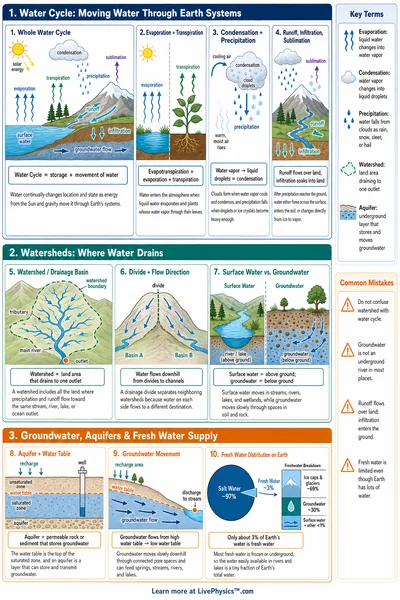
Atmospheric CO₂~4 years Ocean carbon~400 years Water vapor~10 days Groundwater~1,000+ years

Related Content

Related Tools

Earthquake Magnitude Calculator
Four modes: magnitude scales (Richter Mₗ, moment magnitude M𝑤, energy), energy comparison (each step = 31.6× more energy, logarithmic bar chart), Modified Mercalli Intensity I-XII with descriptions, and Richter magnitude from seismograph amplitude. Presets include Minor M3 through Great M8, 1906 San Francisco M7.9, and 2011 Japan M9.1.
Carbon Footprint Calculator
Estimate annual CO₂ emissions from transportation (car miles, fuel type, flights), home energy (electricity, heating, AC), diet (meat consumption, food waste), and lifestyle (shopping, recycling). Pie chart breakdown, country comparison bar chart, trees-to-offset and equivalent-driving metrics. Five presets: Average American, Eco-Conscious, Heavy Commuter, Frequent Flyer, Work from Home.
Star Lifecycle Visualizer
Three modes: interactive HR diagram with 23 real stars (click to see properties), stellar evolution pathway from nebula to end state (white dwarf, neutron star, or black hole based on initial mass), and star properties calculator (luminosity L∝M^3.5, radius, lifetime t∝M^-2.5, apparent magnitude). Six presets: Sun, Red Dwarf (0.3 M☉), Sirius A (2 M☉), Blue Giant (20 M☉), Betelgeuse (15 M☉), Supergiant (50 M☉). Includes spectral class colour strip and SVG star visualization.
H-R Diagram Explorer
Three modes: plot a single star on the Hertzsprung-Russell diagram from temperature, radius, and mass (Stefan-Boltzmann luminosity, spectral class O-M, absolute magnitude, HR region); compare multiple stars side by side; and browse the spectral atlas with typical properties for each class. 23 reference stars plotted, 6 presets from Proxima Centauri to Rigel.