Homeostasis Lab
Investigate how the body maintains stable internal conditions through negative feedback. Adjust body temperature or blood glucose and observe which corrective mechanisms activate, how strong the response is, and what happens when the system reaches its limits.
Guided ExperimentNegative Feedback in Thermoregulation
If you raise body temperature above 37°C, which corrective mechanisms will activate and how strong will they be?
Write your hypothesis in the Lab Report panel, then click Next.
Body Temp
Glucose
Negative Feedback Loop
Controls
Quick Scenarios
Thermoregulation Status
Active Responses
Heat Gen
80
W/m²
Heat Loss
80
W/m²
Net Rate
+0.00
°C/min
Data Table
(0 rows)| # | Trial | Temp(°C) | Shivering | Sweating | Heat Gen(W/m²) | Heat Loss(W/m²) | Severity |
|---|
Reference Guide
Negative Feedback Loop
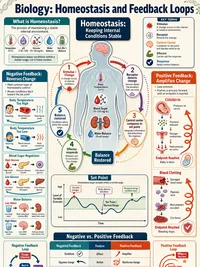
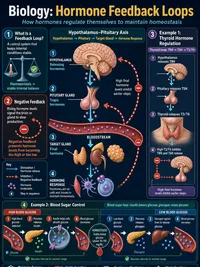
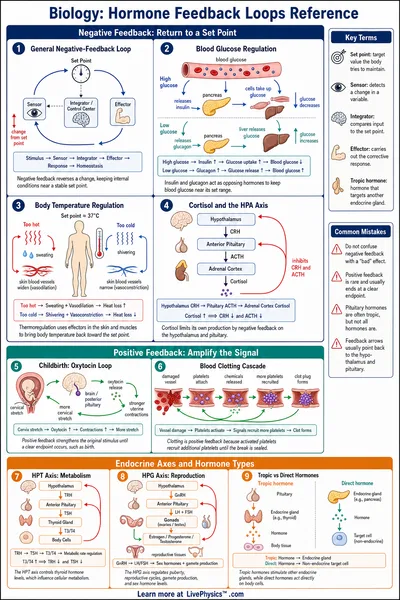
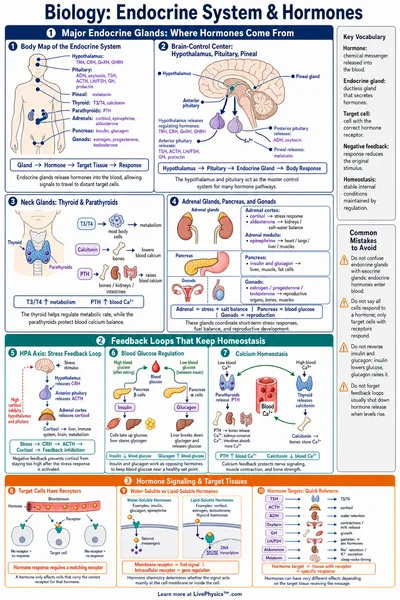
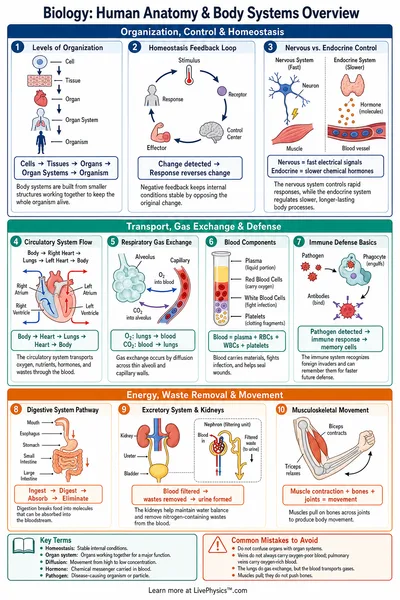
Homeostasis is maintained by negative feedback loops. A stimulus shifts a variable away from its set point. Receptors detect the change and send signals to a control center. The control center activates effectors that produce a corrective response, opposing the original change.
Five-step loop
- Stimulus shifts variable from set point
- Receptor detects deviation
- Control center processes the signal
- Effectors produce corrective action
- Response brings variable back to set point
The feedback is called "negative" because the response negates, or reverses, the original change. This distinguishes it from positive feedback, where the response amplifies the change (as in blood clotting or childbirth contractions).
Thermoregulation
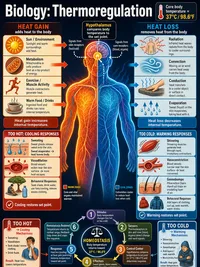
The hypothalamus is the control center for body temperature, with a set point of 37.0°C. It receives signals from thermoreceptors in the skin and core.
Responses to heat (above 37.5°C)
- Vasodilation increases blood flow to skin
- Sweating evaporates water, removing heat
- Reduced metabolic heat production
Responses to cold (below 36.5°C)
- Vasoconstriction reduces heat loss from skin
- Shivering generates heat through muscle contractions
- Piloerection (goosebumps) traps air near skin
Failure modes include fever (set point temporarily elevated by pyrogens), heat stroke (above 40°C, cooling mechanisms overwhelmed), and hypothermia (below 34°C).
Blood Glucose Regulation
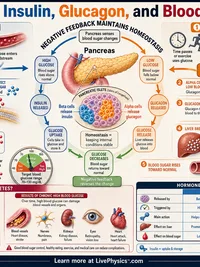
Blood glucose is regulated around 5.0 mmol/L (90 mg/dL) by two antagonistic hormones secreted by the pancreas.
Insulin (beta cells) - glucose too high
- Stimulates cells to absorb glucose
- Promotes glycogen synthesis in liver and muscle
- Suppresses glucose production by the liver
Glucagon (alpha cells) - glucose too low
- Stimulates glycogenolysis (glycogen breakdown)
- Promotes gluconeogenesis (new glucose synthesis)
- Raises blood glucose back to the set point
Failure Modes and Clinical Conditions
Homeostatic failure occurs when a variable moves so far from the set point that corrective mechanisms are overwhelmed or absent.
Heat Stroke (>40°C)
Cooling mechanisms fail; core temp rises uncontrolled
Severe Hypothermia (<34°C)
Shivering stops; cardiac arrhythmia risk
DKA (>14 mmol/L)
Insulin absent; ketones accumulate
Hypoglycemia (<2.5 mmol/L)
Brain glucose supply critically low
Understanding these failure modes is central to treating conditions like diabetes (insufficient insulin), fever management, and emergency care for heat stroke or hypothermia.