Build-a-Musical-Instrument Pitch Lab
Build three kinds of instrument and watch the standing wave and pitch update instantly. Stretch a string, size an open pipe, or pour water into a bottle, then press play to hear the note. Compare frequencies and read off the nearest musical note with its cents offset.
Guided ExperimentHow does string length change pitch?
Predict what happens to the pitch when you make a string shorter while keeping tension and gauge the same. By how much does the frequency change if you halve the length?
Write your hypothesis in the Lab Report panel, then click Next.
Standing Wave
Controls
Pitch & Harmonics
| # | Frequency | Note |
|---|---|---|
| 1 (fundamental) | 243.3 Hz | B3 |
| 2 | 486.5 Hz | B4 |
| 3 | 729.8 Hz | F#5 |
| 4 | 973.0 Hz | B5 |
| 5 | 1216.3 Hz | D#6 |
Data Table
(0 rows)| # | Instrument | Key param | Length / air column (m) | Frequency (Hz) | Note |
|---|
Reference Guide
Vibrating Strings
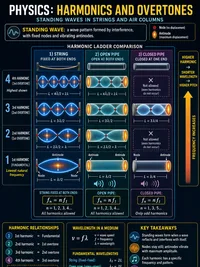
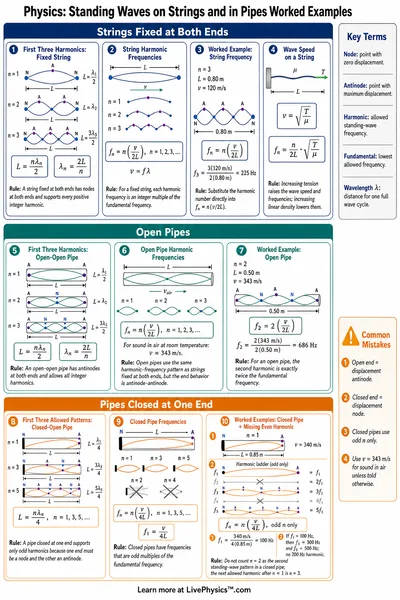
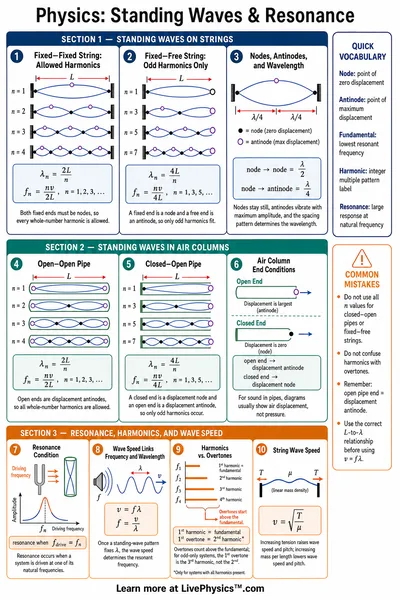
A string fixed at both ends vibrates with a node at each end. The fundamental fits one half wavelength along the length L. Its frequency depends on length, tension T, and the mass per unit length (linear density) μ.
Shorten the string and the pitch rises. Tighten it and the pitch rises. Use a thicker, heavier string and the pitch falls. Halving the length doubles the frequency, which is exactly one octave higher.
Open and Closed Pipes
An open pipe (open at both ends) has an antinode at each end and carries every integer harmonic.
A closed pipe (closed at one end, open at the other) has a node at the closed end and carries only the odd harmonics. Its fundamental is one octave below an open pipe of the same length.
A bottle behaves like a closed pipe. Adding water shortens the air column L and raises the pitch.
Frequency to Note
Western music uses equal temperament with the reference pitch A4 at 440 Hz. Each octave is a doubling of frequency divided into twelve equal semitones.
Rounding n to the nearest whole number gives the closest note. The leftover fraction, scaled to 100, is the cents offset. A reading of plus or minus 50 cents means the pitch sits halfway between two notes.
Speed of Sound
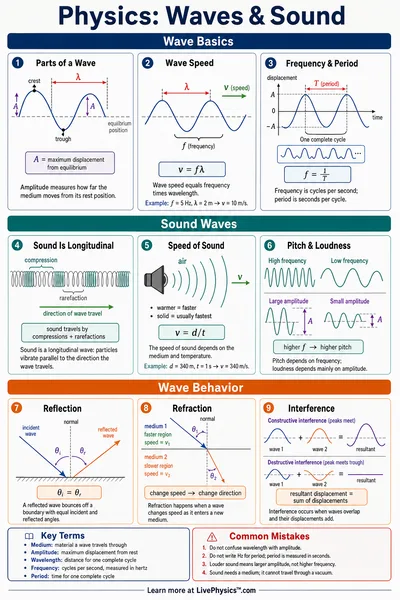
The pipe and bottle frequencies use the speed of sound in air, about 343 m/s at room temperature. Warmer air carries sound faster, which slightly raises the pitch of a wind instrument.
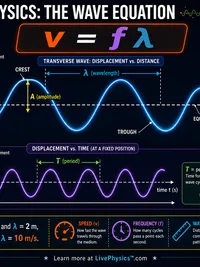
For a string the relevant speed is the wave speed along the string itself, , which is usually far slower than the speed of sound in air. That is why a short, tight string and a long pipe can sound the same note.