Torque and Levers Explorer
Place weights on a seesaw, adjust their distances from the fulcrum, and watch the lever balance or tip. Learn how Class 1, 2, and 3 levers work and see the lever equation come alive with real numbers.
Lever Class
The fulcrum sits between the effort and the load. Like a seesaw!Examples Seesaw, scissors, pliers
Preset Scenarios
💪Effort (Left Side)
Quick pick
⚖️Load (Right Side)
Quick pick
Lever Balance Equation
How Levers Work
The Lever Principle
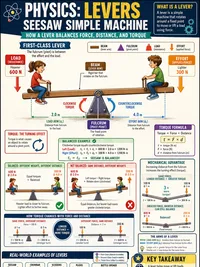
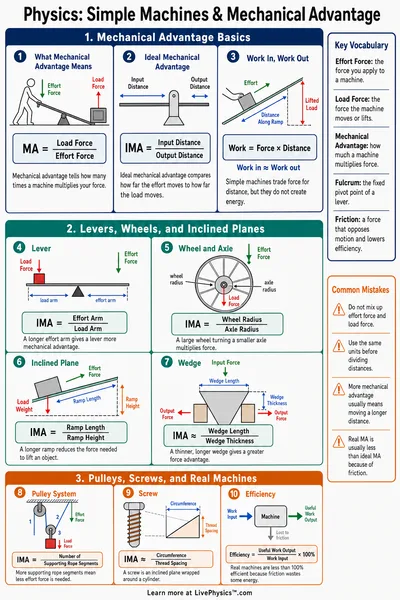
A lever is a rigid beam that rotates around a fixed point called the fulcrum. Every lever obeys one simple rule
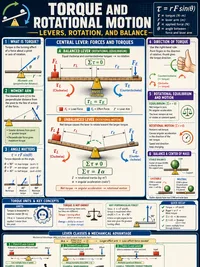
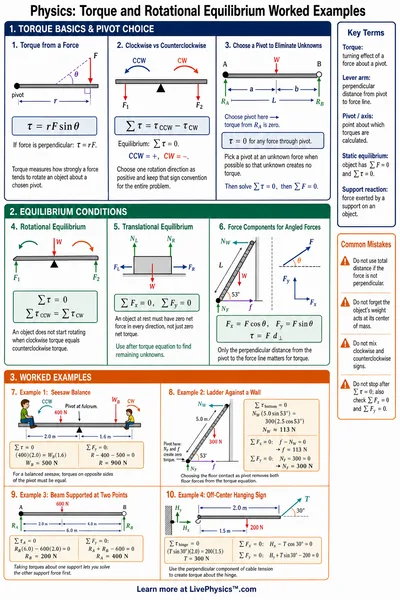
The product of force times distance (called torque) must be equal on both sides for the lever to balance. A small force far from the fulcrum can balance a large force close to it.
- F₁ = effort force (Newtons)
- d₁ = effort arm length (meters)
- F₂ = load force (Newtons)
- d₂ = load arm length (meters)
Three Lever Classes
Class 1 - Fulcrum in the Middle
Effort and load are on opposite sides of the fulcrum. Mechanical advantage can be greater or less than 1.
Examples, seesaw, scissors, pliers
Class 2 - Load in the Middle
Fulcrum at one end, effort at the other, load between. Always a mechanical advantage greater than 1.
Examples, wheelbarrow, nutcracker, bottle opener
Class 3 - Effort in the Middle
Fulcrum at one end, load at the other, effort between. Always a mechanical advantage less than 1 (trades force for range).
Examples, tweezers, fishing rod, forearm
Mechanical Advantage
Mechanical advantage (MA) tells you how much a lever multiplies your effort force. A MA of 3 means you only need one-third the force to lift the load.
| MA value | Meaning |
|---|---|
| MA greater than 1 | Lever multiplies force (easier to lift) |
| MA = 1 | No force advantage; redirects force |
| MA less than 1 | Trades force for speed or range of motion |
Your arm lifting a glass is a Class 3 lever with a low MA. You use more force than the glass weighs, but your hand moves farther and faster than your bicep contracts.
Levers All Around You
Levers appear everywhere in daily life. Once you learn the three classes, you will spot them constantly.
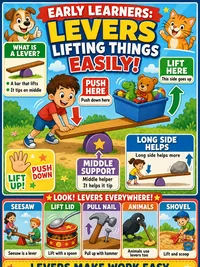
- Seesaw (Class 1). Two children can balance by adjusting their positions even if they weigh different amounts.
- Wheelbarrow (Class 2). Moving the load toward the wheel (fulcrum) makes it harder; moving it toward you makes it easier.
- Your forearm (Class 3). The elbow is the fulcrum, the bicep applies effort, and your hand is the load. Low MA means your bicep must be stronger than whatever you carry.
- Crowbar (Class 1). A long crowbar can multiply your push force 10 times or more because the effort arm is much longer than the load arm.