Matrix Transformation 2D Tool
Enter a 2x2 matrix and see how it transforms the unit square and basis vectors. The tool computes the determinant, eigenvalues, and shows the transformed coordinate grid.
Transformation Diagram
Matrix Entries
2 x 2 Transformation Matrix
Results
Step-by-Step Calculation
1. Transformation of Basis Vectors
2. Determinant (Area Scale Factor)
3. Trace
4. Eigenvalues
Reference Guide
Linear Transformations
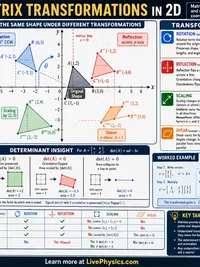
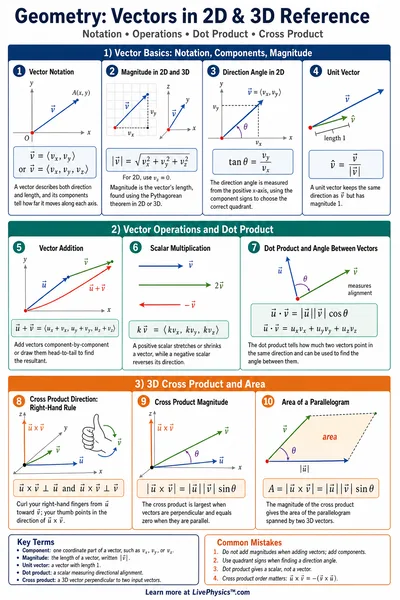
A 2x2 matrix defines a linear transformation of 2D space. Every point (x, y) maps to a new point (x', y') by matrix multiplication.
The Determinant
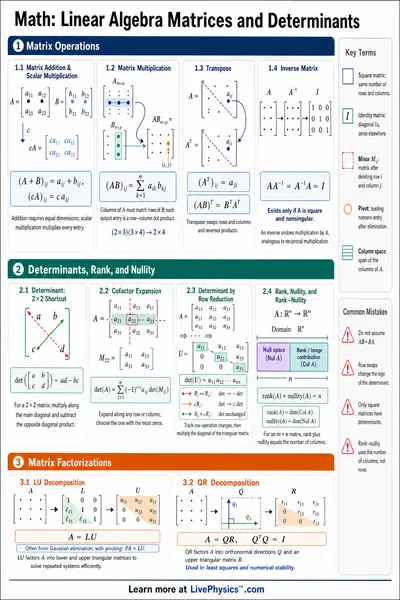
The determinant tells you how the transformation scales area. A determinant of 2 means areas double. A negative determinant means orientation is reversed (mirror).
If the determinant is zero, the transformation collapses 2D space down to a line or a single point.
Eigenvalues
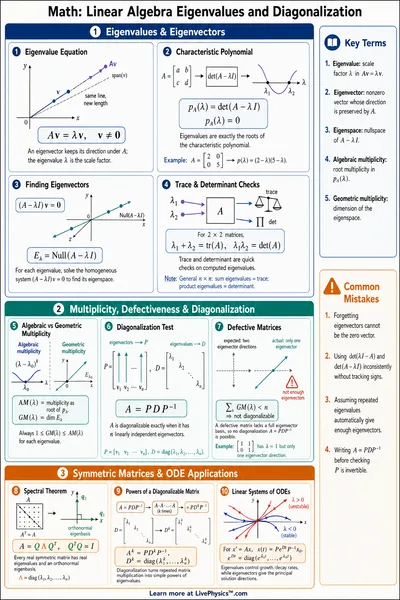
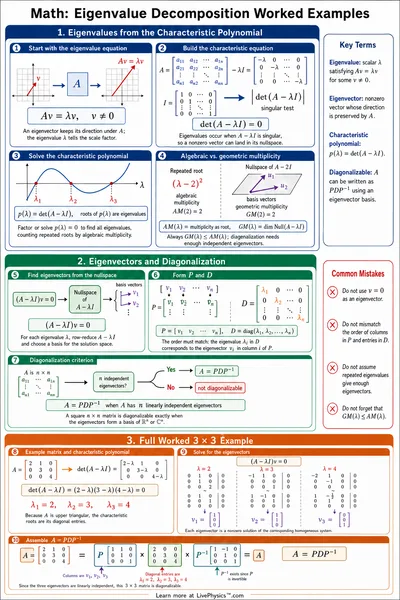
An eigenvalue is a scalar such that the transformation only stretches (or flips) a vector without changing its direction.
Rotations produce complex eigenvalues. Reflections and scaling produce real eigenvalues.
Common Transformations
Rotation by angle uses and . Scaling uses diagonal entries. Shear uses off-diagonal entries. Reflection flips one axis.
Try the presets to see each transformation type in action.