Statistics
Adding Probabilities When Events Are Independent
Students add and to find the chance that two independent events both happen.
Quick check
Why students make it
Students often connect the word independent with separate chances, so they treat the events as a list to add. They mix up the rule for "A or B" with the rule for "A and B."
The rule done right
For independent events that both happen, multiply the probabilities. Use .
Related resources
-
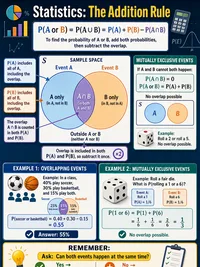 Statistics, The Addition Rule Infographic
-
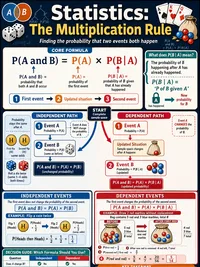 Statistics, The Multiplication Rule Infographic
-
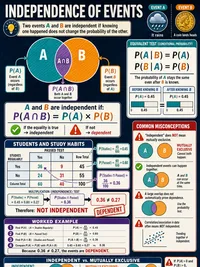 Statistics, Independence of Events Infographic
-
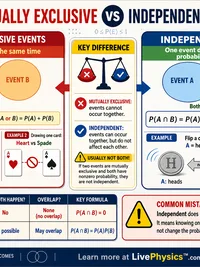 Statistics, Mutually Exclusive vs Independent Events Infographic
-
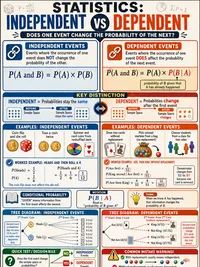 Independent vs Dependent Events Infographic
- Probability Rules & Conditional Probability Cheat Sheet
- Probability Basics & Sample Spaces Cheat Sheet
- Binomial Distribution Reference Cheat Sheet
- Probability Distributions Cheat Sheet
- Statistics, Probability Rules, Addition and Multiplication Worksheet
- Statistics, Two-Way Tables and Conditional Probability Worksheet
- Statistics, Probability with Coins and Dice Worksheet
- Statistics, The Binomial Distribution Worksheet
- Statistics, Bayes' Theorem and Conditional Probability Worksheet
- Probability Distributions Explorer Tool
- Bayes' Theorem Calculator Tool
- Spinners, Dice & Probability for Kids Tool
- Spinners, Dice & Probability Lab Lab
- Monte Carlo Simulation Lab Lab
- Bayesian Inference Lab Lab
- Categorical Data & Chi-Square Lab Lab
Continue learning
- Statistics, Sample Spaces and EventsStudy poster
- Statistics, Non-Parametric Tests, When Assumptions FailWorksheet
- Tree Diagrams for Dependent and Independent EventsCheat sheet
- ANOVA & Chi-Square TestsCheat sheet
- High School Statistics VocabularyFlashcards
- Confusing Theoretical and Experimental ProbabilityCommon mistake