Statistics
Assuming a Small Sample Represents the Whole
Students survey a few convenient people and treat the result as if it represents the whole population.
Quick check
Why students make it
A small sample can feel convincing when every person in it gives a similar answer. The misleading intuition is that any group of responses is automatically a fair snapshot of the population.
The rule done right
A sample represents a population only when it is large enough and selected in a way that avoids bias. A larger random sample usually gives a more reliable estimate, and the estimate should include uncertainty.
Related resources
-
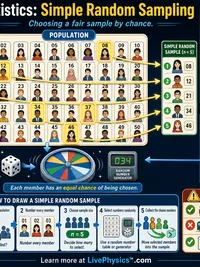 Statistics, Simple Random Sampling Infographic
-
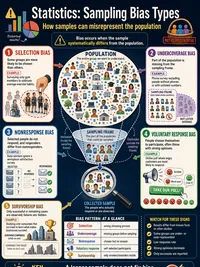 Statistics, Sampling Bias Types Infographic
-
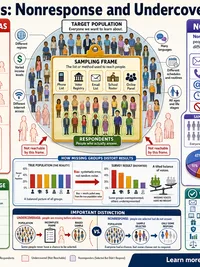 Statistics, Nonresponse and Undercoverage Bias Infographic
-
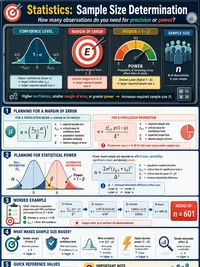 Statistics, Sample Size Determination Infographic
-
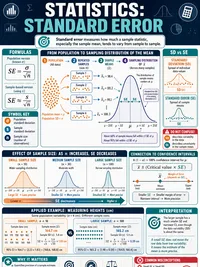 Standard Error Infographic
- Sampling Methods & Survey Design Cheat Sheet
- Survey Bias Types Reference Cheat Sheet
- Margin of Error Reference Cheat Sheet
- Sampling Distribution & Standard Error Cheat Sheet
- Power Analysis & Sample Size Reference Cheat Sheet
- Statistics, Sampling Worksheet
- Statistics, Types of Data and Sampling Methods Worksheet
- Statistics, Designing a Survey, Question Bias and Sampling Worksheet
- Statistics, Confidence Intervals and Margin of Error Worksheet
- Statistics, Sampling (Advanced) Worksheet
- Sampling Distribution Visualizer Tool
- Central Limit Theorem Simulator Tool
- Power & Sample Size Planner Tool
- Confidence Interval Calculator Tool
- Sampling & Randomization Lab Lab
- Central Limit Theorem & Sampling Distributions Lab Lab
- Bootstrap & Confidence Interval Lab Lab