Electoral College Simulator
Assign each US state to a candidate and watch the electoral votes add up to 270. See how a candidate can win the presidency without winning the most votes nationwide.
Click a state to cycle its electoral votes. Once for Candidate A (blue), again for Candidate B (red), and a third time to leave it uncalled. The number under each abbreviation is that state's electoral vote count.
Why the popular vote and the electoral vote can disagree
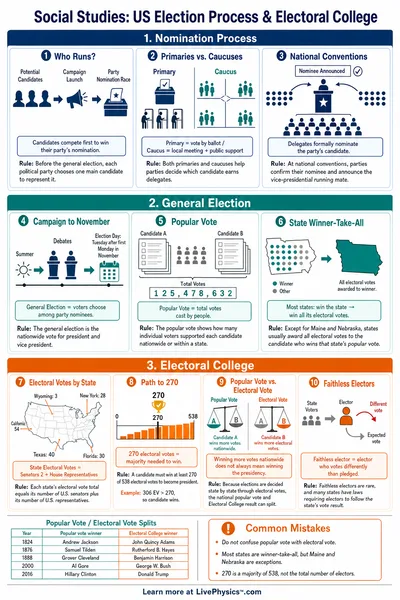
A candidate wins a state's electoral votes by winning that state, in most cases by any margin (Maine and Nebraska are the two exceptions, which split some votes by district). Because small states get a minimum of 3 electoral votes regardless of population, and because winning a state by one vote awards the same electoral votes as winning it by millions, it is possible to win 270 electoral votes while receiving fewer total votes nationwide than the opponent. This has happened in real US elections, including 2000 and 2016.
How the Electoral College works
The United States does not elect its president by a single national vote count. Instead, each state is given a number of electoral votes. That number equals the state's two Senators plus its members in the House of Representatives, so larger states get more electoral votes. The District of Columbia gets 3. The 50 states and DC together hold 538 electoral votes.
In almost every state, whichever candidate wins the most votes in that state takes all of its electoral votes. Maine and Nebraska are the two exceptions and can split their votes by congressional district. A candidate needs a majority, which is 270 of the 538 electoral votes, to win the presidency.
Curriculum alignment
This tool supports middle school and high school civics and US government units on presidential elections, federalism, and the structure of representation. Students can build their own maps, test the 270 threshold, and explore why the popular vote and the electoral vote sometimes disagree.
- Count electoral votes and identify the 270 majority needed to win.
- Explain why population affects a state's electoral vote total.
- Describe how a 269 to 269 tie sends the decision to the House.
- Compare winning states by narrow margins with winning the national vote.