Error Propagation Calculator
Combine experimental uncertainties with the partial-derivative propagation rules used in AP physics, AP chemistry, and college lab courses. Pick a formula preset for sums, products, powers, or generic power laws, or paste a list of repeated measurements to get the mean, standard deviation, standard error, and a 95 percent confidence interval.
f = a + b. Absolute errors add in quadrature.
Propagation formula
Step by step
- Step 1
- Step 2
Reference Guide
Propagation rules at a glance
| Function | Uncertainty rule |
|---|---|
Absolute vs. relative uncertainty
For a sum or difference the absolute uncertainties combine in quadrature. The shape of the formula does not change with the magnitude of a or b.
For a product, quotient, or any power-law expression the fractional (relative) uncertainties combine instead. A 5 percent error on a, multiplied by a 5 percent error on b, still adds in quadrature, producing about a 7 percent error on the result.
For exponentials and logarithms the partial derivative is the function itself or its inverse, so the rules look different but are derived the same way.
Repeated measurement statistics
When you collect N measurements of the same quantity, the best estimate of the true value is the arithmetic mean.
- Sample standard deviation s. Spread of individual readings using the divisor N minus 1 (Bessel correction).
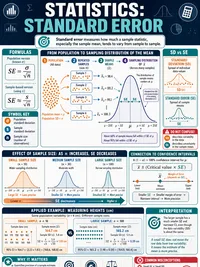
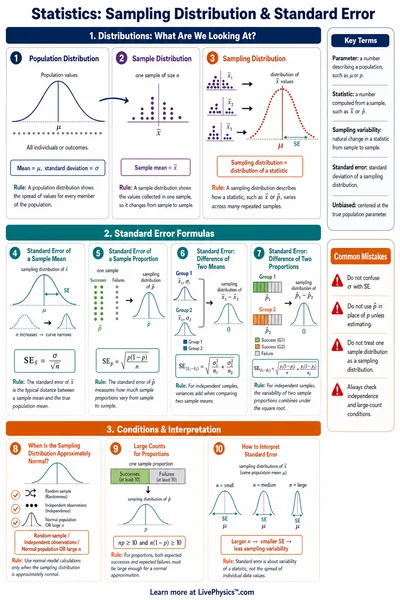
- Standard error of the mean SEM. Equals s divided by the square root of N. This is the uncertainty on the mean itself.
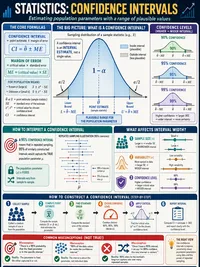
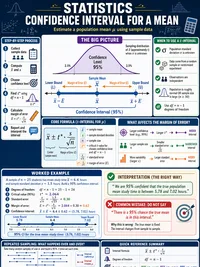
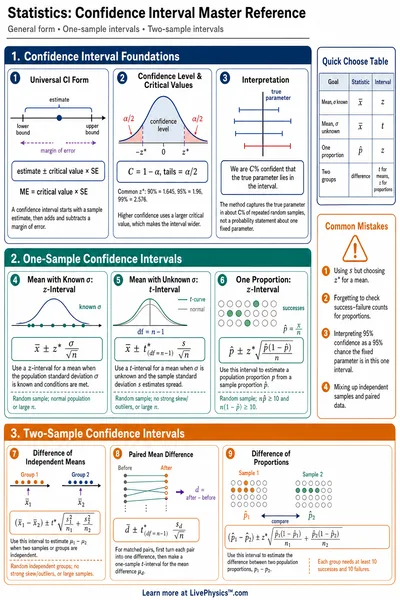
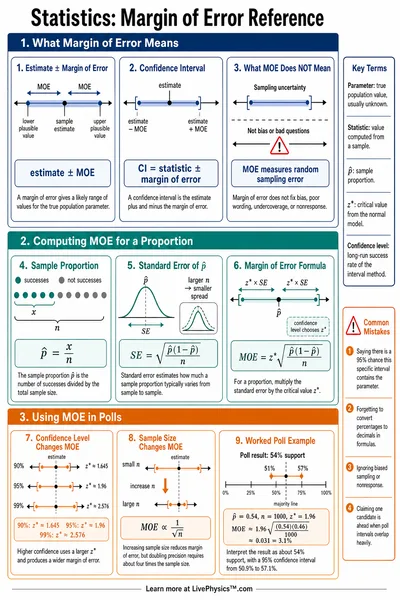
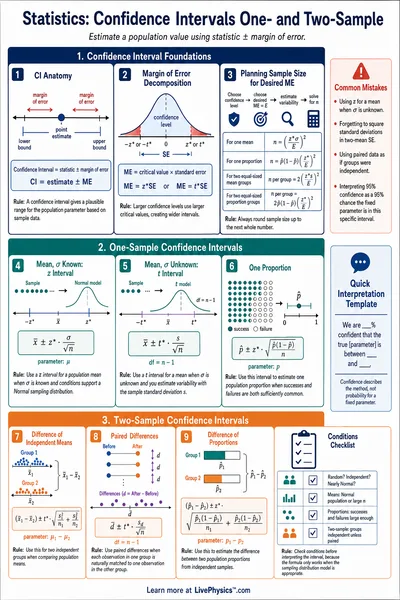
- Approximate 95 percent confidence interval. Mean plus or minus 1.96 times SEM, valid when residuals are approximately normal.
Worked example
A pendulum has length L equal to 1.00 plus or minus 0.01 m and period T equal to 2.01 plus or minus 0.02 s. The acceleration due to gravity is given by g equal to 4 pi squared times L divided by T squared.
- Use the Generic Power Law preset with c equal to 4 pi squared (about 39.48), p equal to 1, q equal to negative 2.
- Set a equal to L and b equal to T.
- The propagated absolute uncertainty on g lands near 0.2 m per second squared.
Report results in matched precision. If the uncertainty is 0.05, write the value to two decimal places. The tool does this matching automatically in the headline result.