Equal Shares & Fraction Shapes
Cut shapes into equal pieces and discover what fraction each piece represents. Explore halves, thirds, fourths, sixths, and eighths with circles, rectangles, triangles, and hexagons.
Fractions Basics
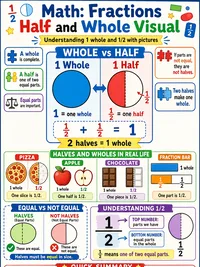
Equal Shares
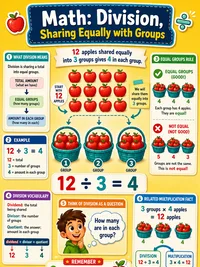
For a fraction to make sense, all the parts must be the same size. When you cut a pizza into 4 slices, each slice must be exactly the same size so every person gets a fair share.
We call these equal shares or equal parts. If the parts are not equal, they do not represent a proper fraction.
Unit Fractions
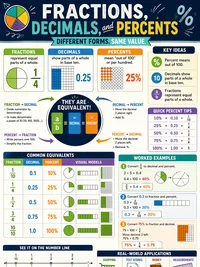
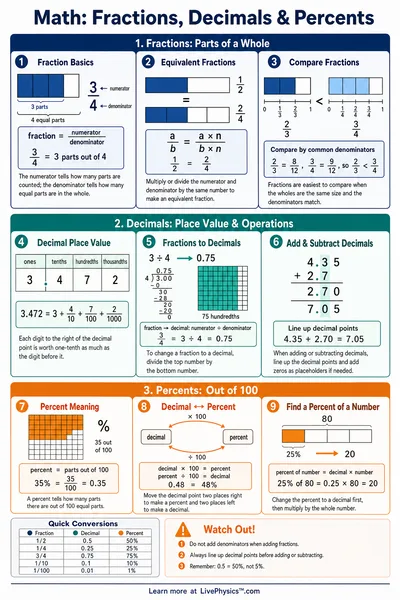
A unit fraction has a 1 on top. The bottom number (denominator) tells you how many equal parts the whole is cut into. The top number (numerator) tells you how many of those parts you have.
- 1/2 - one of two equal parts (one-half)
- 1/3 - one of three equal parts (one-third)
- 1/4 - one of four equal parts (one-fourth)
- 1/8 - one of eight equal parts (one-eighth)
Halves, Thirds, and Fourths
The most common fractions you will see in grades 2 and 3 are halves (2 parts), thirds (3 parts), fourths (4 parts), sixths (6 parts), and eighths (8 parts).
Folding a square piece of paper in half, then in half again gives you 4 equal parts - each is one-fourth (1/4) of the whole paper.
Fractions in Real Life
Fractions appear everywhere around us every day
- Pizza and pie cut into equal slices
- Folding paper for art projects
- Reading a ruler or tape measure
- Sharing food fairly at lunch
- Clock faces divided into quarters and halves