Landmark Supreme Court Cases Explorer
Study the major US Supreme Court cases taught in civics and US history. Browse case summaries, rulings, and constitutional principles, then test yourself with a quiz.
Shows the year and a principle hint with each question.
Showing 16 of 16 cases, ordered by year.
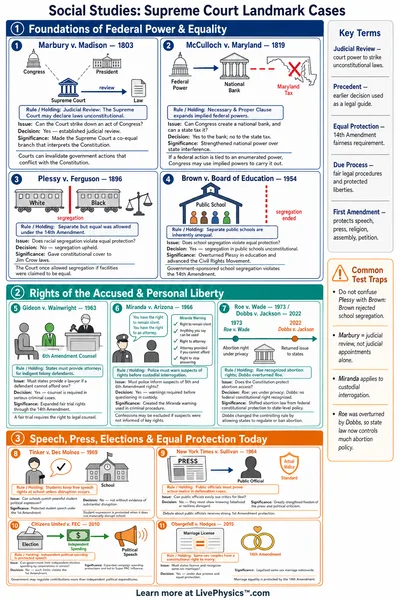
Marbury v. Madison
1803- The dispute
- Whether the Supreme Court could compel delivery of a judicial commission, and whether part of the Judiciary Act of 1789 conflicted with the Constitution.
- The ruling
- The Court declined to issue the order, holding that the section of the Judiciary Act giving it that power was unconstitutional.
- Why it matters
- Established judicial review, the power of federal courts to strike down laws that conflict with the Constitution.
McCulloch v. Maryland
1819- The dispute
- Whether Congress could charter a national bank and whether a state could tax it.
- The ruling
- Congress had implied powers to create the bank, and Maryland could not tax it.
- Why it matters
- Affirmed the Necessary and Proper Clause and the supremacy of federal law over conflicting state action.
Dred Scott v. Sandford
1857- The dispute
- Whether an enslaved man taken into free territory was a citizen who could sue in federal court.
- The ruling
- The Court held that people of African descent were not citizens and that Congress could not ban slavery in the territories.
- Why it matters
- A widely condemned decision that deepened national divisions before the Civil War and was later overturned by the 13th and 14th Amendments.
Plessy v. Ferguson
1896- The dispute
- Whether a state law requiring separate railway cars for Black and white passengers violated the 14th Amendment.
- The ruling
- The Court upheld the law, allowing racial segregation under a separate but equal standard.
- Why it matters
- Legitimized racial segregation for decades until it was overturned by Brown v. Board of Education.
Korematsu v. United States
1944- The dispute
- Whether the forced relocation and internment of Japanese Americans during World War II was constitutional.
- The ruling
- The Court upheld the internment order as a wartime military necessity.
- Why it matters
- A heavily criticized ruling, later repudiated by the Court, that highlighted the danger of suspending civil rights during crises.
Brown v. Board of Education
1954- The dispute
- Whether racial segregation in public schools violated the Equal Protection Clause of the 14th Amendment.
- The ruling
- The Court ruled unanimously that separate educational facilities are inherently unequal.
- Why it matters
- Overturned Plessy v. Ferguson and declared segregation in public schools unconstitutional, a cornerstone of the Civil Rights Movement.
Mapp v. Ohio
1961- The dispute
- Whether evidence obtained through an unlawful search could be used in a state criminal trial.
- The ruling
- The Court held that illegally seized evidence must be excluded from state courts.
- Why it matters
- Applied the 4th Amendment exclusionary rule to the states, strengthening protections against unreasonable searches.
Engel v. Vitale
1962- The dispute
- Whether a state-sponsored prayer in public schools violated the Establishment Clause.
- The ruling
- The Court held that official school-sponsored prayer was unconstitutional.
- Why it matters
- Reinforced the separation of church and state in public schools under the 1st Amendment.
Gideon v. Wainwright
1963- The dispute
- Whether the state must provide an attorney to a defendant who cannot afford one.
- The ruling
- The Court held that states must provide counsel to defendants in criminal cases who cannot afford a lawyer.
- Why it matters
- Guaranteed the 6th Amendment right to an attorney in state criminal trials.
Miranda v. Arizona
1966- The dispute
- Whether statements made during police interrogation are admissible if the suspect was not informed of their rights.
- The ruling
- The Court held that suspects must be informed of their rights before questioning.
- Why it matters
- Created the Miranda warning, protecting the 5th Amendment right against self-incrimination during custodial interrogation.
Tinker v. Des Moines
1969- The dispute
- Whether students could be punished for wearing armbands to protest the Vietnam War.
- The ruling
- The Court held that students do not lose their free speech rights at school.
- Why it matters
- Affirmed that symbolic student speech is protected by the 1st Amendment unless it substantially disrupts school.
Wisconsin v. Yoder
1972- The dispute
- Whether a state could require Amish children to attend school past the eighth grade against their religious beliefs.
- The ruling
- The Court held that compelling attendance violated the families' free exercise of religion.
- Why it matters
- Recognized that the 1st Amendment can exempt religious practice from some general state laws.
Roe v. Wade
1973- The dispute
- Whether the Constitution protected a right to choose to have an abortion.
- The ruling
- The Court held that a right to privacy under the 14th Amendment protected that choice, subject to state interests.
- Why it matters
- A landmark and long-debated privacy decision that was later overturned by Dobbs v. Jackson in 2022.
United States v. Nixon
1974- The dispute
- Whether the President could withhold subpoenaed tape recordings by claiming executive privilege.
- The ruling
- The Court held that executive privilege is not absolute and ordered the tapes released.
- Why it matters
- Confirmed that the President is not above the law and led to President Nixon's resignation.
New Jersey v. T.L.O.
1985- The dispute
- Whether a school official needed a warrant or probable cause to search a student.
- The ruling
- The Court held that school searches require only reasonable suspicion, not a warrant.
- Why it matters
- Defined the lower 4th Amendment standard that applies to searches of students in public schools.
Texas v. Johnson
1989- The dispute
- Whether burning the American flag as a protest was protected expression.
- The ruling
- The Court held that flag burning is symbolic speech protected by the 1st Amendment.
- Why it matters
- Affirmed that the government cannot ban expression simply because society finds it offensive.
How it works
Browse 16 landmark cases as searchable cards, or switch to quiz mode to identify a case from its description or match a case to its constitutional principle. Each card lists the dispute, the ruling, the principle or amendment involved, and why the decision matters.
Three difficulty presets shape the quiz. Learn shows the year and a principle hint. Practice removes the hints. Challenge uses description-only prompts across every case.
Curriculum alignment
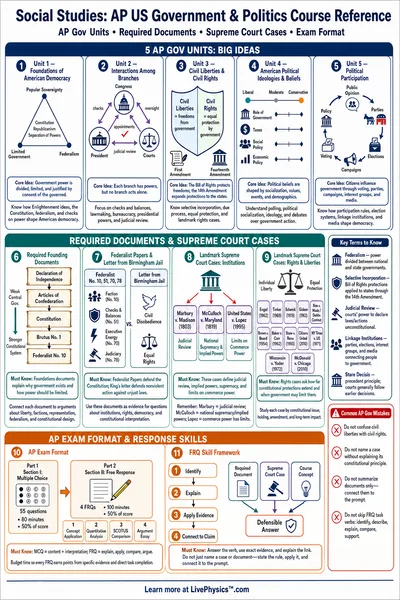
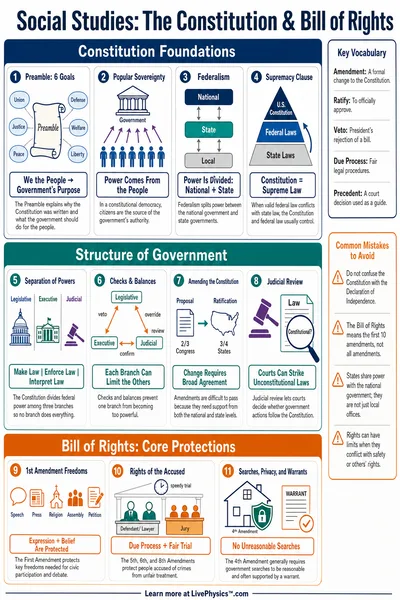
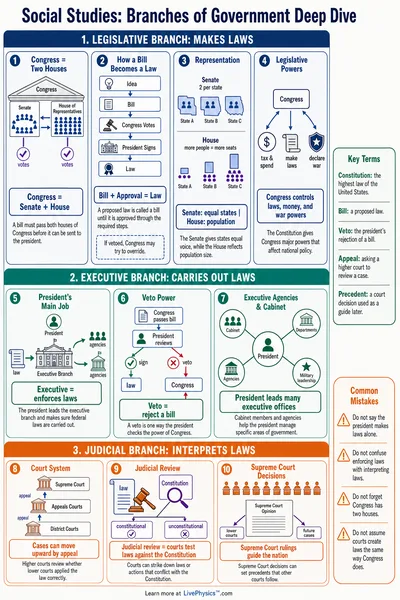
These cases appear across high school US Government, Civics, and US History courses, and on AP US Government required case lists. They cover judicial review, federalism, equal protection, due process, free speech, religious liberty, and the limits of executive power.
Use the explorer to review before an exam, to prepare for a document-based question, or to connect a current event back to the constitutional principle behind it.
Reference guide to key cases
Marbury v. Madison (1803)
Established judicial review, the power of courts to strike down laws that conflict with the Constitution.
McCulloch v. Maryland (1819)
Affirmed the implied powers of Congress and the supremacy of federal law over conflicting state action.
Brown v. Board of Education (1954)
Held that separate educational facilities are inherently unequal, overturning Plessy v. Ferguson under the Equal Protection Clause.
Gideon v. Wainwright (1963)
Guaranteed the 6th Amendment right to an attorney in state criminal trials for defendants who cannot afford one.
Miranda v. Arizona (1966)
Created the Miranda warning, protecting the 5th Amendment right against self-incrimination during police interrogation.
Tinker v. Des Moines (1969)
Affirmed that students keep their 1st Amendment free speech rights at school unless the speech substantially disrupts learning.
United States v. Nixon (1974)
Held that executive privilege is not absolute, confirming that the President is not above the law.
New Jersey v. T.L.O. (1985)
Defined the reasonable suspicion standard for searches of students in public schools under the 4th Amendment.