Mineral Identification Tool
Work like a geologist. Record what you observe about a mineral sample, its hardness, luster, streak color, cleavage, and any special clues, and watch the list of possible minerals shrink toward a single match. A Mohs hardness scale and a property table for fourteen common minerals are built in.
Try an example
Observed properties
Field test hardness reference
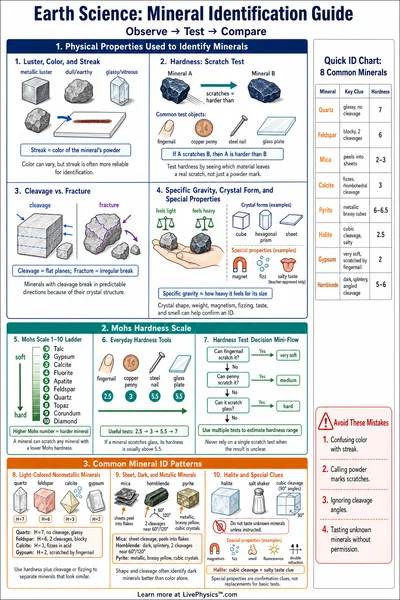
- Fingernail (2.5) scratches minerals softer than about 2.5
- Copper penny (3.5) scratches minerals softer than about 3.5
- Steel knife or nail (5.5) scratches minerals softer than about 5.5
- Glass plate (5.5) scratched by minerals harder than about 5.5
- Steel file (6.5) scratches minerals softer than about 6.5
Candidate minerals
Showing all 14 minerals. Choose properties to narrow the list.
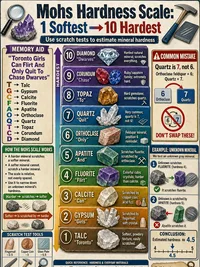
Mohs hardness scale
Each mineral on the scale scratches everything below it. The steps are ordered, not evenly spaced. Diamond is far harder than the gap between 9 and 10 suggests.
Field tests
- Fingernail ≈ 2.5 · scratches minerals softer than about 2.5
- Copper penny ≈ 3.5 · scratches minerals softer than about 3.5
- Steel knife or nail ≈ 5.5 · scratches minerals softer than about 5.5
- Glass plate ≈ 5.5 · scratched by minerals harder than about 5.5
- Steel file ≈ 6.5 · scratches minerals softer than about 6.5
Common mineral properties
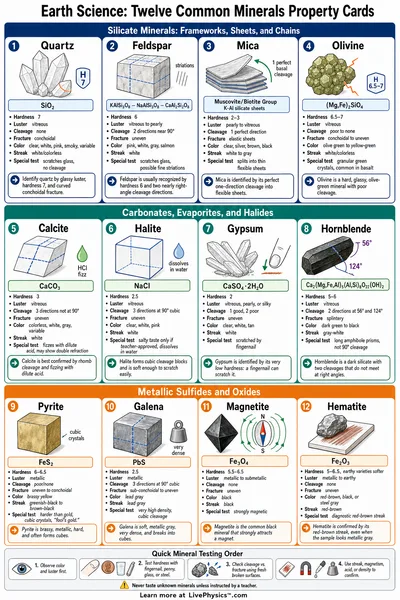
| Mineral | Hardness | Luster | Streak | Color | Special clue |
|---|---|---|---|---|---|
| TalcMg₃Si₄O₁₀(OH)₂ | 1 | non-metallic | white | white to pale green, greasy feel | greasy or soapy feel |
| GypsumCaSO₄·2H₂O | 2 | non-metallic | white | colorless, white, or gray | scratched by fingernail |
| GraphiteC | 1–2 | metallic | gray to black | dark gray to black | greasy feel |
| HaliteNaCl | 2.5 | non-metallic | white | colorless, white, or pale colors | salty taste |
| Mica (Muscovite)KAl₂(AlSi₃O₁₀)(OH)₂ | 2–3 | non-metallic | white | colorless, silvery, or pale brown | peels into thin elastic sheets |
| CalciteCaCO₃ | 3 | non-metallic | white | colorless, white, or many tints | fizzes with dilute acid |
| FluoriteCaF₂ | 4 | non-metallic | white | purple, green, blue, yellow, or colorless | may glow under ultraviolet light |
| MagnetiteFe₃O₄ | 5.5–6.5 | metallic | black | black | strongly magnetic |
| HematiteFe₂O₃ | 5–6 | metallic | reddish brown | steel gray to red | reddish brown streak |
| Feldspar (Orthoclase)KAlSi₃O₈ | 6 | non-metallic | white | pink, white, or gray | scratches glass |
| PyriteFeS₂ | 6–6.5 | metallic | greenish black | brass yellow (fool's gold) | greenish black streak |
| GalenaPbS | 2.5 | metallic | lead gray | lead gray | very high density |
| QuartzSiO₂ | 7 | non-metallic | white | colorless, white, or many varieties | scratches glass |
| DiamondC | 10 | non-metallic | white | colorless to pale tints | hardest known mineral |
Common mineral properties
| Mineral | Hardness | Luster | Streak | Color | Special clue |
|---|---|---|---|---|---|
| TalcMg₃Si₄O₁₀(OH)₂ | 1 | non-metallic | white | white to pale green, greasy feel | greasy or soapy feel |
| GypsumCaSO₄·2H₂O | 2 | non-metallic | white | colorless, white, or gray | scratched by fingernail |
| GraphiteC | 1–2 | metallic | gray to black | dark gray to black | greasy feel |
| HaliteNaCl | 2.5 | non-metallic | white | colorless, white, or pale colors | salty taste |
| Mica (Muscovite)KAl₂(AlSi₃O₁₀)(OH)₂ | 2–3 | non-metallic | white | colorless, silvery, or pale brown | peels into thin elastic sheets |
| CalciteCaCO₃ | 3 | non-metallic | white | colorless, white, or many tints | fizzes with dilute acid |
| FluoriteCaF₂ | 4 | non-metallic | white | purple, green, blue, yellow, or colorless | may glow under ultraviolet light |
| MagnetiteFe₃O₄ | 5.5–6.5 | metallic | black | black | strongly magnetic |
| HematiteFe₂O₃ | 5–6 | metallic | reddish brown | steel gray to red | reddish brown streak |
| Feldspar (Orthoclase)KAlSi₃O₈ | 6 | non-metallic | white | pink, white, or gray | scratches glass |
| PyriteFeS₂ | 6–6.5 | metallic | greenish black | brass yellow (fool's gold) | greenish black streak |
| GalenaPbS | 2.5 | metallic | lead gray | lead gray | very high density |
| QuartzSiO₂ | 7 | non-metallic | white | colorless, white, or many varieties | scratches glass |
| DiamondC | 10 | non-metallic | white | colorless to pale tints | hardest known mineral |
Reference Guide
Mohs hardness scale
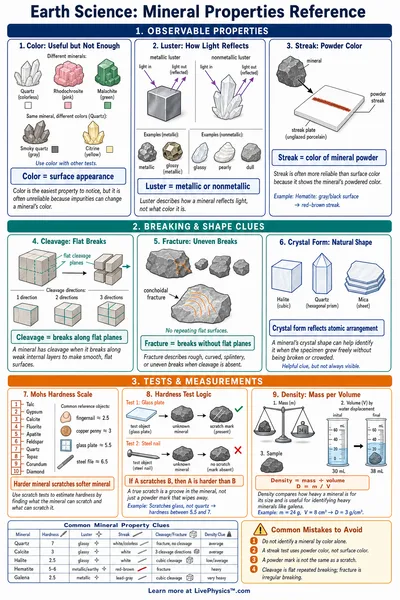
Hardness is a mineral's resistance to scratching. The Mohs scale ranks ten reference minerals from talc at 1 to diamond at 10. A harder mineral always scratches a softer one. The scale is ordered but not evenly spaced, so the jump from 9 (corundum) to 10 (diamond) is much larger than the jump from 1 to 2.
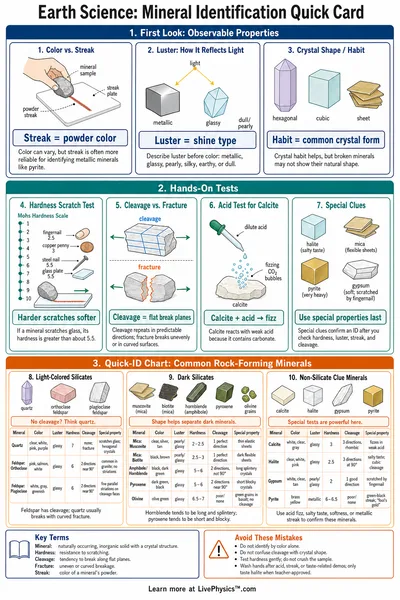
In the field you can estimate hardness with common objects. A fingernail is about 2.5, a copper penny about 3.5, a glass plate and a steel knife about 5.5, and a steel file about 6.5. If your sample scratches glass it is harder than 5.5, which already rules out most soft minerals.
Diagnostic properties
Color alone is unreliable because many minerals come in several colors. Streak, the color of a mineral's powder rubbed on a tile, is far more consistent. Luster describes how a surface reflects light, either metallic like polished steel or non-metallic. Cleavage is the tendency to break along flat planes, while fracture is breakage without flat surfaces.
Special tests confirm an identification. Calcite fizzes with dilute acid, magnetite attracts a magnet, halite tastes salty and dissolves in water, talc feels greasy, and fluorite often glows under ultraviolet light. Combining several properties is the reliable way to name a mineral.
How to use this tool
Start with the easiest observations. Choose a hardness band from the scratch tests, then pick the luster and streak color. Each choice removes minerals that do not fit and updates the candidate list. Add cleavage and special clues until one mineral remains. You can open any candidate to see its full property card, or load an example to see how a classic identification comes together.
Curriculum alignment
Mineral identification is a core middle school and high school Earth science topic. Students learn that minerals are defined by their physical and chemical properties, practice using a dichotomous approach to narrow choices, and connect properties to atomic structure and crystal form. This tool supports lab work on rocks and minerals and reinforces the idea that careful observation leads to evidence-based conclusions.