Political Spectrum Explorer
Learn the basic left-right political spectrum in a neutral, balanced way. Explore what labels like left, center, and right generally mean, then place general policy positions in a guided quiz.
The left to right spectrum
A note on simplification. This left-right spectrum is a simplification. Real people hold a mix of views and may agree with some ideas on the left and others on the right. The goal here is to learn what the common labels generally mean, not to label any person.
Hover or tap a zone above to highlight it, then read what each label generally means. These are common, textbook-level descriptions, presented without endorsing any view.
Far Left
also called radical left
Economy. Favors a very large government role in the economy, with broad public ownership or strong control of major industries.
Society. Emphasizes rapid, sweeping change toward greater social and economic equality.
Left
also called liberal, progressive
Economy. Favors more government services and regulation, funded by higher taxes, to reduce inequality.
Society. Tends to support broad change to existing social norms and expanded individual rights.
Center
also called moderate, centrist
Economy. Favors a mix of government and market roles, often seeking compromise between more and less government.
Society. Tends to take balanced or case-by-case positions rather than strongly favoring one side.
Right
also called conservative
Economy. Favors a smaller government role in the economy, with lower taxes and less regulation, relying more on free markets.
Society. Tends to value established traditions and gradual rather than rapid change.
Far Right
also called radical right
Economy. Favors a strongly limited government role in the economy, or a strong emphasis on national interests.
Society. Emphasizes preserving long-standing traditions and national identity.
How it works
The left-right spectrum is a common way to describe political views. It mostly captures two questions. How large a role should government play in the economy, and how quickly should society change.
In Explore mode, hover or tap a zone on the bar to read a neutral, textbook-level description of what that label generally means. In Quiz mode, you read a general policy position and click the zone it is most commonly associated with, then see a short explanation.
Three levels are available. Learn shows zone hints, Practice removes them, and Challenge uses subtler statements.
Curriculum alignment
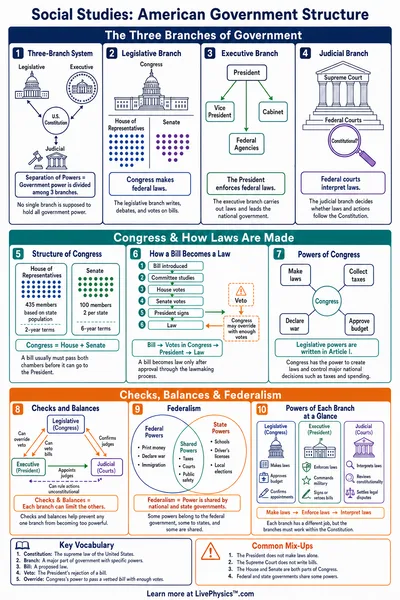
This tool supports high-school civics and government units on political ideologies, the role of government, and how citizens form and label opinions. It pairs well with lessons on political parties and public policy.
The spectrum is a simplification. Real people hold a mix of views and may agree with some ideas on the left and others on the right. The aim is to learn what the common labels generally mean, presented fairly and without endorsing any position.
Reference guide
Below are neutral descriptions of the common zones, from one end of the spectrum to the other. Two framings are presented fairly throughout. More government and less government are both treated as ordinary, reasonable positions that citizens hold.
- Far left. Favors a very large government role in the economy, with broad public ownership or strong control of major industries, and rapid change toward greater equality.
- Left, also called liberal or progressive. Favors more government services and regulation, funded by higher taxes, to reduce inequality, and tends to support broad social change and expanded rights.
- Center, also called moderate. Favors a mix of government and market roles, often seeking compromise, and tends to take balanced, case-by-case positions.
- Right, also called conservative. Favors a smaller government role, with lower taxes and less regulation, relying more on free markets, and tends to value established traditions and gradual change.
- Far right. Favors a strongly limited government role in the economy or a strong emphasis on national interests, and emphasizes preserving long-standing traditions and identity.
Remember that these labels describe broad tendencies, not fixed categories. A single person can sit in different zones on different issues.