Spanish Question Word Trainer
Practice the Spanish interrogatives qué, quién, cuál, cómo, cuándo, dónde, adónde, por qué, and cuánto. Pick the right question word, learn the written accent rule, and practice tricky contrasts like qué vs cuál.
Difficulty
Shows the English hint and a usage tip before you answer.
¿ vas después de clase?
Where are you going after class?
Tip. Asks about destination with verbs of motion: ¿Adónde vas? Note the built-in a (to).
Palabras interrogativas
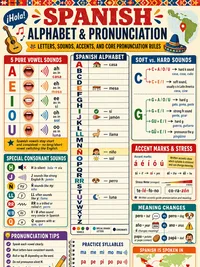
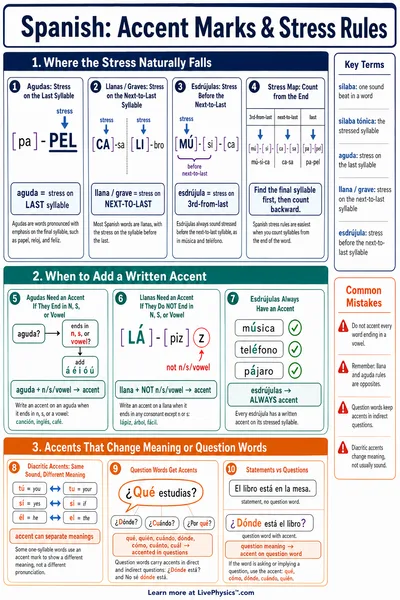
Every Spanish question word carries a written accent. That accent is what separates qué (what) from the relative que (that), or dónde (where) from the connector donde.
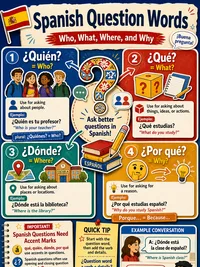
- quéwhat
Asks for a definition, identity, or thing. Use before a noun for a general choice (¿Qué libro?) and to mean what is or what are when seeking a definition.
- quiénwho (singular)
Asks about one person. Pairs with a singular verb: ¿Quién es?
- quiéneswho (plural)
Asks about more than one person: ¿Quiénes son ellos?
- cuálwhich / what one
Asks to pick from a set. Use ¿Cuál es...? for what is when a fact is selected from options (¿Cuál es tu nombre?).
- cuáleswhich ones
Plural of cuál, picking several from a set: ¿Cuáles prefieres?
- cómohow / what like
Asks about manner or condition: ¿Cómo estás? Also ¿Cómo te llamas? for what is your name.
- cuándowhen
Asks about time: ¿Cuándo llegas?
- dóndewhere (location)
Asks about a fixed place or location: ¿Dónde vives?
- adóndeto where
Asks about destination with verbs of motion: ¿Adónde vas? Note the built-in a (to).
- por quéwhy
Asks for a reason. Two words, with an accent on qué. The answer porque (because) is one word with no accent.
- cuántohow much (masc.)
Asks about quantity of a masculine singular noun: ¿Cuánto dinero?
- cuántahow much (fem.)
Feminine singular agreement: ¿Cuánta agua?
- cuántoshow many (masc.)
Masculine plural agreement: ¿Cuántos libros?
- cuántashow many (fem.)
Feminine plural agreement: ¿Cuántas hermanas?
How it works
Each question shows a Spanish sentence with a missing interrogative and, depending on the mode, an English hint. Choose the question word that fits, then check your answer to see the rule that explains it. The reference card on the right highlights the correct word so you connect the choice to its meaning. Pick Learn for guided tips, Practice for the English hint only, or Challenge for no hint plus the tricky qué vs cuál and dónde vs adónde contrasts.
The accent rule
Every Spanish question word carries a written accent, called the tilde diacrítica. That accent is the only thing separating a question word from a look-alike connector. Compare qué (what) with the relative que (that), cómo (how) with the conjunction como (as or like), and dónde (where) with the relative donde. When the word asks a question, whether direct with the signs ¿ and ? or indirect inside a sentence, it takes the accent.
Interrogatives reference
- qué. What. Asks for a definition or, before a noun, a general choice. ¿Qué hora es?
- quién / quiénes. Who, singular or plural. ¿Quién es? ¿Quiénes son?
- cuál / cuáles. Which one, picking from a set. ¿Cuál prefieres?
- cómo. How, or what something is like. ¿Cómo estás?
- cuándo. When. Asks about time. ¿Cuándo llegas?
- dónde. Where, a fixed location. ¿Dónde vives?
- adónde. To where, with motion. ¿Adónde vas?
- por qué. Why, two words. The answer porque (because) is one word with no accent.
- cuánto / cuánta / cuántos / cuántas. How much or how many. The form agrees in gender and number with the noun it counts. ¿Cuántos años tienes?
Two contrasts trip up most learners. Use cuál, not qué, when no noun follows and you select from options (¿Cuál es tu nombre?), but use qué directly before a noun (¿Qué color te gusta?). Use dónde for a fixed place and adónde for a destination after a verb of motion like ir or viajar.