Tides Explorer
Adjust the Moon's position to see spring and neap tides form. Compare semidiurnal, diurnal, and mixed tide patterns, and discover why high tide arrives about 50 minutes later each day.
Earth-Moon System
Spring TideTide Summary
Spring tides occur when Moon and Sun are aligned (new or full Moon).
24.84 h
12.42 h
2.18x
~50 min
The tide-generating force
The tide-generating force is proportional to mass / distance3. Even though the Sun is far more massive than the Moon, the Moon is much closer, so the Moon exerts about 2.2x the tide-generating force of the Sun.
Controls
Tidal pattern
Time window
Presets
Tide Height Curve(24 hours, semidiurnal pattern)
Reference Guide
The Tide-Generating Force
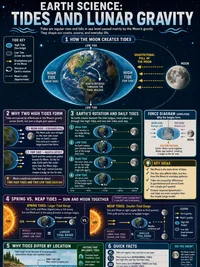
The Moon's gravity pulls on every part of Earth, but it pulls harder on the near side (closer to the Moon) than on the center, and harder on the center than on the far side. This difference in pull is called the tide-generating force. It is proportional to mass divided by distance cubed, which is why distance matters so much.
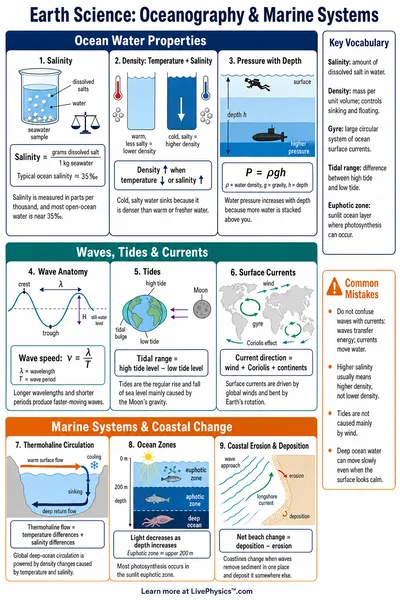
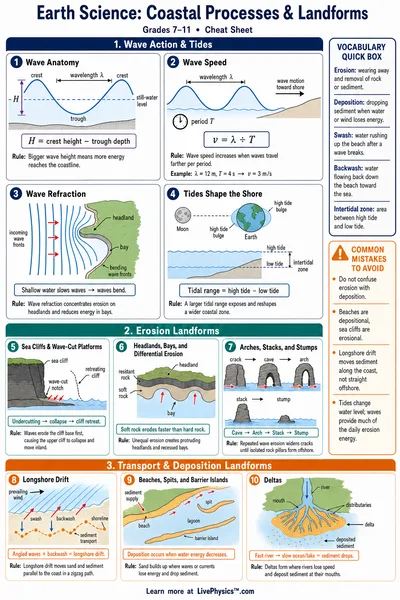
The differential pull stretches the ocean into two bulges, one pointing toward the Moon (near-side bulge, where gravity is strongest) and one pointing directly away from the Moon (far-side bulge, where gravity is weakest and inertia pushes water outward). Earth rotates under these bulges roughly every 24 hours, producing two high tides per day at most locations.
Even though the Sun is about 27 million times more massive than the Moon, it is about 390 times farther away. Cubing that distance difference reduces the Sun's tide-generating force to roughly 46% of the Moon's - the Moon dominates the tides.
The Tidal Day and the 50-Minute Delay
Earth rotates once every 24 hours, but in that time the Moon has moved about 13 degrees forward in its orbit. Earth must rotate that extra 13 degrees to "catch up" to the Moon's new position, which takes about 50 additional minutes. The result is that the tidal day is roughly 24 hours and 50 minutes.
Because there are two high tides per tidal day in a semidiurnal regime, the time between successive highs is about 12 hours and 25 minutes, not exactly 12 hours. This means a 7 AM high tide on Monday will occur around 7:50 AM on Tuesday, 8:40 AM on Wednesday, and so on.
The precise principal lunar semidiurnal period used in tidal science is 12.4206 hours (the M2 tidal constituent), and the lunar day is 24.8412 hours.
Spring Tides and Neap Tides
When the Moon, Earth, and Sun are aligned - at new Moon (Moon between Earth and Sun) or full Moon (Earth between Moon and Sun) - the Moon's and Sun's tide-generating forces add together. The combined force produces higher-than-average high tides and lower-than-average low tides. These are called spring tides (from an Old English word meaning to "leap up"), and they happen roughly every two weeks.
At first and third quarter Moons the Moon is at a right angle to the Sun as seen from Earth. The two forces partially cancel each other, producing smaller tidal ranges called neap tides. The word neap may come from an Old English term meaning "scanty."
The combined amplitude at any Moon-Sun angle follows the formula, sqrt(Fm squared + Fs squared + 2 times Fm times Fs times cos(2 times elongation)), where Fm and Fs are the Moon and Sun tide forces respectively.
The Three Tidal Patterns
Coastlines around the world experience three different tidal patterns depending on their latitude, basin shape, and the way tidal waves resonate in that ocean basin.
- Semidiurnal - Two nearly equal high tides and two nearly equal low tides each tidal day. Common along the Atlantic coasts of North America and Europe, and most of the UK. The dominant tide-forcing constituent is M2 at 12.42 hours.
- Diurnal - One high tide and one low tide per tidal day. Seen in the Gulf of Mexico, parts of Southeast Asia, and some areas of the Pacific. The tidal range is smaller on average.
- Mixed - Two high tides and two low tides per day, but the two highs have noticeably different heights and the two lows differ as well. Common on the US Pacific coast (California, Oregon, Washington) and much of the Pacific Rim.
Using a Local Tide Table for Real Predictions
This explorer teaches the physics of tides - the tide-generating force, the tidal bulge geometry, and the Moon-Sun interaction. It does not predict actual tide times at a real location.
Real local tide times depend on the shape of the coastline, the depth and geometry of the sea floor (bathymetry), and how tidal waves amplify or dampen as they travel through bays, estuaries, and shallow water. The Bay of Fundy in Canada has tidal ranges exceeding 16 meters because of resonance in the basin, while the Mediterranean has ranges of only 10 to 30 centimeters.
For tide times at your location, consult a local tide table from a government hydrographic office such as NOAA Tides and Currents (USA), the UK National Tidal and Sea Level Facility, or the Bureau of Meteorology (Australia). These agencies publish accurate harmonic predictions based on years of coastal measurements.