Practice using atom economy calculations and solvent safety ideas to compare chemical processes and make greener choices.
Read each problem carefully. Show calculations when needed and explain your reasoning in complete sentences.
Evaluating chemical reactions for waste reduction and solvent safety
Chemistry - Grade 9-12
- 1
Define atom economy in your own words. How is atom economy different from percent yield?
- 2
The reaction A + B -> C has molar masses of A = 30 g/mol, B = 20 g/mol, and desired product C = 50 g/mol. Calculate the atom economy.
- 3
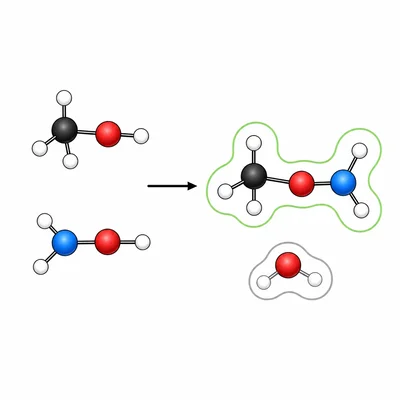
The reaction A + B -> C + D has molar masses of A = 60 g/mol, B = 40 g/mol, desired product C = 70 g/mol, and byproduct D = 30 g/mol. Calculate the atom economy for product C.
- 4
A student says, "A reaction with 90% yield is always greener than a reaction with 60% yield." Explain why this statement is incomplete.
- 5
Two pathways can make the same product. Pathway 1 has 45% atom economy and uses benzene as a solvent. Pathway 2 has 80% atom economy and uses ethanol as a solvent. Which pathway is greener based on the information given, and why?
- 6
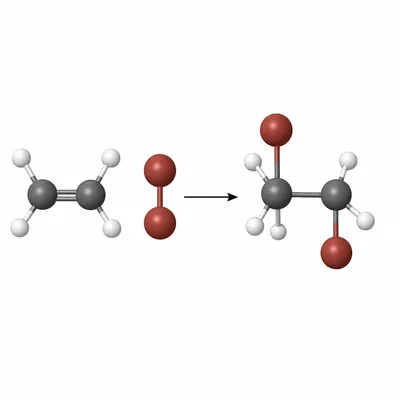
A reaction has a balanced equation: C2H4 + Br2 -> C2H4Br2. The molar masses are C2H4 = 28 g/mol, Br2 = 160 g/mol, and C2H4Br2 = 188 g/mol. Calculate the atom economy.
- 7
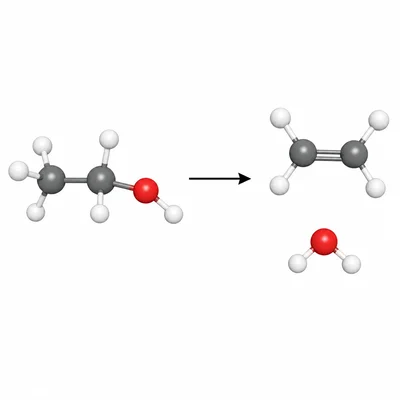
A reaction has a balanced equation: C2H5OH -> C2H4 + H2O. If ethene, C2H4, is the desired product, calculate the atom economy. Use molar masses C2H5OH = 46 g/mol, C2H4 = 28 g/mol, and H2O = 18 g/mol.
- 8
List three properties that make a solvent safer or greener for use in a chemistry lab or industrial process.
- 9
Classify each solvent as generally safer or higher concern: water, ethanol, hexane, benzene, and acetone. Briefly explain one classification.
- 10
A process uses 500 mL of dichloromethane for every 10 g of product. Suggest two changes that could make the solvent use greener.
- 11
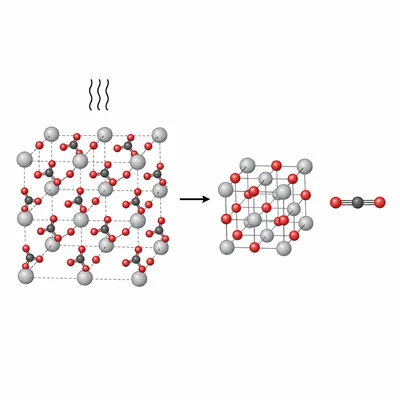
The balanced reaction CaCO3 -> CaO + CO2 is used to make calcium oxide. If CaO is the desired product, calculate the atom economy. Use molar masses CaCO3 = 100 g/mol, CaO = 56 g/mol, and CO2 = 44 g/mol.
- 12
Explain why a reaction that produces only one product often has a high atom economy.
- 13
A company is choosing between two solvents for a reaction. Solvent X gives 95% yield but is toxic, nonrenewable, and difficult to dispose of. Solvent Y gives 88% yield but is low toxicity, biodegradable, and recyclable. Which solvent would you recommend, and what tradeoff should the company consider?
- 14
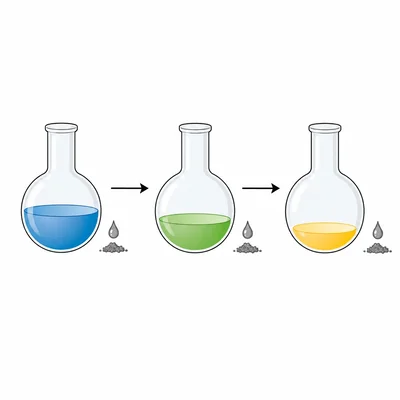
A reaction route is shown as three steps. Step 1 has 90% yield, Step 2 has 80% yield, and Step 3 has 75% yield. Calculate the overall percent yield for the route.
- 15
A chemist redesigns a synthesis from a three-step process to a one-step process. The new process has better atom economy and uses water instead of a chlorinated solvent. Explain how this redesign follows green chemistry principles.