Intermolecular Forces & Boiling Point Explorer
Select up to six molecules from the curated library. The tool breaks down each molecule's London dispersion, dipole-dipole, and hydrogen bonding contributions, predicts a relative boiling-point ranking, and compares the prediction against experimental reference values. Useful for AP, IB, and intro college chemistry.
Quick Presets
Load a curated comparison and see the trend in seconds.
Molecule Library
Choose up to 6 molecules to compare. Click again to remove.
Noble Gas
Diatomic
Alkane
Hydrogen Halide
Group VI Hydride
Group V Hydride
Alcohol
Other Organic
Other
Selected Molecules
- M (g/mol)
- 18.02
- μ (D)
- 1.85
- α (ų)
- 1.45
- M (g/mol)
- 34.08
- μ (D)
- 0.97
- α (ų)
- 3.78
- M (g/mol)
- 17.03
- μ (D)
- 1.47
- α (ų)
- 2.26
- M (g/mol)
- 34.00
- μ (D)
- 0.58
- α (ų)
- 4.84
Predicted vs Actual Boiling Point
Sorted high to low by predicted IMF score. The teal bar shows the model. The amber bar shows the reference boiling point.
Analysis
- Water boils highest at 100 °CHydrogen Bonding is the dominant force holding Water molecules together in the liquid phase.
- Water boils 160 °C higher than Hydrogen SulfideHydrogen Sulfide is heavier by 16.1 g/mol, yet Water boils higher because hydrogen bonding dominates dispersion forces.
- Water boils 188 °C higher than PhosphinePhosphine is heavier by 16.0 g/mol, yet Water boils higher because hydrogen bonding dominates dispersion forces.
- Ammonia boils 27 °C higher than Hydrogen SulfideHydrogen Sulfide is heavier by 17.0 g/mol, yet Ammonia boils higher because hydrogen bonding dominates dispersion forces.
How the IMF Score Works
London Dispersion
Dipole-Dipole
Hydrogen Bonding
Total score and ranking
Higher total score predicts a higher boiling point. The Spearman correlation ρ measures how well the predicted ranking matches the experimental ranking. Values near +1 mean the model captures the trend.
Reference Guide
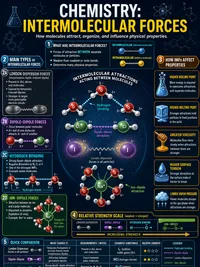
London Dispersion Forces
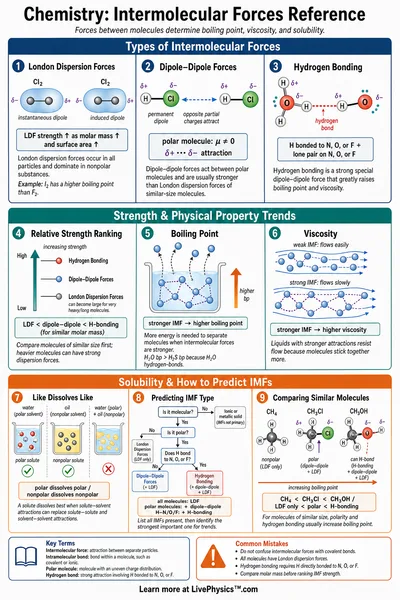
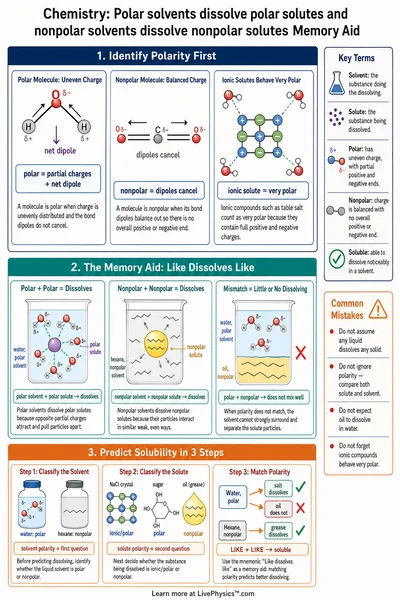
Every molecule experiences London dispersion. Random electron motion creates instantaneous dipoles that induce dipoles in neighboring molecules. Larger, more polarizable electron clouds give rise to stronger dispersion forces.
The strength scales with polarizability , which grows with molar mass and surface area. Noble gases boil from -269 °C (He) to -108 °C (Xe) on dispersion alone.
- He, very small, very weak dispersion.
- Xe, bigger atom, stronger dispersion.
- Hexane (C₆H₁₄) outboils methane (CH₄) by more than 200 °C.
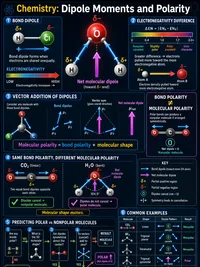
Dipole-Dipole Interactions
Polar molecules have a permanent dipole moment measured in Debye. The positive end of one molecule attracts the negative end of its neighbor. The interaction strength scales with .
CO and N₂ have nearly identical molar mass, but CO's small dipole (0.12 D) gives it a boiling point 5 °C higher than N₂. Acetone (2.88 D) boils at 56 °C while propane of similar mass boils at -42 °C.
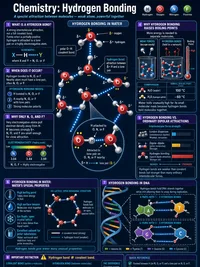
Hydrogen Bonding
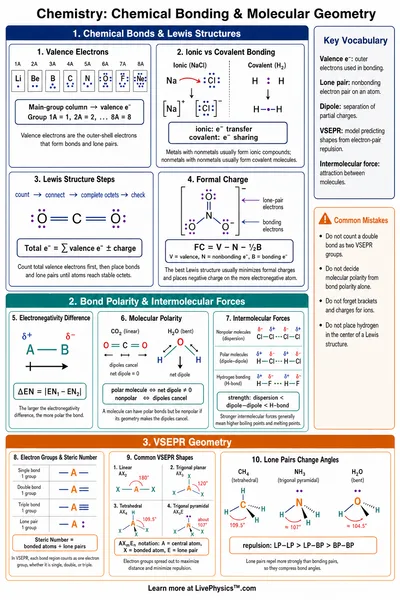
Hydrogen bonds form between an H bonded to N, O, or F and a lone pair on another N, O, or F atom. Bond strength sits between 5 and 30 kJ/mol, an order of magnitude stronger than typical dipole-dipole.
P-H and S-H bonds do not qualify because P and S are not electronegative enough. This is why H₂O boils at 100 °C but H₂S boils at -60 °C, even though sulfur is heavier. The same anomaly appears in HF vs HCl and in NH₃ vs PH₃.
Look for both a donor (H on N, O, or F) and an acceptor (lone pair on N, O, or F) on the same species. Without both, the chip stays off in this tool.
Predicting Boiling-Point Trends
Stronger total IMFs require more energy to overcome, so they push boiling point higher. The tool combines three contributions into one score
Spearman rank correlation ρ measures how well the predicted ranking matches the experimental boiling-point ranking. ρ near +1 means strong agreement. A drop below 0.7 usually flags a competing effect such as hydrogen bonding acting in only some members of the comparison.
- Compare same-family molecules first. Trends are clearest.
- Watch for anomalies. H₂O, HF, and NH₃ break periodic trends.
- For nearly equal molar mass, the polar molecule wins.