Practice interpreting thermochemical equations, calculating heat from calorimeter data, and connecting energy changes to moles of reactants and products.
Read each problem carefully. Show your work, include units, and use correct signs for heat gained or released.
Using heat, temperature change, and balanced equations
Chemistry - Grade 9-12
- 1
A coffee-cup calorimeter contains 150.0 g of water. A reaction causes the water temperature to increase from 22.4°C to 29.8°C. Calculate the heat gained by the water. Use c = 4.184 J/g°C.
- 2
In a calorimeter, the water absorbs 3.25 kJ of heat during a reaction. What is the heat change of the reaction, assuming the calorimeter itself absorbs no heat?
- 3
The thermochemical equation for methane combustion is CH4(g) + 2O2(g) → CO2(g) + 2H2O(l), ΔH = -890 kJ. Is the reaction exothermic or endothermic? Explain.
- 4
Using the equation CH4(g) + 2O2(g) → CO2(g) + 2H2O(l), ΔH = -890 kJ, calculate the heat released when 2.50 mol of CH4 reacts completely.
- 5
Using the equation 2H2(g) + O2(g) → 2H2O(l), ΔH = -572 kJ, calculate the enthalpy change when 1.00 mol of H2O(l) forms.
- 6
A reaction is represented by N2(g) + 3H2(g) → 2NH3(g), ΔH = -92.4 kJ. Write the thermochemical equation for the reverse reaction.
- 7
A student mixes two solutions in a coffee-cup calorimeter. The solution mass is 100.0 g, the specific heat is assumed to be 4.184 J/g°C, and the temperature changes from 20.0°C to 18.6°C. Calculate q for the solution and state whether the reaction absorbed or released heat.
- 8
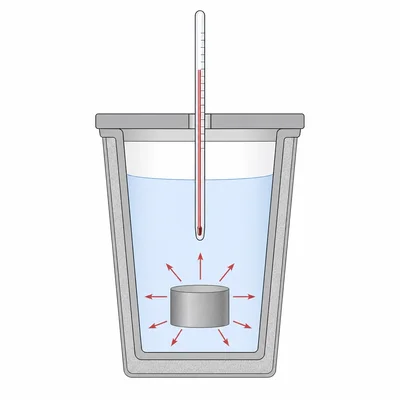
A 25.0 g metal sample is heated to 95.0°C and placed in 100.0 g of water at 22.0°C. The final temperature is 24.5°C. Calculate the heat gained by the water. Use cwater = 4.184 J/g°C.
- 9
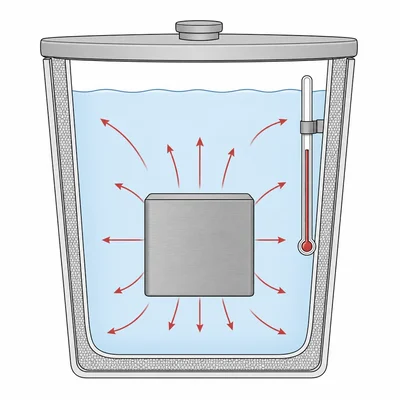
Using the data from the previous problem, calculate the specific heat of the metal. Assume the heat lost by the metal equals the heat gained by the water.
- 10
A calorimeter has a heat capacity of 45.0 J/°C. During a reaction, its temperature increases by 6.20°C. How much heat does the calorimeter absorb?
- 11
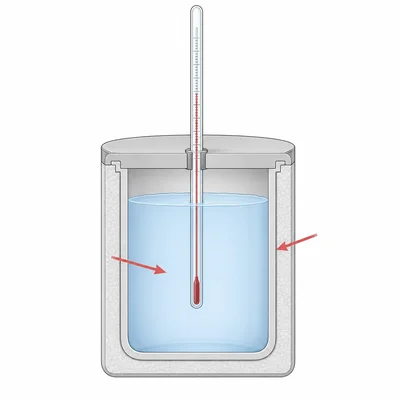
A reaction warms 80.0 g of solution from 19.5°C to 27.0°C in a calorimeter with heat capacity 30.0 J/°C. Assume the solution has c = 4.184 J/g°C. Calculate the total heat absorbed by the solution and calorimeter.
- 12
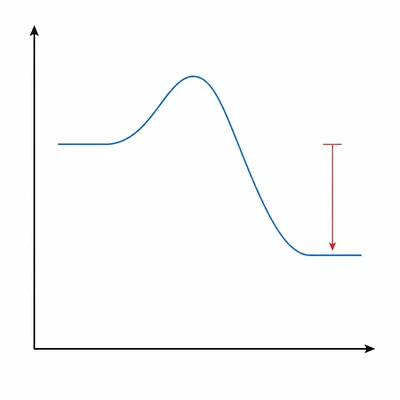
For the reaction A + B → C, a reaction coordinate diagram shows the products at a lower energy than the reactants. What is the sign of ΔH, and is the reaction exothermic or endothermic?
- 13
The decomposition of calcium carbonate is represented by CaCO3(s) → CaO(s) + CO2(g), ΔH = +178 kJ. How much heat is required to decompose 0.750 mol of CaCO3?
- 14
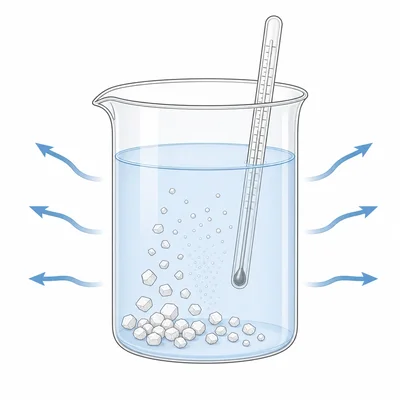
A student dissolves 5.00 g of NH4NO3 in 100.0 g of water. The water temperature decreases from 23.0°C to 17.5°C. Calculate the heat change of the water. Use c = 4.184 J/g°C.
- 15
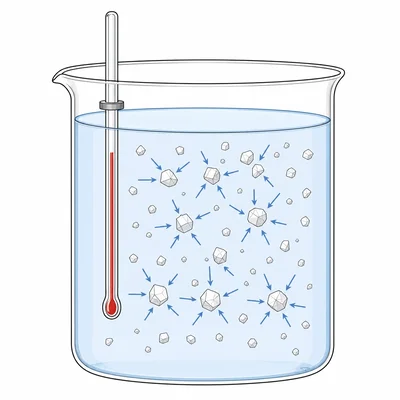
Using the data from the NH4NO3 dissolving problem, calculate the molar enthalpy of solution in kJ/mol. The molar mass of NH4NO3 is 80.04 g/mol. Assume the heat absorbed by dissolving NH4NO3 equals the heat lost by the water.