Practice interpreting enthalpy changes, using calorimetry data, and applying Hess's Law to chemical reactions.
Read each problem carefully. Show your setup, units, and final answer in the space provided.
Calculating heat, enthalpy changes, and reaction pathways
Chemistry - Grade 9-12
- 1
The combustion of methane is represented by CH4(g) + 2O2(g) -> CO2(g) + 2H2O(l), delta H = -890 kJ per mole of CH4. How much heat is released when 2.50 mol of CH4 burns completely?
- 2
A reaction warms 150.0 g of water from 22.0°C to 31.5°C. Use q = mc delta T and c = 4.184 J/g°C to find the heat gained by the water. Then state the heat change for the reaction.
- 3
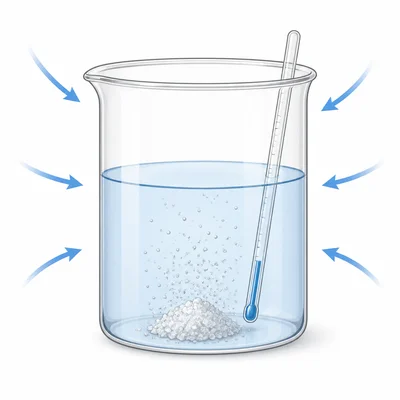
When ammonium nitrate dissolves in water, the temperature of the solution decreases. State whether the process is endothermic or exothermic and explain the sign of delta H.
- 4
Use the data to find delta H for CO(g) + 1/2O2(g) -> CO2(g). Given: C(s) + O2(g) -> CO2(g), delta H = -393.5 kJ. C(s) + 1/2O2(g) -> CO(g), delta H = -110.5 kJ.
- 5
Use standard enthalpies of formation to calculate delta H for C2H5OH(l) + 3O2(g) -> 2CO2(g) + 3H2O(l). Values: C2H5OH(l) = -277.7 kJ/mol, CO2(g) = -393.5 kJ/mol, H2O(l) = -285.8 kJ/mol, O2(g) = 0 kJ/mol.
- 6
For N2(g) + 3H2(g) -> 2NH3(g), delta H = -92.4 kJ. What is delta H for 4NH3(g) -> 2N2(g) + 6H2(g)?
- 7
Use Hess's Law to find delta H for 2SO2(g) + O2(g) -> 2SO3(g). Given: 2S(s) + 3O2(g) -> 2SO3(g), delta H = -790.4 kJ. S(s) + O2(g) -> SO2(g), delta H = -296.8 kJ.
- 8
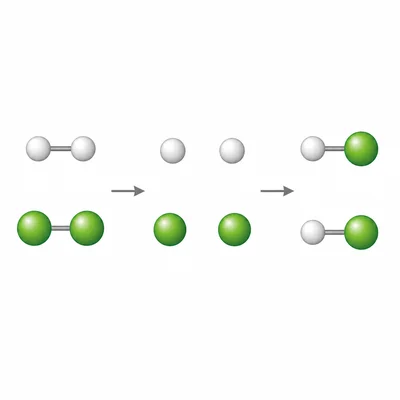
Estimate delta H for H2(g) + Cl2(g) -> 2HCl(g) using bond enthalpies. H-H = 436 kJ/mol, Cl-Cl = 243 kJ/mol, H-Cl = 431 kJ/mol.
- 9
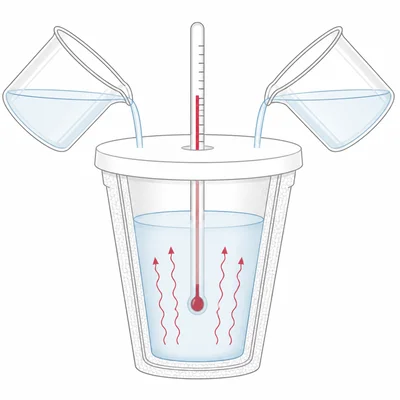
In a coffee-cup calorimeter, 50.0 mL of 1.00 M HCl reacts with 50.0 mL of 1.00 M NaOH. The temperature rises from 22.0°C to 28.7°C. Assume the solution has a mass of 100.0 g and c = 4.184 J/g°C. Calculate delta H in kJ per mole of water formed.
- 10
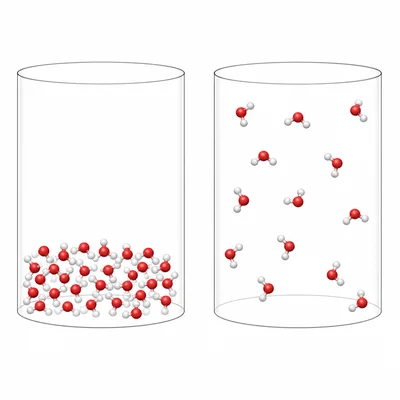
Explain why the state symbols in a thermochemical equation matter. Use H2O(l) and H2O(g) as part of your explanation.
- 11
Use standard enthalpies of formation to calculate delta H for CaCO3(s) -> CaO(s) + CO2(g). Values: CaCO3(s) = -1207.0 kJ/mol, CaO(s) = -635.1 kJ/mol, CO2(g) = -393.5 kJ/mol.
- 12
Use Hess's Law to calculate delta H for N2(g) + 2O2(g) -> 2NO2(g). Given: N2(g) + O2(g) -> 2NO(g), delta H = +180.5 kJ. 2NO(g) + O2(g) -> 2NO2(g), delta H = -114.1 kJ.