Practice using data from solar panels to calculate energy, power, efficiency, and the effect of panel angle on electrical output.
Read each problem carefully. Show your equations, substitutions, units, and final answer in the space provided.
Calculating solar energy, power output, efficiency, and angle effects
Physics - Grade 9-12
- 1
A solar panel produces an average power of 120 W for 4.0 hours. How much electrical energy does it produce in watt-hours and in joules?
- 2
A 2.0 m² solar panel receives sunlight with an intensity of 850 W/m². If the panel is 18% efficient, what electrical power output should it produce?
- 3
A student measures the voltage across a solar panel as 18 V and the current through a load as 2.5 A. What is the electrical power delivered to the load?
- 4
The table shows solar panel power output at different tilt angles: 0 degrees: 68 W, 15 degrees: 82 W, 30 degrees: 95 W, 45 degrees: 88 W, 60 degrees: 70 W. Which tilt angle gives the maximum power output, and what is that output?
- 5
A solar panel is rated at 300 W under standard test conditions. During a cloudy period, it produces 90 W. What percent of its rated power is it producing?
- 6
A solar array produces 1.8 kWh of energy in 6.0 hours. What was its average power output in kilowatts and watts?
- 7
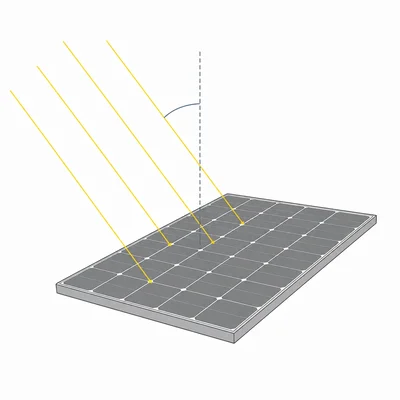
Sunlight strikes a flat solar panel at an angle, so the effective intensity is I_effective = I cos theta. If the sunlight intensity is 1000 W/m² and theta = 40 degrees from perpendicular, what is the effective intensity on the panel? Use cos 40 degrees = 0.766.
- 8
A 1.5 m² solar panel receives an effective intensity of 700 W/m² and produces 160 W of electrical power. What is the efficiency of the panel?
- 9
A solar panel charges a battery by supplying a current of 3.0 A at 12 V for 2.0 hours. How much energy is transferred to the battery in watt-hours?
- 10
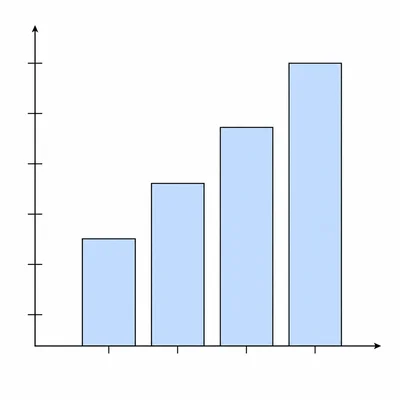
A graph of power output versus time shows these average power values during each hour: 8-9 AM: 80 W, 9-10 AM: 140 W, 10-11 AM: 210 W, 11 AM-12 PM: 260 W. Estimate the total energy produced over these four hours.
- 11
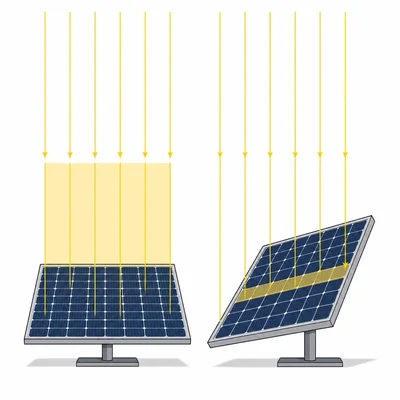
Two identical solar panels are tested at noon. Panel A is aimed directly at the Sun and produces 200 W. Panel B is at an angle where cos theta = 0.60. If all other conditions are the same, estimate the power output of Panel B.
- 12
A home uses 12 kWh of electrical energy per day. A solar system produces an average of 3.0 kWh per day. What fraction and percent of the home's daily energy use is supplied by the solar system?
- 13
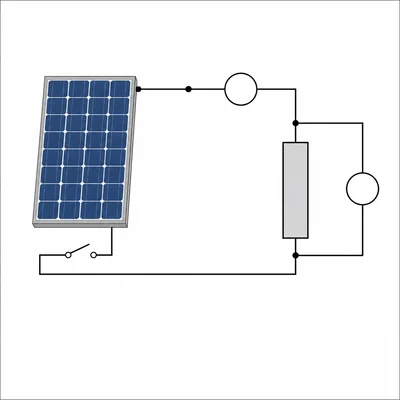
A solar panel has an open-circuit voltage of 21 V, but when connected to a load it operates at 17 V and 4.0 A. Why should the load values be used to calculate useful power, and what is the useful power?
- 14
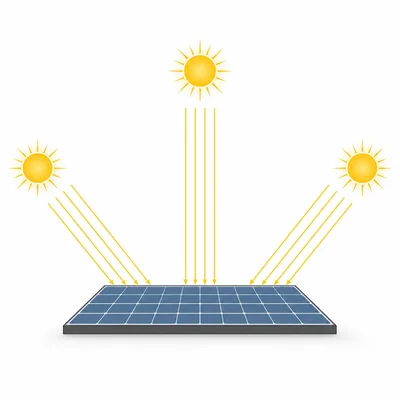
A student records power output at three times during a lab: 10 AM: 150 W, 12 PM: 240 W, 2 PM: 170 W. Explain one physical reason the noon value may be the largest.
- 15
A 250 W solar panel costs $200. A 400 W solar panel costs $360. Which panel has the lower cost per watt, and by how much?