Practice calculating speed, distance, and time using real-world motion situations, units, and simple graphs.
Read each problem carefully. Use the formulas speed = distance ÷ time, distance = speed × time, and time = distance ÷ speed. Show your work and include units in your answers.
Use formulas and units to solve motion problems
Physics - Grade 6-8
- 1
A cyclist travels 24 kilometers in 2 hours. What is the cyclist's average speed?
- 2
A car moves at a constant speed of 60 miles per hour for 3 hours. How far does the car travel?
- 3
A student walks 800 meters at a speed of 2 meters per second. How long does the walk take?
- 4
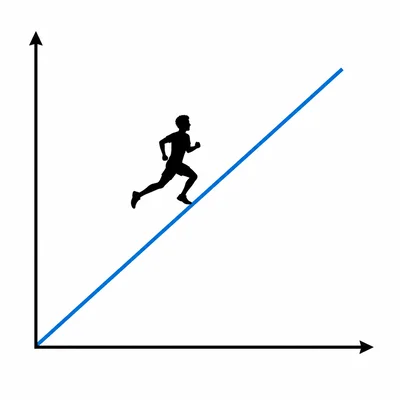
The distance-time graph shows a runner traveling from 0 meters to 100 meters in 20 seconds in a straight line. What is the runner's speed?
- 5
A skateboarder travels 150 meters in 30 seconds. What is the skateboarder's average speed in meters per second?
- 6
A train travels at 90 kilometers per hour. How long will it take the train to travel 270 kilometers?
- 7

Two students race across a 50-meter field. Maya finishes in 10 seconds, and Leo finishes in 12.5 seconds. Who has the greater average speed, and what is each student's speed?
- 8
A bus travels 45 kilometers in 30 minutes. What is its average speed in kilometers per hour?
- 9
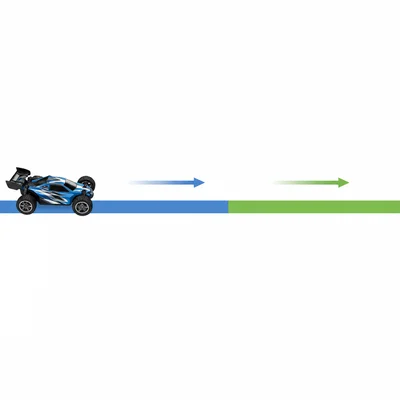
A remote-control car moves 18 meters in 6 seconds, then 12 meters in 4 seconds. What is its average speed for the entire trip?
- 10
A boat travels at 12 meters per second for 25 seconds. How far does the boat travel?
- 11
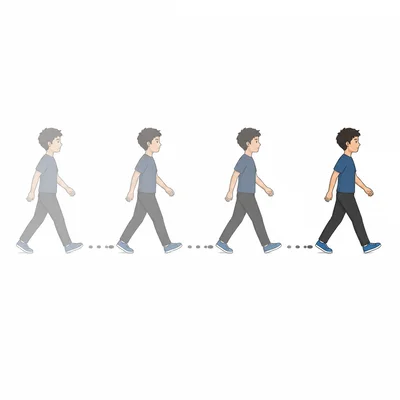
The table shows a person walking at a constant speed: after 1 second, the person is 1.5 meters from the start; after 2 seconds, 3 meters; after 3 seconds, 4.5 meters; after 4 seconds, 6 meters. What is the person's speed?
- 12
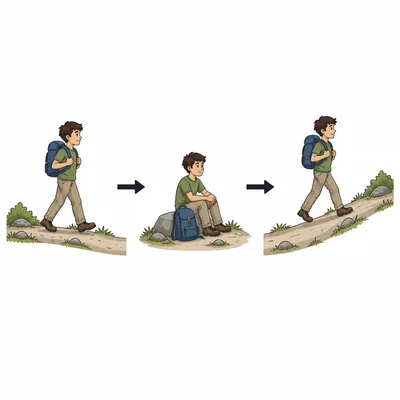
A hiker travels 6 kilometers in 2 hours, rests for 1 hour, then travels 6 more kilometers in 3 hours. What is the hiker's average speed for the whole trip, including the rest time?
- 13
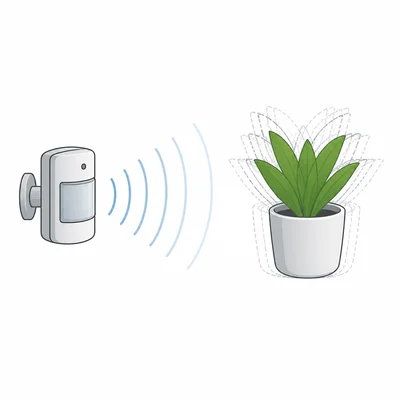
A motion sensor records that an object stays at 20 meters from the start for 5 seconds. What is the object's speed during this time?
- 14
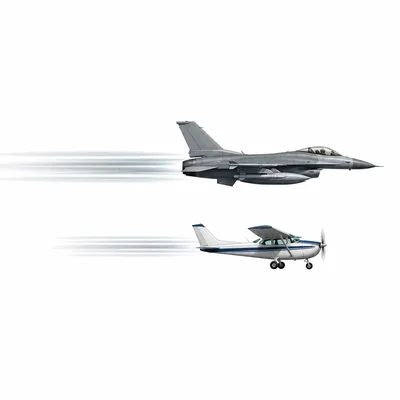
A jet travels 1,200 kilometers in 2 hours. A smaller plane travels 900 kilometers in 3 hours. How many times faster is the jet than the smaller plane?
- 15
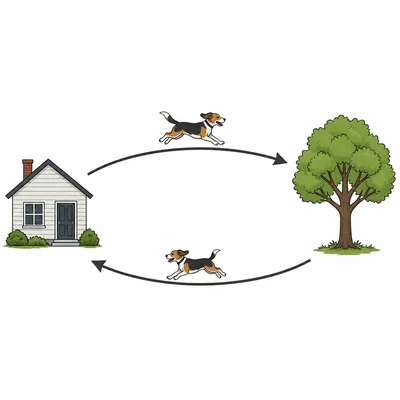
A dog runs from a house to a tree 40 meters away in 8 seconds, then runs back to the house in 10 seconds. What is the dog's average speed for the full trip?