Practice identifying, comparing, and applying major ideas from Freud, Jung, and Rogers in the study of personality.
Read each problem carefully. Use complete sentences and include evidence from the theory when explaining your answer.
Comparing psychodynamic, analytic, and humanistic views of personality
Psychology - Grade 9-12
- 1
Define personality as psychologists use the term, then explain why psychologists create personality theories.
- 2

Freud described the mind as having conscious, preconscious, and unconscious levels. Explain each level in your own words.
- 3
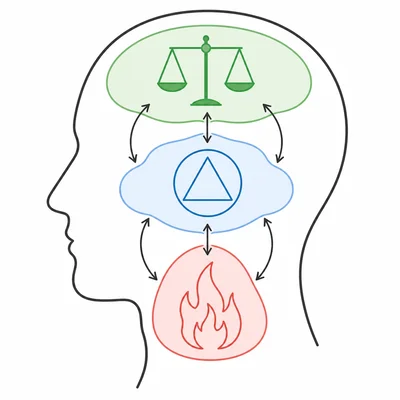
In Freud's theory, compare the id, ego, and superego. Include the goal of each part of personality.
- 4
A student wants to cheat on a test, feels guilty about the idea, and then decides to study instead. Explain this situation using Freud's id, ego, and superego.
- 5
Explain what Freud meant by defense mechanisms, then give one example of a defense mechanism in everyday life.
- 6
Match each defense mechanism to the best example: repression, projection, rationalization. A person forgets an upsetting memory. A person blames others for feelings they have themselves. A person makes an excuse for a poor choice.
- 7
Jung agreed with Freud that the unconscious is important, but he expanded the idea. Explain the difference between the personal unconscious and the collective unconscious.
- 8
Define archetype in Jung's theory and explain one archetype using an example from a story, movie, myth, or culture.
- 9
Jung used the terms persona and shadow. Explain both terms and describe how they might appear in a teenager's life.
- 10

Rogers believed that people have an actual self and an ideal self. Explain these terms and describe what congruence means.
- 11
Explain unconditional positive regard in Rogers's humanistic theory. Include why it matters for personality development.
- 12
A parent says, 'I love you only when you get perfect grades.' Explain how Rogers might describe the effect of this message on self-concept.
- 13
Compare Freud, Jung, and Rogers by completing this explanation: Freud emphasized blank, Jung emphasized blank, and Rogers emphasized blank.
- 14
Choose one theory from Freud, Jung, or Rogers and use it to explain why a person might feel anxious before giving a class presentation.
- 15
Evaluate one strength and one limitation of studying personality through Freud, Jung, or Rogers. Use a specific theory in your answer.