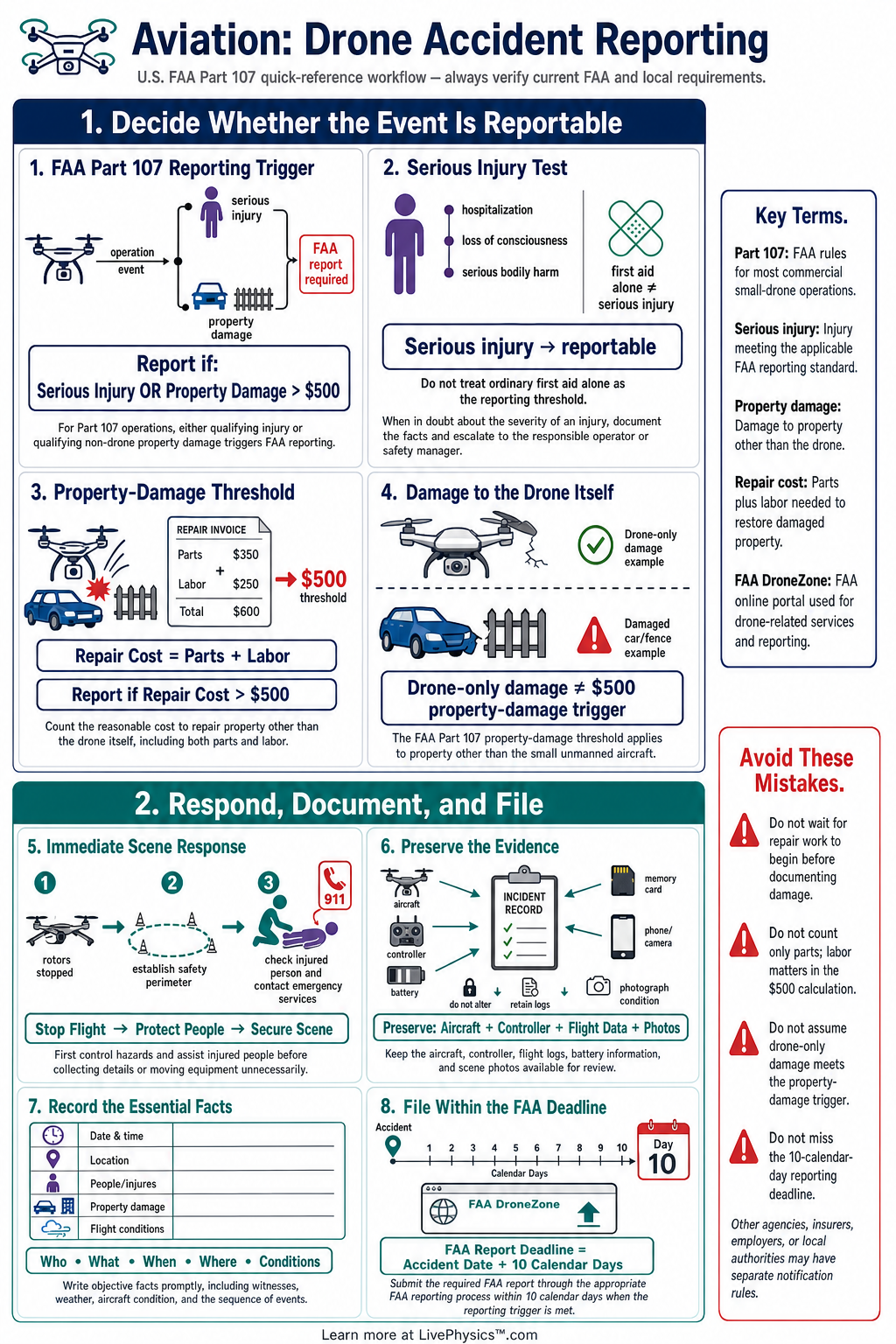
Drone accident reporting helps operators respond correctly after an unsafe event. This cheat sheet explains when a report is required, what information to collect, and how quickly action must be taken. It is useful for remote pilots, aviation students, and anyone flying under United States drone rules.
The main FAA Part 107 reporting trigger involves serious injury, loss of consciousness, or qualifying property damage. Qualifying damage is based on repair cost and excludes damage to the drone itself. Strong reporting also depends on preserving flight data, recording facts, and following any additional local or organizational requirements.
Key Facts
- Under FAA Part 107, report an operation that causes serious injury, loss of consciousness, or qualifying property damage.
- The Part 107 property damage rule is report required when repair cost for property other than the drone is greater than 500 dollars.
- Property damage value equals the cost of replacement parts plus the cost of labor needed for repair.
- Damage to the small unmanned aircraft itself is excluded when deciding whether the 500 dollar Part 107 threshold is met.
- The FAA reporting deadline equals the date of the operation plus 10 calendar days.
- A repair estimate of exactly 500 dollars does not meet a rule requiring damage greater than 500 dollars.
- Preserve flight logs, photographs, video, maintenance records, and witness details before files are changed or lost.
Vocabulary
- Remote pilot in command
- The person directly responsible for the safe operation of a small unmanned aircraft.
- Part 107
- The FAA rule that governs many commercial and nonrecreational small drone operations in the United States.
- Qualifying property damage
- Damage to property other than the drone that costs more than 500 dollars to repair, including parts and labor.
- Loss of consciousness
- A condition in which a person becomes unconscious, even if the person later recovers.
- Flight log
- A digital or written record that may show details such as aircraft location, altitude, speed, battery status, and time.
- Evidence preservation
- The safe protection of records, files, photographs, and physical items that may help explain an accident.
Common Mistakes to Avoid
- Counting damage to the drone toward the 500 dollar threshold is wrong because Part 107 excludes damage to the small unmanned aircraft itself.
- Using only the price of replacement parts is wrong because the repair value includes both parts and labor costs.
- Waiting until the drone is repaired before collecting records is wrong because flight logs, images, and scene details can be lost or changed.
- Assuming an FAA report proves the pilot caused the event is wrong because reporting provides factual information and is not automatically a finding of fault.
- Ignoring local, employer, insurer, or airport reporting rules is wrong because separate reporting duties can apply in addition to the FAA requirement.
Practice Questions
- 1 A drone damages a fence. Replacement materials cost 340 dollars and labor costs 190 dollars. Determine whether the property damage meets the Part 107 reporting threshold, assuming no injuries occurred.
- 2 A drone damages a parked vehicle, and the documented repair cost is exactly 500 dollars. Determine whether this damage alone meets the Part 107 threshold.
- 3 An operation resulting in qualifying property damage occurs on May 4. Calculate the final calendar date for submitting the FAA report.
- 4 Explain why a remote pilot should preserve original flight logs and photographs even when the pilot believes the accident was caused by equipment failure.
Understanding Drone Accident Reporting
An accident begins with safety, not paperwork. Stop the flight, keep people away from hazards, and call emergency services when someone may be hurt or property creates a public danger. The remote pilot in command should secure the aircraft and prevent an unplanned second flight.
They should also protect the scene when doing so is safe. Do not move damaged property unless safety, rescue, or a responsible authority requires it.
Prompt action can preserve evidence, support medical care, and show that the operator responded responsibly. A calm, factual record is more useful than guesses about cause.
For operations under Part 107, the FAA reporting trigger includes a serious injury to any person, any loss of consciousness, or qualifying damage to property other than the small unmanned aircraft. Qualifying damage means the repair cost, including parts and labor, is more than 500 dollars. This is a strict greater than test.
Damage valued at exactly 500 dollars does not cross this particular FAA threshold. The report is due within 10 calendar days of the operation. Recreational flyers also have federal reporting duties under their operating exception, and every operator should check the rules that apply to the purpose and location of the flight.
Good documentation starts immediately. Record the date, time, location, aircraft registration number when applicable, remote pilot information, weather, planned mission, and people involved. Take clear photographs of the aircraft, damage, surroundings, and any relevant barriers or markings.
Preserve flight logs, controller logs, video, maintenance records, and witness contact details. Write down factual observations, such as altitude setting or battery condition, without changing files or editing timestamps.
Estimate property damage using repair quotes and include labor as well as replacement parts. If facts are uncertain, say that they are uncertain and update the record when reliable information arrives.
An FAA report is not a finding of fault. It gives the agency a timely account and helps identify safety patterns across drone operations. Separate reporting may be required by local police, an airport authority, an insurer, an employer, or the National Transportation Safety Board for events within its rules.
These obligations can exist alongside the FAA ten day report. Students should learn to identify the governing operating rule before launch and keep a simple incident checklist in their flight kit.
Focus study on the reporting threshold, the deadline, evidence preservation, and honest descriptions. These habits reduce confusion during a stressful event and improve future risk decisions.