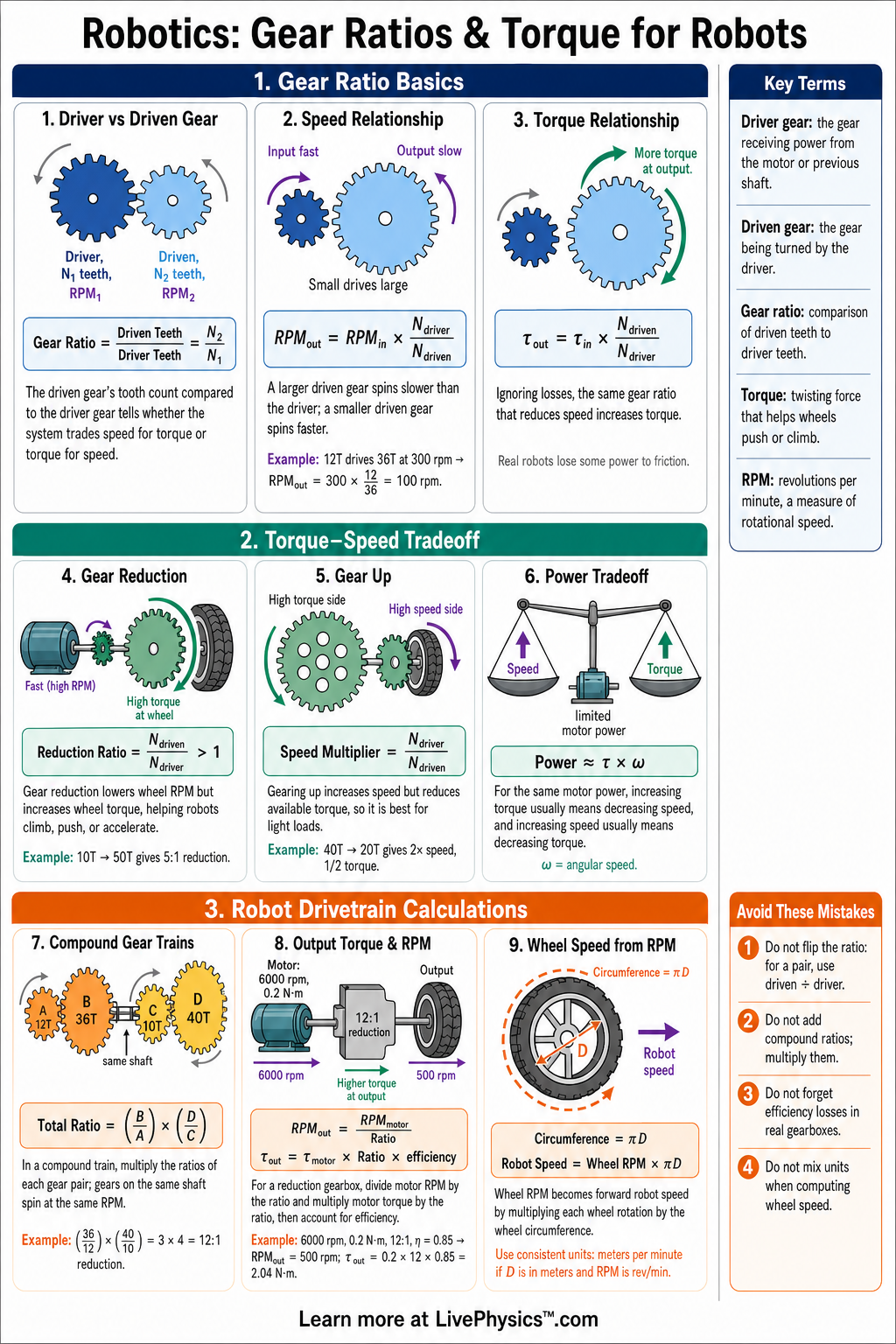
Robotics gear ratios connect motor speed and motor torque to how a robot actually moves, lifts, or pushes. This cheat sheet helps students choose gears for drivetrains, arms, elevators, and intakes. It is useful when a motor spins too fast, stalls too easily, or cannot create enough force at the wheel or mechanism.
Students in grades 8-12 can use it as a quick reference during robot design, building, and troubleshooting.
The core idea is that gears trade speed for torque. A reduction ratio makes the output turn slower but with more torque, while an overdrive ratio makes the output turn faster but with less torque. Important formulas include gear ratio = driven gear teeth / driving gear teeth, output speed = motor speed / gear ratio, and output torque = motor torque x gear ratio x efficiency.
These relationships help predict whether a robot will accelerate, climb, lift, or push effectively.
Key Facts
- Gear ratio = driven gear teeth / driving gear teeth when one gear drives another directly.
- Output speed = input speed / gear ratio, so a 5:1 reduction makes the output spin one fifth as fast.
- Output torque = input torque x gear ratio x efficiency, so reductions increase usable torque after losses are included.
- Wheel force = wheel torque / wheel radius, so smaller wheels create more pushing force for the same axle torque.
- Robot speed = wheel circumference x wheel rpm, where wheel circumference = pi x wheel diameter.
- Power is approximately conserved, so increasing torque with gears decreases speed by a similar factor before efficiency losses.
- A compound gear ratio is found by multiplying each stage, such as total ratio = stage 1 ratio x stage 2 ratio.
- A motor stalls when the load torque is greater than the motor can supply, causing speed to drop near zero and current to rise.
Vocabulary
- Gear Ratio
- The comparison between input rotation and output rotation, usually showing how much gears change speed and torque.
- Torque
- A turning force measured in newton-meters or inch-pounds that causes a shaft, wheel, or arm to rotate.
- Reduction
- A gear setup with a ratio greater than 1:1 that lowers output speed and raises output torque.
- Overdrive
- A gear setup with a ratio less than 1:1 that raises output speed and lowers output torque.
- Efficiency
- The fraction of input power that becomes useful output power after losses from friction, heat, and gear contact.
- Stall Torque
- The maximum torque a motor can produce when its shaft is not rotating.
Common Mistakes to Avoid
- Reversing the gear ratio formula is wrong because the driven gear teeth must be divided by the driving gear teeth for a simple gear pair.
- Ignoring efficiency is wrong because real gearboxes lose energy to friction, so output torque is less than input torque x gear ratio.
- Assuming more torque always makes a better robot is wrong because extra reduction lowers speed and can make the robot too slow for the task.
- Using wheel diameter instead of wheel radius in wheel force is wrong because force = torque / radius, not torque / diameter.
- Comparing free speed only is wrong because motors slow down under load, so design should consider operating torque, current, and stall risk.
Practice Questions
- 1 A 12-tooth gear drives a 60-tooth gear. What is the gear ratio, and is this a reduction or an overdrive?
- 2 A motor spins at 6000 rpm and drives a 10:1 gearbox. What is the output speed before losses?
- 3 A motor produces 0.8 N m of torque into a 6:1 gearbox with 85% efficiency. What is the approximate output torque?
- 4 A robot drivetrain is fast on flat ground but struggles to push another robot. Explain how changing the gear ratio could improve pushing force and what tradeoff would result.
Understanding Gear Ratios & Torque for Robots
A motor does not deliver the same torque at every speed. It produces its greatest turning force when it is stopped, but this condition draws the most current and quickly heats the motor. As the motor speeds up, its available torque falls.
Near its free speed, it turns quickly but produces very little useful force. A good robot mechanism usually operates between these extremes.
The motor should have enough speed left to respond to changing loads, while keeping current at a safe level. This is why a drivetrain that looks powerful while holding the robot off the floor can still struggle during a match.
Acceleration depends on more than top speed. The robot must accelerate its own mass, rotate wheels, spin shafts, and move any gears connected to the motor. Heavy arms and elevators add another challenge because gravity pulls against them.
A mechanism may lift an object once but still be poorly geared if it takes too long to reach position or overheats after repeated lifts. Designers often begin with the hardest expected load, such as climbing a ramp or raising a full game piece. They then leave a safety margin rather than choosing a ratio that only barely works.
At the wheels, available force is limited by traction. A gear reduction can create a large calculated pushing force, but the wheels cannot use more force than the floor grip allows. If the wheels spin, extra torque is being wasted.
Wheel material, robot weight, weight distribution, and surface condition all affect traction. More weight over driven wheels can improve grip, though it may make the robot harder to accelerate.
Larger wheels travel farther per turn and can cross bumps more easily, but they need more axle torque to produce the same ground force. Students should separate the ideas of motor capability, wheel force, and tire grip when diagnosing a robot.
Real gearboxes lose energy through friction, flexing, misalignment, and bearing resistance. Each gear stage adds some loss, so a long compound gearbox can be less efficient than its ideal calculation suggests. Loose gears can create backlash, which is small free movement before the output responds.
Backlash matters in arms, shooters, and position-controlled mechanisms because it reduces accuracy. Gears that are pressed too tightly create friction, while gears with too much space may skip teeth under load. Check that shafts stay parallel, bearings are supported, and gears are properly aligned.
The best ratio comes from testing as well as calculation. Measure travel time, motor temperature, battery voltage, and current if tools are available. Watch for slow starts, wheel spin, brownouts, and motors that become too hot to touch.
A ratio that gives the highest possible speed is rarely the best choice. Reliable robots usually use enough reduction to accelerate smoothly and survive repeated hard use.
When changing a ratio, change one thing at a time and record the result. This makes it easier to tell whether a problem comes from gearing, friction, battery condition, traction, or excessive mechanism weight.