Sign in to save

Bookmark this page so you can find it later.

Sign in to save

Bookmark this page so you can find it later.

Earth Science middle-school May 21, 2026

Why Do Earthquakes Happen?

How moving plates store and release energy
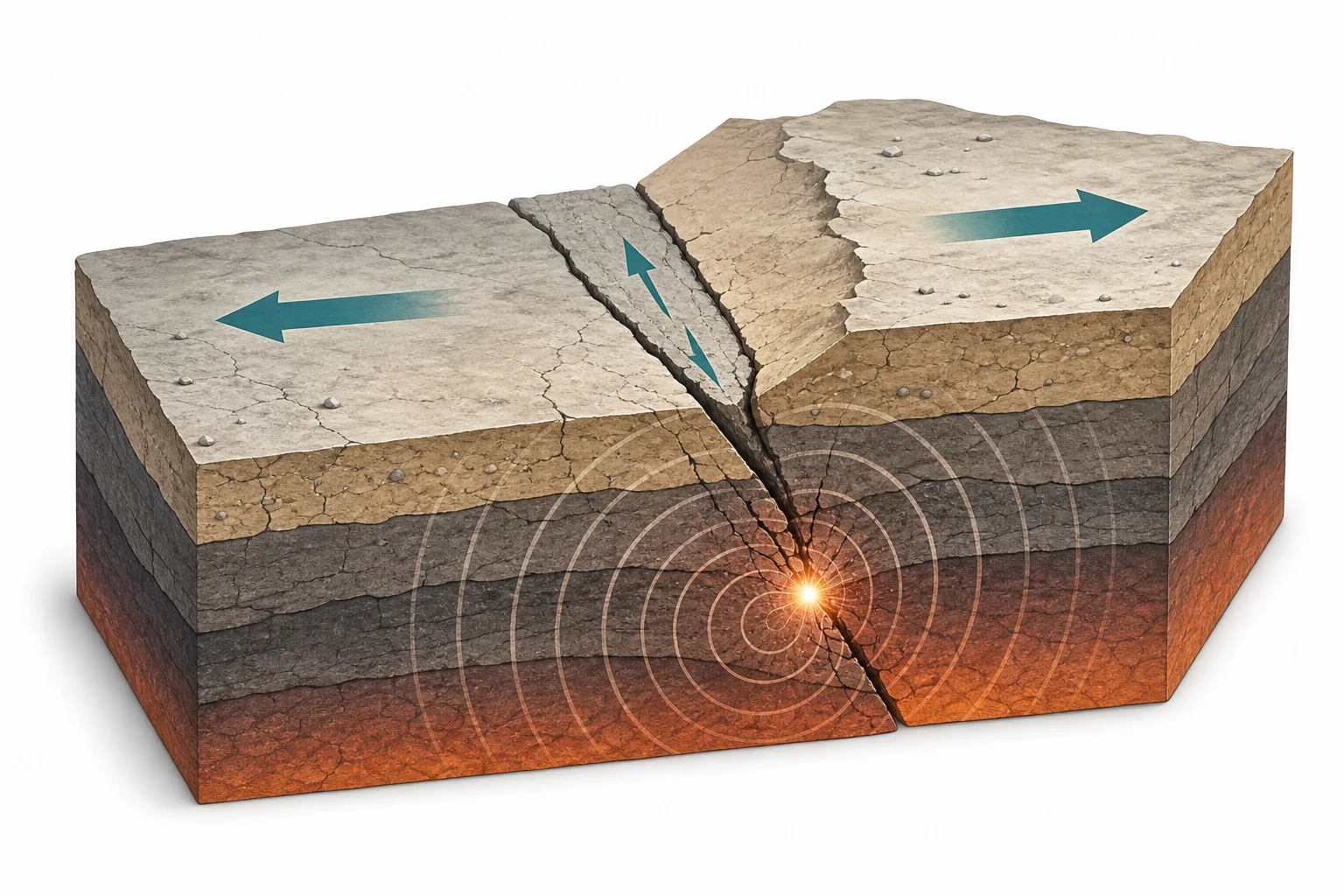
Cutaway view of Earth showing tectonic plates, a fault, and shaking waves spreading from an underground slip point

Earthquakes happen when rocks underground suddenly slip after being squeezed or pulled for a long time. The sudden motion sends shaking waves through the ground. Most happen near the edges of Earth's moving plates.

Big Idea. NGSS MS-ESS2-2 connects earthquake patterns to evidence that Earth's plates move and interact.

An earthquake is not a random burst of shaking. It is usually the result of slow motion that builds up over years, decades, or longer. Earth’s outer shell is broken into large pieces called tectonic plates. These plates move only a few centimeters each year, about as fast as fingernails grow. That motion is small, but plates are enormous. When plates push, pull, or slide past each other, rocks near their edges can bend and lock in place. Stress builds inside the rock. When the rock can no longer hold that stress, it breaks or slips along a fault. The stored energy moves outward as seismic waves, and the ground shakes. Understanding earthquakes helps scientists map hazards, design safer buildings, and explain why earthquakes cluster in certain regions instead of happening evenly across Earth.

Earth's crust is in motion
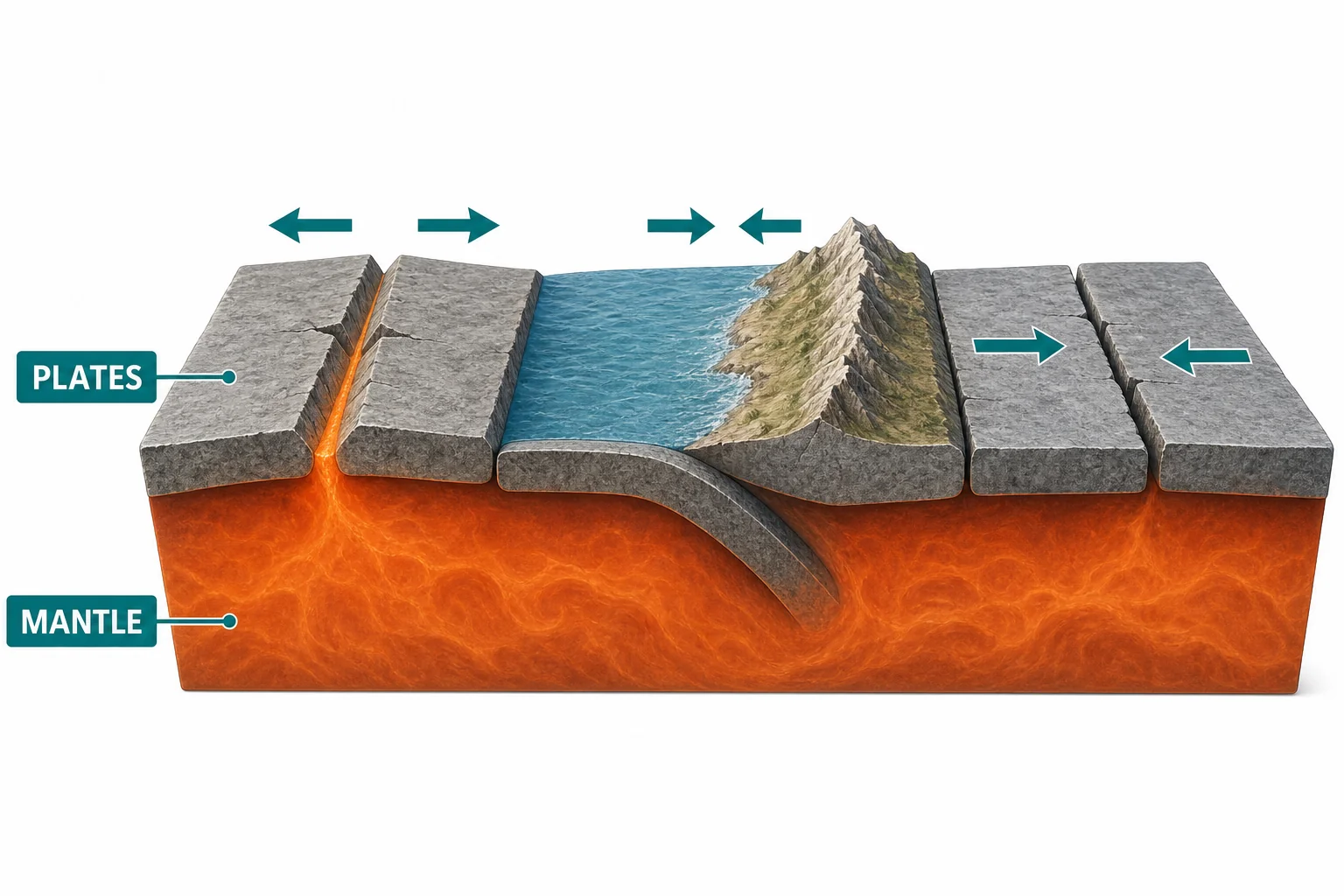
Diagram of tectonic plates moving on top of the mantle with arrows showing different directions of plate motion
Earth's outer layer is broken into moving plates.
Earth’s surface may feel still under your feet, but it is slowly moving. The crust and uppermost mantle form a hard outer layer broken into tectonic plates. These plates ride over softer, hotter rock below. Heat from inside Earth helps keep that deeper material moving very slowly. As it moves, it drags and nudges the plates above it. Some plates move apart. Some collide. Some slide sideways past each other. Plate motion is measured in centimeters per year, so people do not feel it day by day. Over time, that slow motion changes ocean basins, raises mountains, and creates places where earthquakes are more likely. Earthquakes are common near plate boundaries because that is where rocks are pushed, pulled, or scraped the most. The motion is slow, but the release can be sudden.

Earthquake risk is highest where moving plates meet.

Faults are breaks in rock
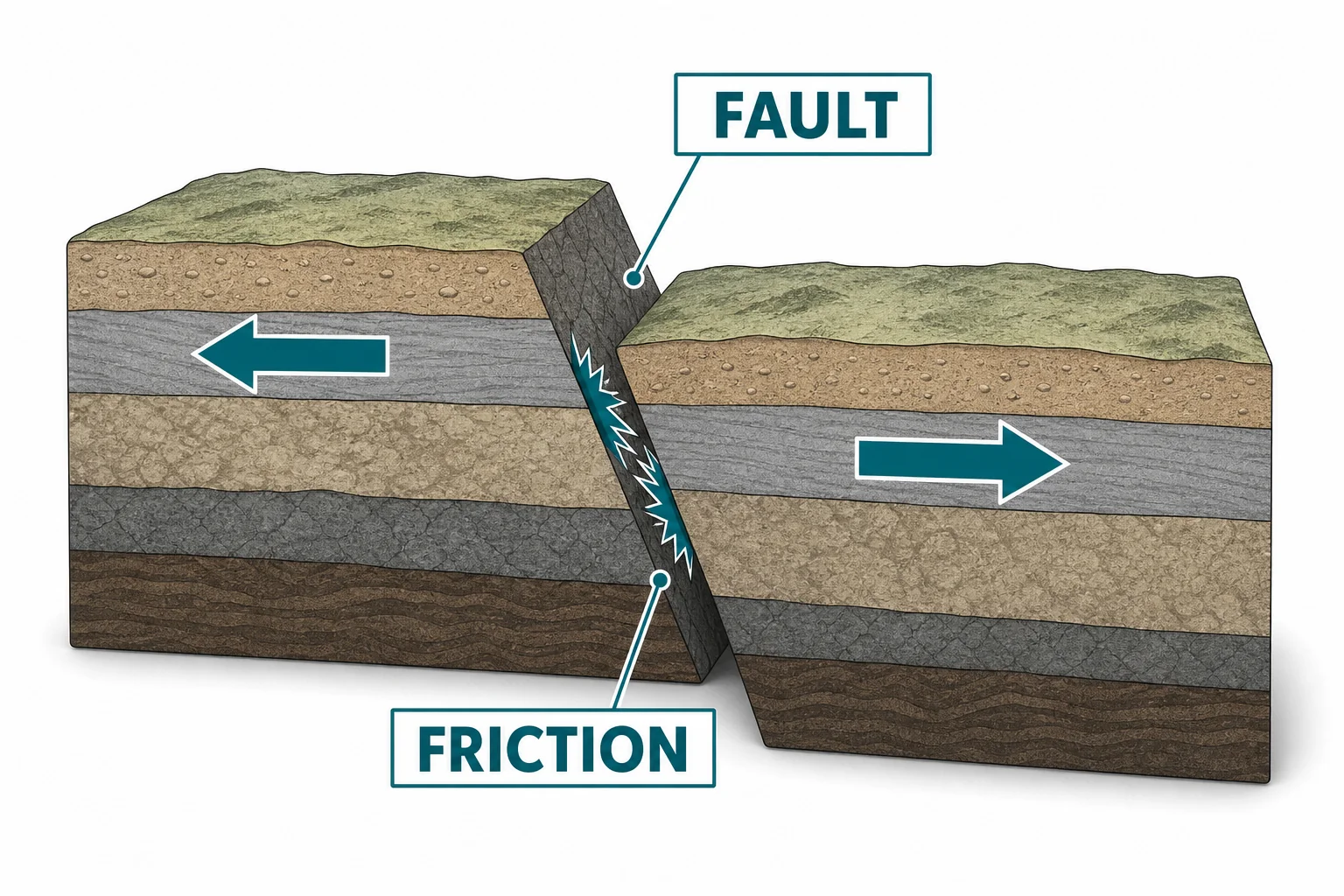
Cross section of a fault with two rock blocks locked together and arrows showing opposite motion
A fault is a break where rock blocks can slip.
A fault is a break in Earth’s crust where blocks of rock can move. Faults can be tiny, or they can stretch for hundreds of kilometers. Many faults are found near plate boundaries, but some are inside plates where old zones of weakness remain. Rocks on each side of a fault do not always move smoothly. Friction can lock them together. Plate motion keeps pushing anyway, so the locked rocks bend slightly. This bending stores energy, like a flexed ruler stores energy before it snaps back. The rock may stay locked for a long time. Then one part of the fault slips. That slip can pull nearby parts of the fault along with it. The earthquake begins at the first slip point underground. Shaking then spreads through the crust as waves.

A fault can stay stuck while stress keeps building.

Stress builds before the slip
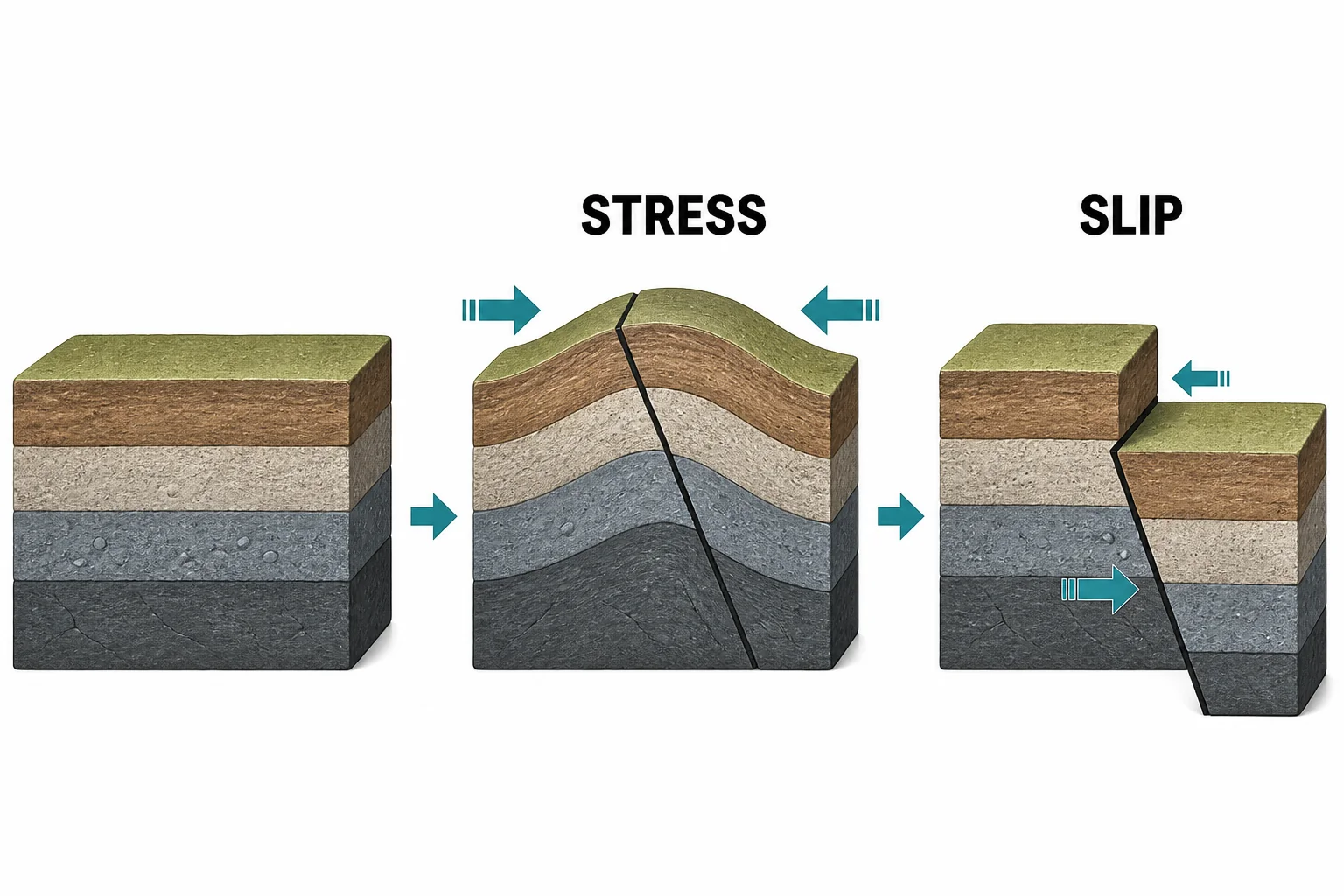
Three-panel diagram showing rock layers before stress, bending under stress, and sudden slip during an earthquake
Stress stores energy until rock slips.
Stress is a push, pull, or twist inside rock. Plate motion creates stress because plates keep moving even when a fault is stuck. Rock is strong, but it is not perfectly rigid. Deep underground, rock can bend a little without breaking. This bending is called elastic deformation. The longer a fault stays locked, the more energy can be stored in the surrounding rock. The pattern is similar to slowly bending a stick. The stick may look stable until it suddenly cracks. In an earthquake, the rock slips and springs toward a less bent shape. The stored energy does not disappear. It travels away as seismic waves. Larger earthquakes usually involve more slip, a bigger fault area, or both. Scientists study stress and past earthquakes to estimate where strong shaking is possible.

The shaking starts when stored energy is released suddenly.

Seismic waves spread outward
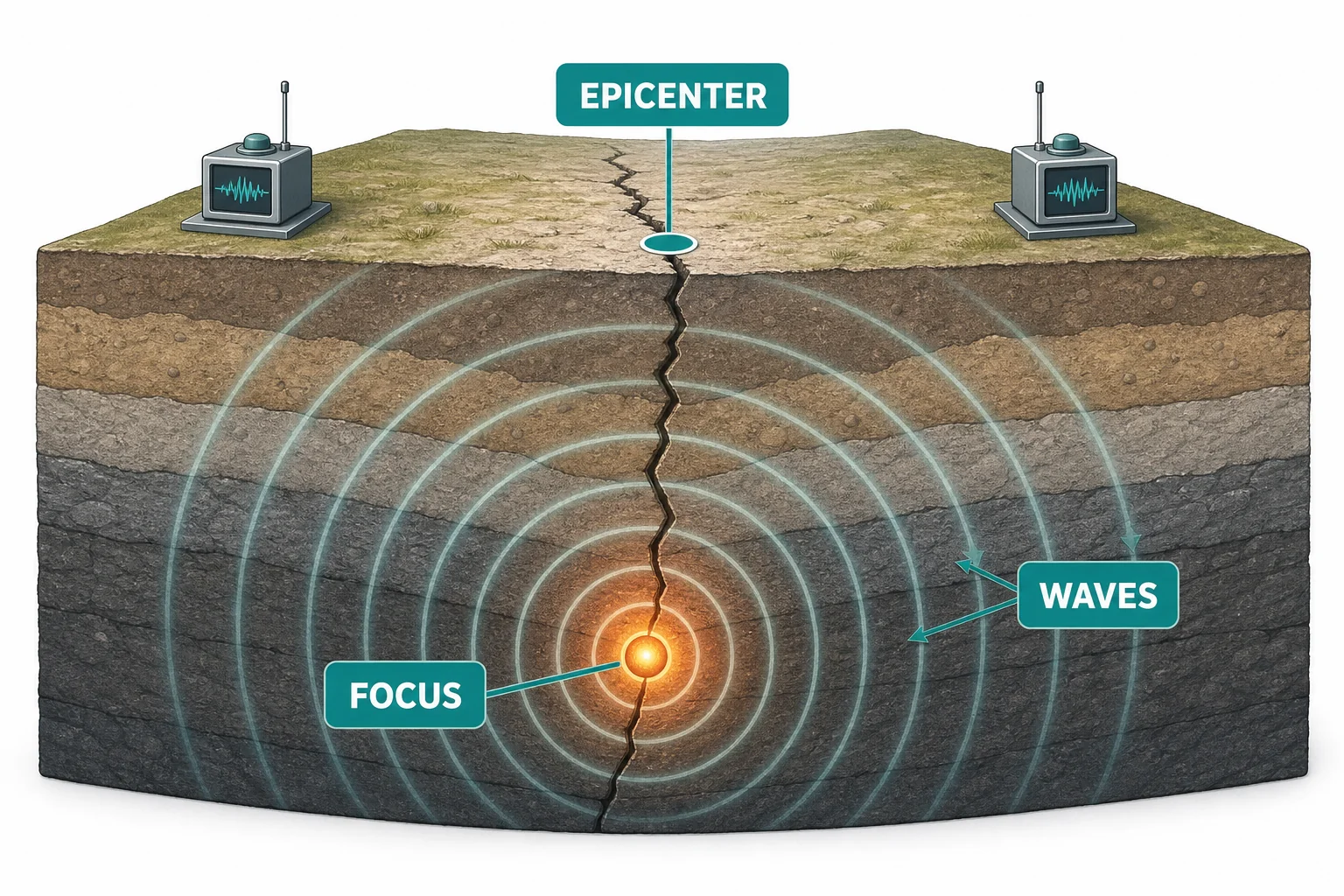
Cutaway diagram showing seismic waves spreading from an underground focus to the surface epicenter and seismometer stations
Seismic waves carry energy through the ground.
The place where an earthquake starts underground is called the focus. The point on the surface directly above it is called the epicenter. When the fault slips, energy moves away from the focus as seismic waves. Some waves travel through Earth’s interior. Others move along the surface. Different waves move at different speeds and shake the ground in different ways. Fast waves may arrive first with a small jolt. Slower waves can arrive later and cause stronger side-to-side or rolling motion. Seismometers record these waves as wiggly lines. By comparing the arrival times at several stations, scientists can locate the earthquake. The amount of shaking at one place depends on the earthquake size, the distance from the fault, the rock and soil nearby, and the depth of the slip.

Seismometers use wave arrival times to locate earthquakes.

Patterns reveal plate boundaries
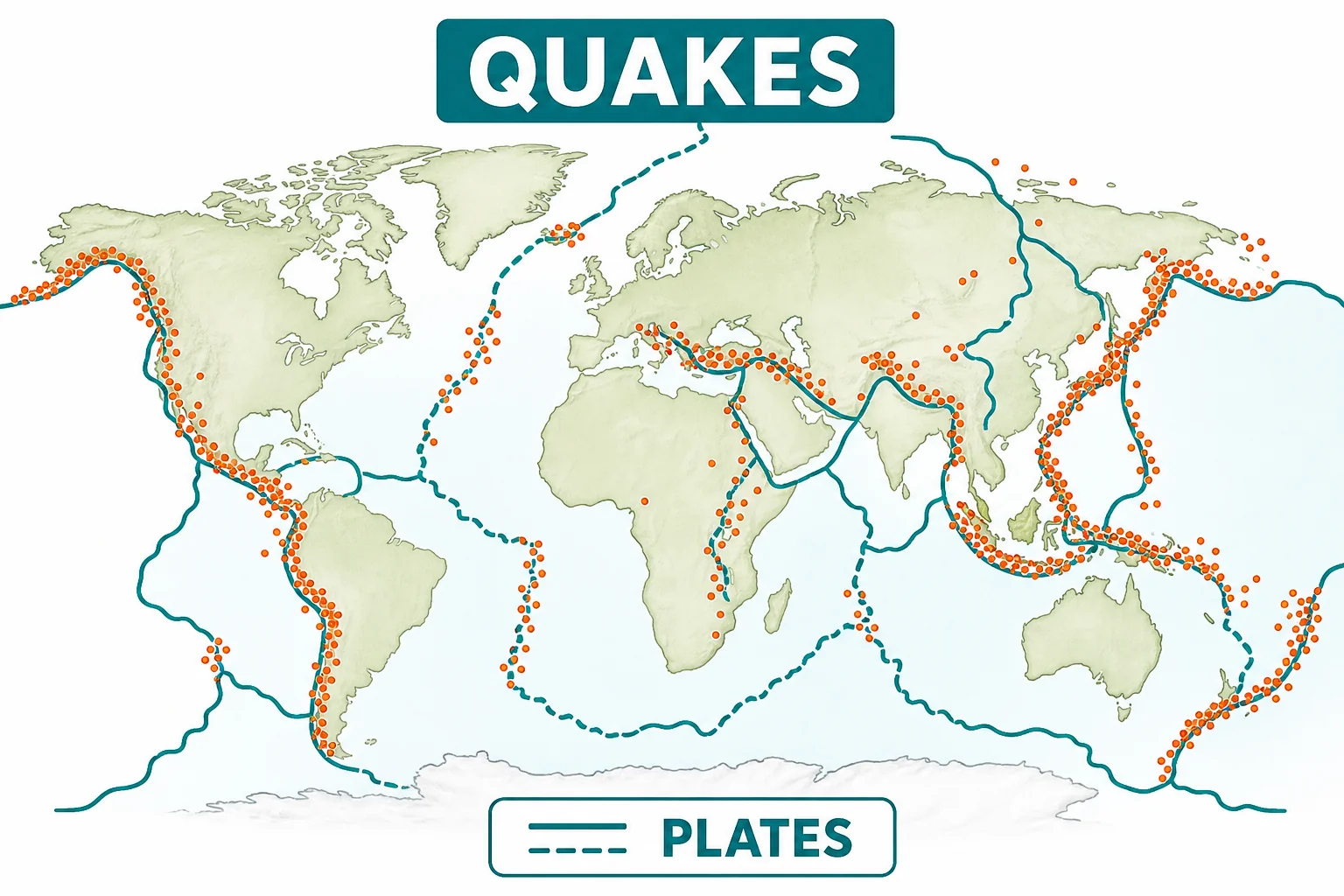
World map showing earthquake dots clustered along plate boundaries, including around the Pacific Ocean
Earthquakes cluster along plate boundaries.
Earthquakes do not happen evenly across the planet. They form long belts that match plate boundaries. Around the Pacific Ocean, many earthquakes occur where plates collide or sink below other plates. This region is often called the Ring of Fire. Along mid-ocean ridges, earthquakes happen where plates move apart and new crust forms. Along transform boundaries, earthquakes happen where plates slide sideways. A map of earthquake epicenters gives strong evidence that plates move and interact. It also helps communities understand local hazards. Scientists cannot predict the exact day and time of most earthquakes. They can identify places where earthquakes are more likely, study how often large events happened in the past, and help engineers plan for shaking. Patterns turn many earthquake records into a map of Earth’s active surface.

Earthquake maps are evidence for plate tectonics.

Vocabulary

Tectonic plate
A large piece of Earth's hard outer layer that moves slowly over deeper, softer rock.
Fault
A break in rock where the blocks on each side can move past each other.
Stress
A force inside rock caused by pushing, pulling, or twisting.
Seismic wave
A wave of energy that travels through Earth after rock slips during an earthquake.
Epicenter
The point on Earth's surface directly above where an earthquake starts underground.

In the Classroom

Fault slip with sandpaper blocks

20 minutes | Grades 6-8

Students pull two sandpaper-covered blocks past each other using rubber bands. They observe how the blocks stick, store energy, and then slip suddenly.

Map the earthquake pattern

35 minutes | Grades 6-8

Students plot recent earthquake locations on a blank world map. They compare the pattern with a plate boundary map and write a claim supported by evidence.

Wave arrival challenge

30 minutes | Grades 7-8

Students use simple arrival-time data from three stations to estimate an earthquake location. The activity connects seismic wave speed to how scientists locate earthquakes.

Key Takeaways

  • Earthquakes happen when locked rocks suddenly slip along a fault.
  • Plate motion builds stress in rocks over long periods of time.
  • The released energy travels through Earth as seismic waves.
  • Earthquakes are most common near tectonic plate boundaries.
  • Scientists use earthquake patterns and seismic waves to study Earth’s moving crust.