Plate Boundary Simulator
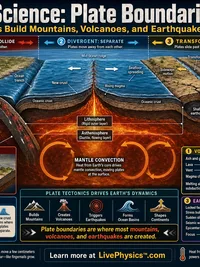
Earth's surface is broken into massive tectonic plates that move a few centimeters each year. Select a boundary type to see how plate interactions create mountains, ocean trenches, volcanic arcs, and earthquake faults.
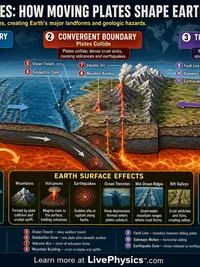
Convergent Boundary
Plates collide
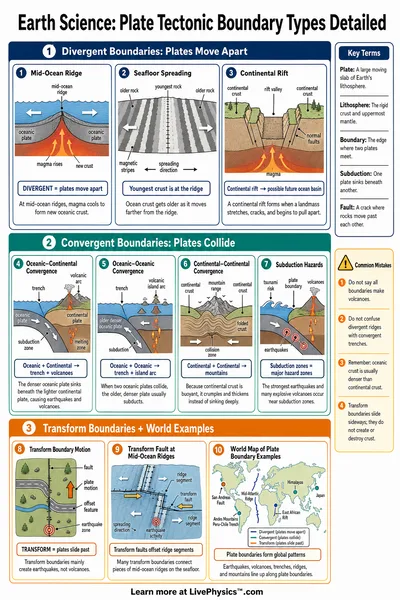
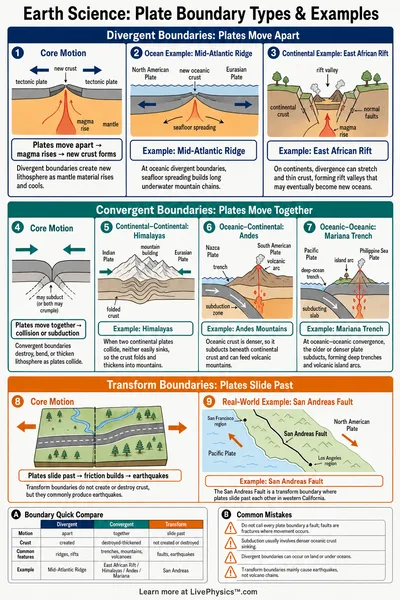
Two tectonic plates move toward each other. The denser plate (usually oceanic) subducts beneath the lighter one, or both continental plates crumple to form mountains.
Geological Features
- Mountain ranges (Himalayas, Andes)
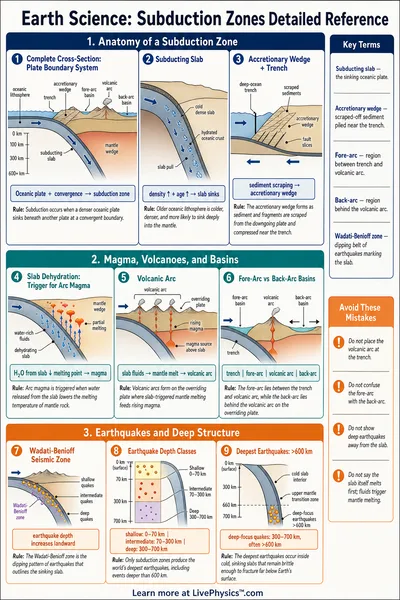
- Subduction zones and deep ocean trenches
- Volcanic arcs and island chains
- Intense earthquakes along the collision zone
- Fold and thrust belts
Real-World Examples
- Himalayas - India-Eurasia continental collision
- Andes - Nazca Plate subducting under South America
- Japan - Pacific Plate subduction, forming island arcs
- Cascadia - Juan de Fuca Plate subducting under North America
Key Facts
- The Himalayas are still rising about 5 mm per year as India continues pushing into Eurasia
- Subducting oceanic crust can descend as deep as 700 km into the mantle before fully melting
- The deepest earthquakes on Earth occur at subduction zones, sometimes exceeding 650 km depth
Reference Guide
Plate Tectonics
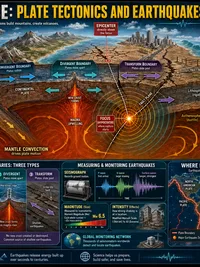
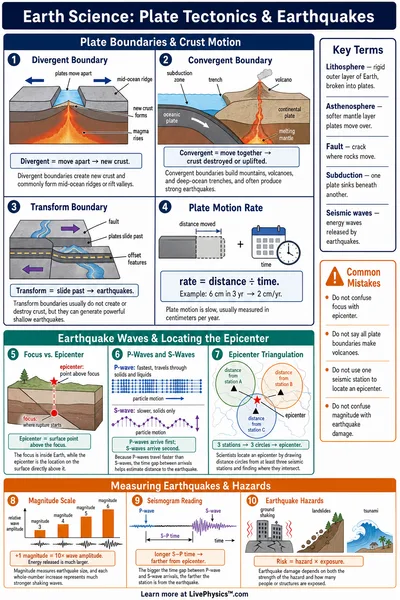
Earth's outer shell, the lithosphere, is divided into roughly 15 major tectonic plates and several smaller ones. These rigid slabs of rock float on the semi-molten asthenosphere below and move continuously due to convection currents in the mantle.
- Plates range in size from the vast Pacific Plate to small ones like the Juan de Fuca Plate
- Average movement is 2 to 10 cm per year, roughly the rate fingernails grow
- The theory of plate tectonics explains the distribution of earthquakes, volcanoes, and mountain belts worldwide
- Continental crust is less dense than oceanic crust, which is why continents stay at the surface
Evidence for Plate Motion
Multiple independent lines of evidence confirm that tectonic plates move and have been moving for billions of years.
- GPS measurements directly track plate movement in real time, confirming rates of 1 to 15 cm per year
- Seafloor spreading creates symmetric magnetic stripes on either side of mid-ocean ridges, recording the history of Earth's magnetic field reversals
- Fossil distribution shows identical species on continents now separated by oceans, evidence they were once joined
- Paleomagnetism in ancient rocks records the direction of the magnetic field when the rock solidified, revealing past plate positions
Geological Hazards
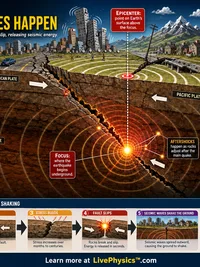
Most major geological hazards occur at or near plate boundaries, where stress concentrates and rock deforms.
- Earthquakes occur at all three boundary types. The largest (magnitude 9 and above) happen at subduction zones where one plate dives beneath another
- Volcanoes form above subduction zones (where melting oceanic crust generates magma) and along divergent boundaries (where decompression melting occurs)
- Tsunamis are triggered when subduction-zone earthquakes suddenly lift or drop the seafloor, displacing massive volumes of water
- The Ring of Fire is a zone around the Pacific Ocean where 75% of Earth's volcanoes and 90% of earthquakes occur, driven by Pacific Plate subduction