Earth History Lab
Determine the ages of rock samples using radiometric dating across four isotope systems. Measure seafloor spreading rates from magnetic reversal patterns at mid-ocean ridges. Collect data, record observations, and export complete lab reports.
Guided ExperimentRadiometric Dating of Rock Samples
Given 5 rock samples with different parent/daughter ratios and different isotope systems, can you calculate each sample's age and arrange them chronologically?
Write your hypothesis in the Lab Report panel, then click Next.
Isotope Composition
Controls
Results
Radioactive Decay Curve
Data Table
(0 rows)| # | Trial | Isotope System | Half-life (yr) | Parent (%) | Daughter (%) | Calculated Age (yr) | Actual Age (yr) | Error (%) |
|---|
Reference Guide
Radiometric Decay Formula
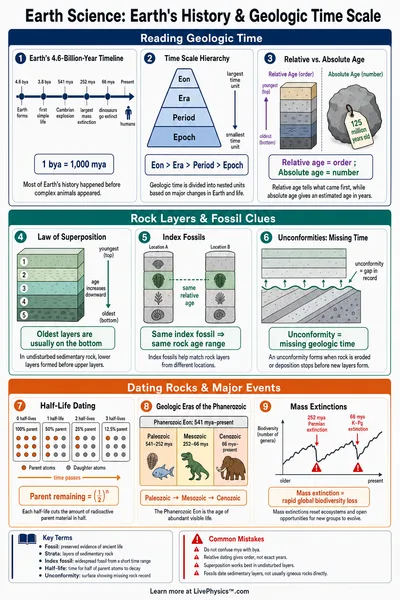
Radioactive parent isotopes decay into stable daughter isotopes at a rate defined by the half-life. The age of a sample is calculated from the ratio of parent to daughter atoms.
Where is the current parent amount, is the original total (parent + daughter), and is the half-life.
Isotope System Selection
Choose an isotope system whose half-life matches the expected age range of your sample.
- ¹⁴C → ¹⁴N (t½ = 5,730 yr) - organic material up to ~50,000 years
- ⁴⁰K → ⁴⁰Ar (t½ = 1.25 Byr) - volcanic rocks, hundreds of millions of years
- ²³⁸U → ²⁰⁶Pb (t½ = 4.47 Byr) - oldest rocks and meteorites
- ⁸⁷Rb → ⁸⁷Sr (t½ = 48.8 Byr) - very ancient igneous and metamorphic rocks
Magnetic Reversals and Spreading
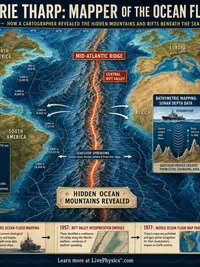
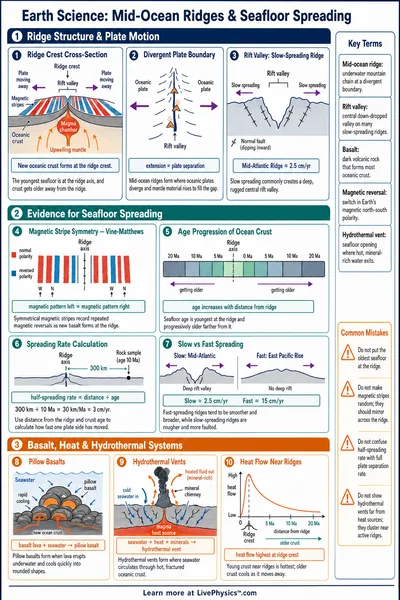
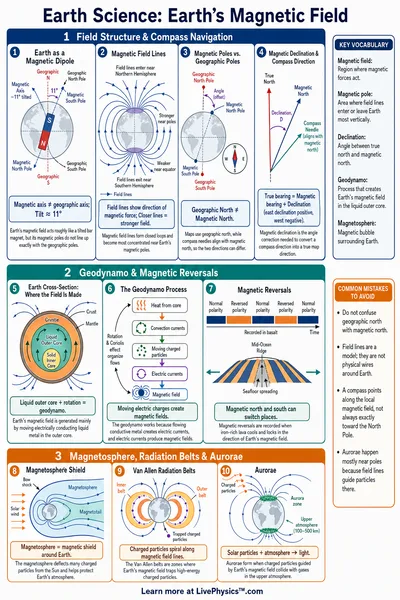
Earth's magnetic field periodically reverses polarity. New oceanic crust at mid-ocean ridges records these reversals as symmetric magnetic stripes.
By measuring the distance from the ridge to a reversal of known age, you can calculate how fast the plates are moving apart. Typical rates range from 2 to 16 cm/year.
Geologic Time Scale
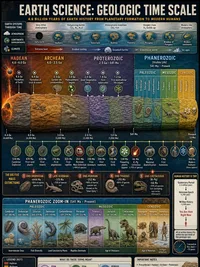
Radiometric dating provides the absolute ages that anchor the geologic time scale. Key boundaries include the following.
- Earth's formation - 4.54 billion years ago (meteorite dating with U-Pb)
- Oldest rocks - 4.03 Byr (Acasta Gneiss, Rb-Sr and U-Pb)
- Cambrian Explosion - 541 Myr (K-Ar dating of volcanic ash layers)
- Dinosaur extinction - 66 Myr (K-Ar dating of impact layer)
- Last Ice Age peak - 20,000 yr (¹⁴C dating of organic material)