Understanding Volcano Eruption Lab
Magma begins as rock that has melted beneath the surface, but it changes as it rises. Pressure falls during ascent, so gases that were dissolved in the melt can form bubbles, much like gas escaping from a drink when opened.
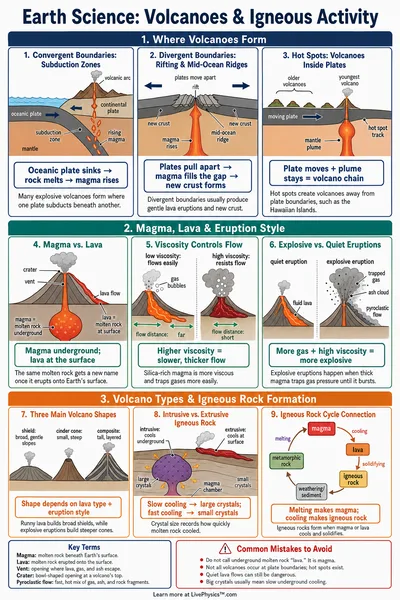
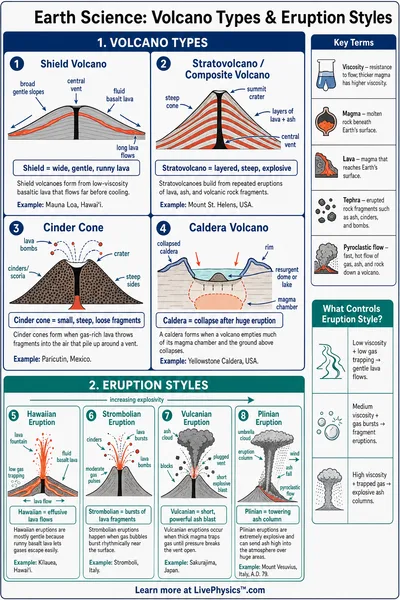
Whether bubbles escape or remain trapped depends strongly on the magma's resistance to flow. Thick magma slows bubble movement, causing pressure to build inside the volcanic conduit, which is the pipe-like route leading toward the surface.
Silica is a major reason some magmas are thick. Silica-rich melt contains linked structures that make the liquid harder to move, while silica-poor melt usually flows more easily at similar temperatures.
Temperature matters too. Hotter magma is generally less viscous because its particles move more freely, whereas cooler magma stiffens and can seal pathways that might otherwise release gas gradually.
Gas content is not just a single number in nature. Water vapor, carbon dioxide, and sulfur gases leave magma at different pressures, so bubble growth can continue throughout an eruption.
A rapid release of gas can fragment magma into ash, pumice, and larger rock pieces. These fragments are carried upward by expanding gas, creating an eruption column rather than a simple stream of lava.
The VEI describes the size of explosive eruptions using material erupted and column height. It is useful for comparing events, but it does not fully describe every danger, especially long lava flows or toxic gases.
Column height depends on more than the initial blast. Hot ash and gas can rise because they are less dense than surrounding air, though wind may bend the column and spread ash far from the volcano.
When an eruption column collapses, it can produce pyroclastic flows. These fast, ground-hugging mixtures of hot gas, ash, and rock are among the most dangerous volcanic hazards because they can travel across valleys quickly.
Ash creates risks even after an eruption ends. Rain can mix with loose ash to form lahars, which are muddy volcanic flows that follow river channels and may reach communities far downstream.
Use the trial table like a scientist rather than changing every setting at once. Hold gas content steady while changing viscosity, then hold viscosity steady while changing gas content, so patterns have a clearer cause.
Real volcanoes rarely keep one magma composition or one gas level for long. Their behavior can change during the same eruption, so the lab model shows important relationships but cannot predict an exact future event.