Plate Tectonics Explorer
Explore divergent, convergent, and transform plate boundaries with labeled cross-sections. Trace the rock cycle between igneous, sedimentary, and metamorphic rocks. Calculate radiometric ages from isotope ratios, and examine Earth's interior layers with seismic wave velocity profiles.
Cross-Section View
Controls
Results
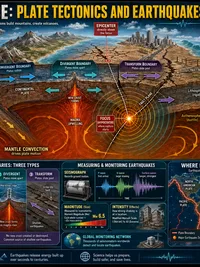
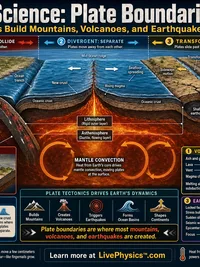
Divergent Boundary
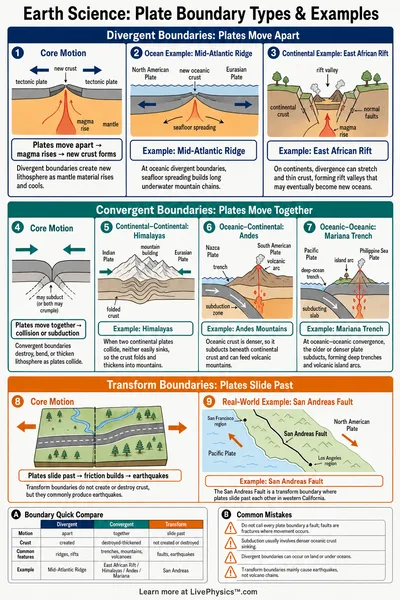
Plates move apart. Magma rises from the asthenosphere to fill the gap, creating new oceanic crust.
Reference Guide
Plate Boundary Types
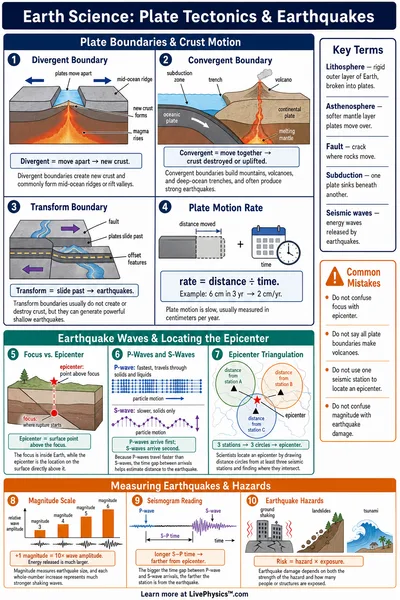
Earth's lithosphere is divided into tectonic plates that move on the asthenosphere. Interactions at plate boundaries produce earthquakes, volcanoes, and mountain building.
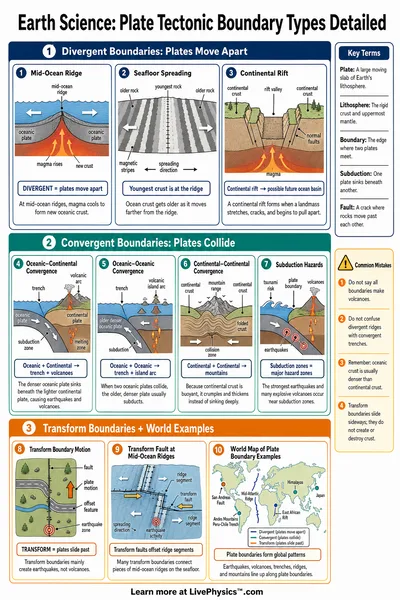
- Divergent - plates move apart, creating new crust at mid-ocean ridges
- Convergent - plates collide, causing subduction or mountain building
- Transform - plates slide past each other along strike-slip faults
Plate velocities range from 1 to 10 cm/year, roughly the rate your fingernails grow.
Radiometric Dating Formula
Radioactive isotopes decay at a constant rate described by their half-life. Measuring the ratio of parent to daughter isotopes gives the age of a rock.
Where is the half-life, is the current amount of parent isotope, and is the original amount (parent + daughter).
Carbon-14 (t½ = 5,730 years) dates recent organic material. Uranium-238 (t½ = 4.47 billion years) dates ancient rocks and meteorites.
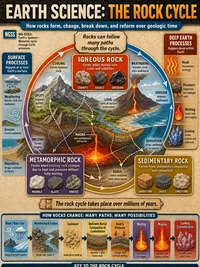
Rock Cycle Processes
The rock cycle describes how rocks transform from one type to another through geological processes over millions of years.
- Igneous - formed when magma/lava cools (granite, basalt)
- Sedimentary - formed by compaction of sediments (sandstone, limestone)
- Metamorphic - transformed by heat and pressure (marble, slate)
Any rock type can become any other through the right sequence of processes. Tectonic forces drive the cycle by causing uplift, burial, and melting.
Earth Layer Properties
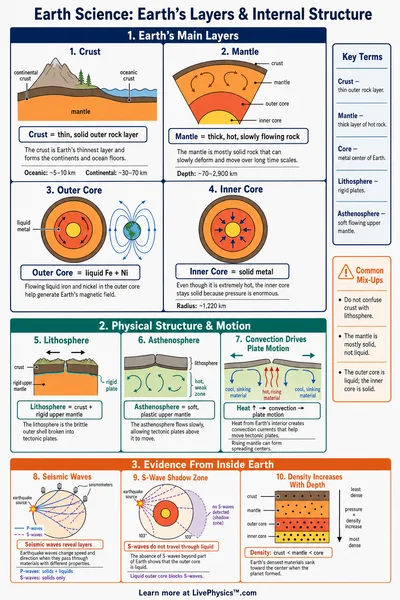
Earth has a layered structure determined by density, composition, and physical state. We know this primarily from seismic wave analysis.
- Crust - 5-70 km thick, rocky silicates
- Mantle - to 2,890 km, slow convective flow drives plate tectonics
- Outer Core - 2,890-5,150 km, liquid iron-nickel (S-waves blocked)
- Inner Core - 5,150-6,371 km, solid iron-nickel under extreme pressure
S-waves (shear waves) cannot travel through liquids. Their absence in the outer core is how we know it is liquid, which generates Earth's magnetic field.