Sign in to save

Bookmark this page so you can find it later.

Sign in to save

Bookmark this page so you can find it later.

Physics middle-school May 24, 2026

How Does a Microwave Oven Heat Food?

Invisible waves make molecules move
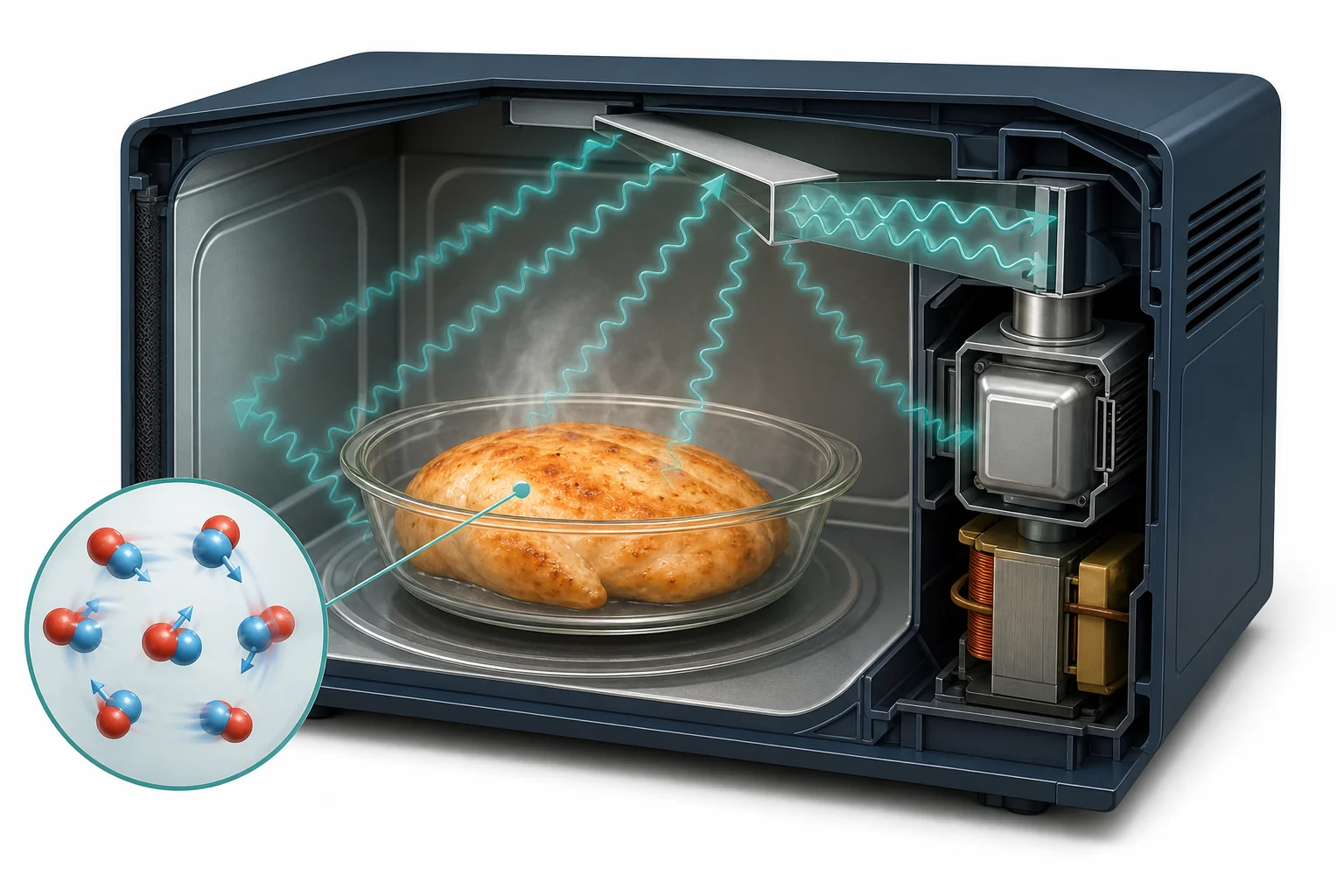
Cutaway view of a microwave oven showing electromagnetic waves inside the cooking chamber and food warming on a glass plate

A microwave oven sends invisible waves into food. These waves make some tiny parts of the food, especially water, move back and forth very fast. That motion spreads as heat through the food.

Big Idea. NGSS MS-PS4-2 connects microwave cooking to how waves are reflected, absorbed, or transmitted by different materials.

A microwave oven can warm soup in minutes, but the food is not being heated by a flame or a glowing burner. The oven uses a kind of electromagnetic wave. These waves are related to light, radio waves, and X-rays, but they have a different wavelength and energy. Inside the oven, the waves bounce around the metal walls and pass into the food. Some molecules in the food respond to the changing electric field of the wave. Water is especially important because each water molecule has a slightly positive side and a slightly negative side. As the field changes direction, water molecules try to turn with it. Their motion is transferred to nearby molecules, and the food gets warmer. This is a good middle-school example of wave energy and matter, the same idea behind models of reflection and absorption in LivePhysics classroom explorations.

Microwaves are waves
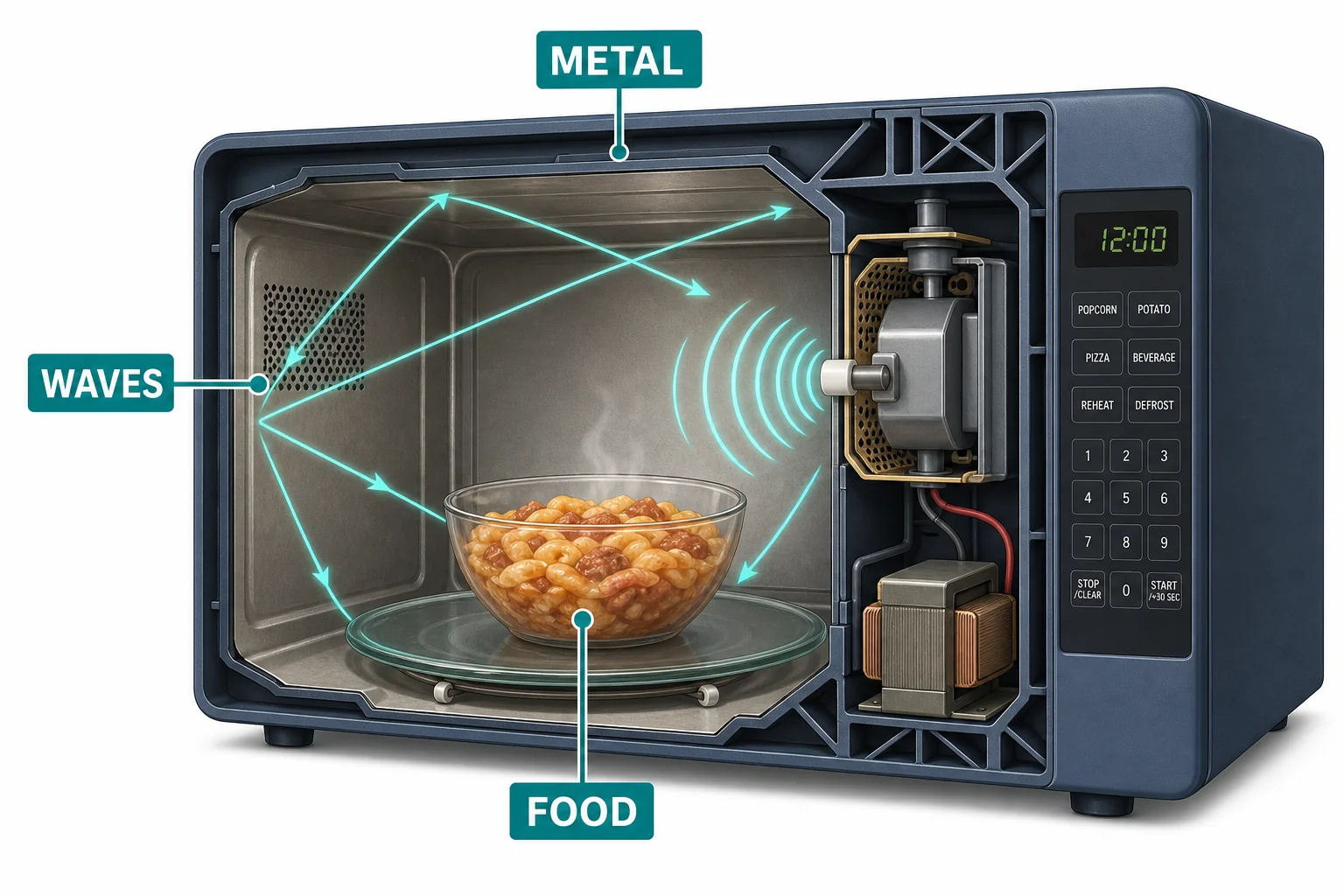
Diagram of a microwave oven cutaway showing electromagnetic waves reflecting from metal walls and entering food
Microwaves reflect from metal and can enter food
Microwaves are a type of electromagnetic radiation. That means they are waves made from changing electric and magnetic fields. They do not need air or another material to travel. In a microwave oven, a device called a magnetron makes waves with a common frequency near 2.45 gigahertz. That means the electric field changes direction billions of times each second. The waves move into the cooking chamber and reflect from the metal walls. The metal door screen also reflects most of the waves, while its tiny holes let visible light through so you can see the food. Materials inside the oven matter. Metal reflects microwaves. Glass and many plastics let many of them pass through. Food absorbs some of the wave energy, especially if it contains water, fats, or salts.

A microwave oven is a controlled box for electromagnetic waves.

Water molecules twist
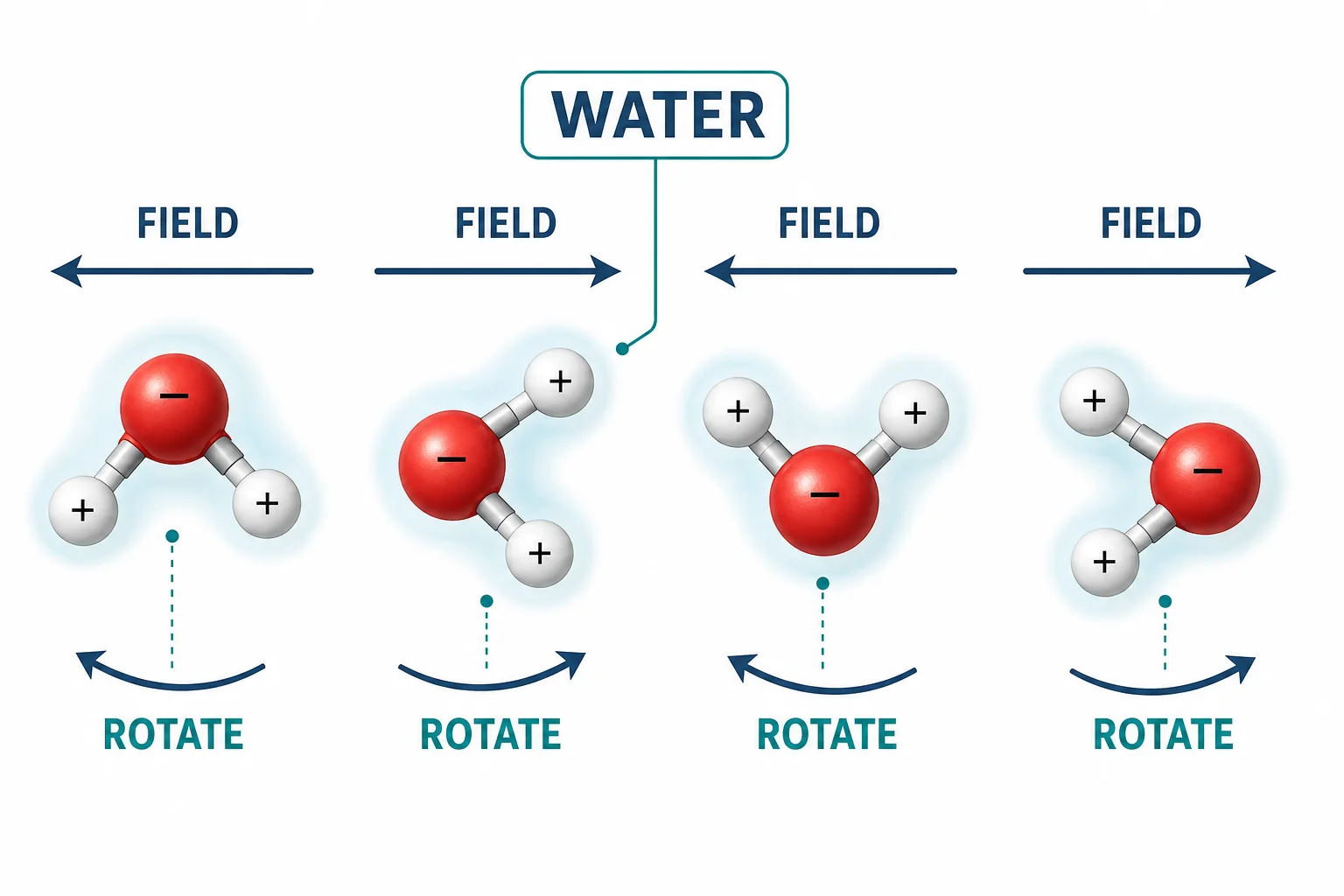
Close-up model of water molecules rotating in response to a changing electric field from a microwave
Water molecules respond to the changing field
Water molecules are not evenly charged from end to end. The oxygen side is slightly negative, and the hydrogen side is slightly positive. This makes a water molecule act like a tiny electric dipole. When a microwave passes through food, its electric field changes direction again and again. Water molecules try to line up with the field, so they rotate back and forth. They do not spin freely like tiny wheels in empty space. They are crowded by other molecules in the food. As they twist and jostle, they bump nearby molecules. The energy of organized wave motion becomes random molecular motion. We measure that random motion as temperature. This process is called dielectric heating. It is not a special heat ray. It is wave energy being absorbed by matter and changed into thermal energy.

Heating starts when wave energy becomes molecular motion.

Not all materials heat the same
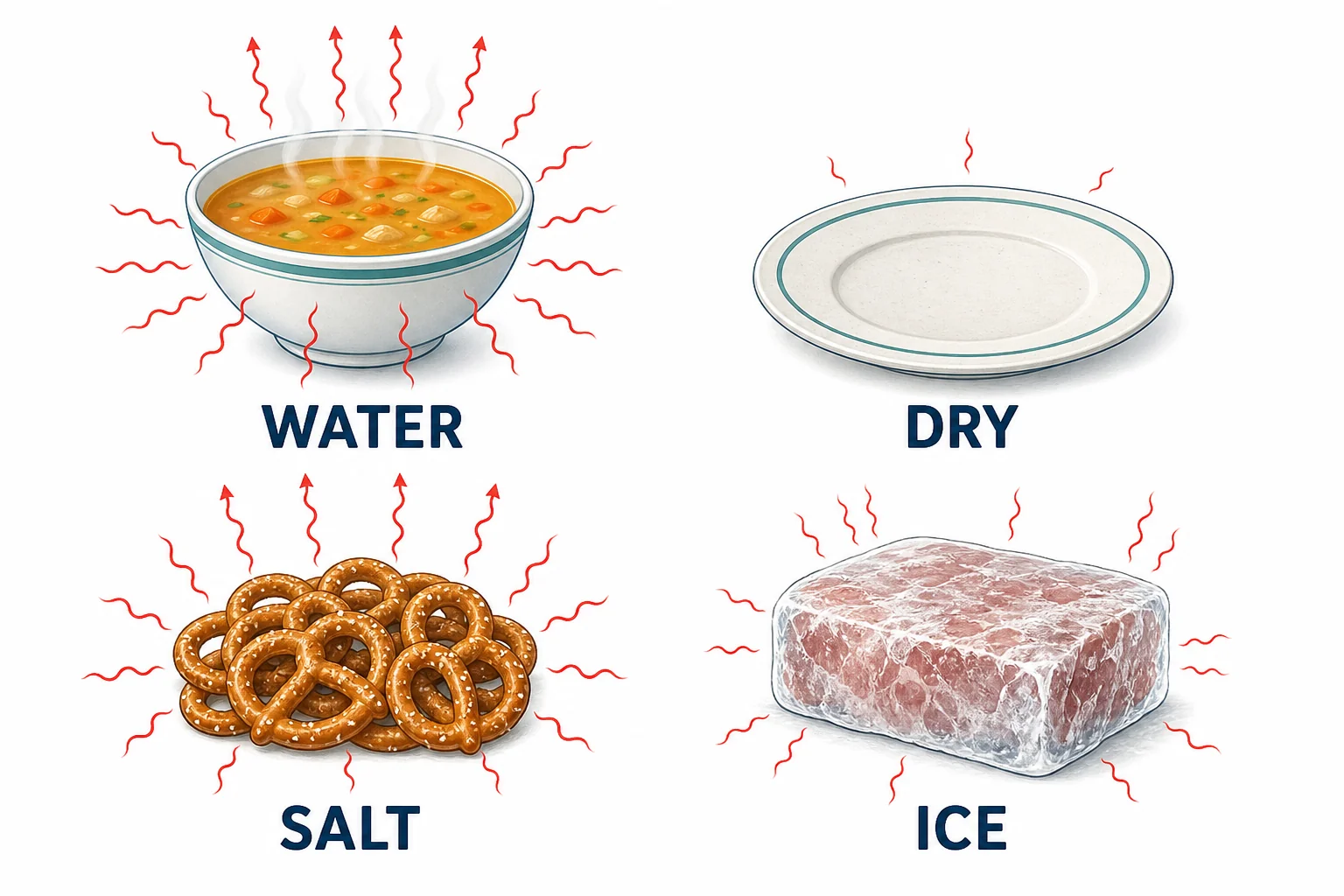
Comparison of microwave absorption in water-rich food, dry plate, salty soup, and frozen food
Different materials absorb different amounts of energy
A dry ceramic plate may stay cooler than the leftovers on it because it absorbs less microwave energy. A glass cup may also stay fairly cool, unless heat flows into it from the food or drink. Water-rich foods usually heat well. Foods with salt can heat strongly because charged particles move in response to the changing field. Fats also absorb microwave energy, but not exactly the same way as water. Ice behaves differently from liquid water because its molecules are locked into a crystal structure. That is one reason frozen food can heat unevenly. Parts that melt first can absorb more energy, while still-frozen parts absorb less. The oven does not know what is inside the food. It only sends waves. The food’s material properties decide how much energy is absorbed in each place.

Microwaves heat food according to what the food is made of.

Hot spots and cold spots
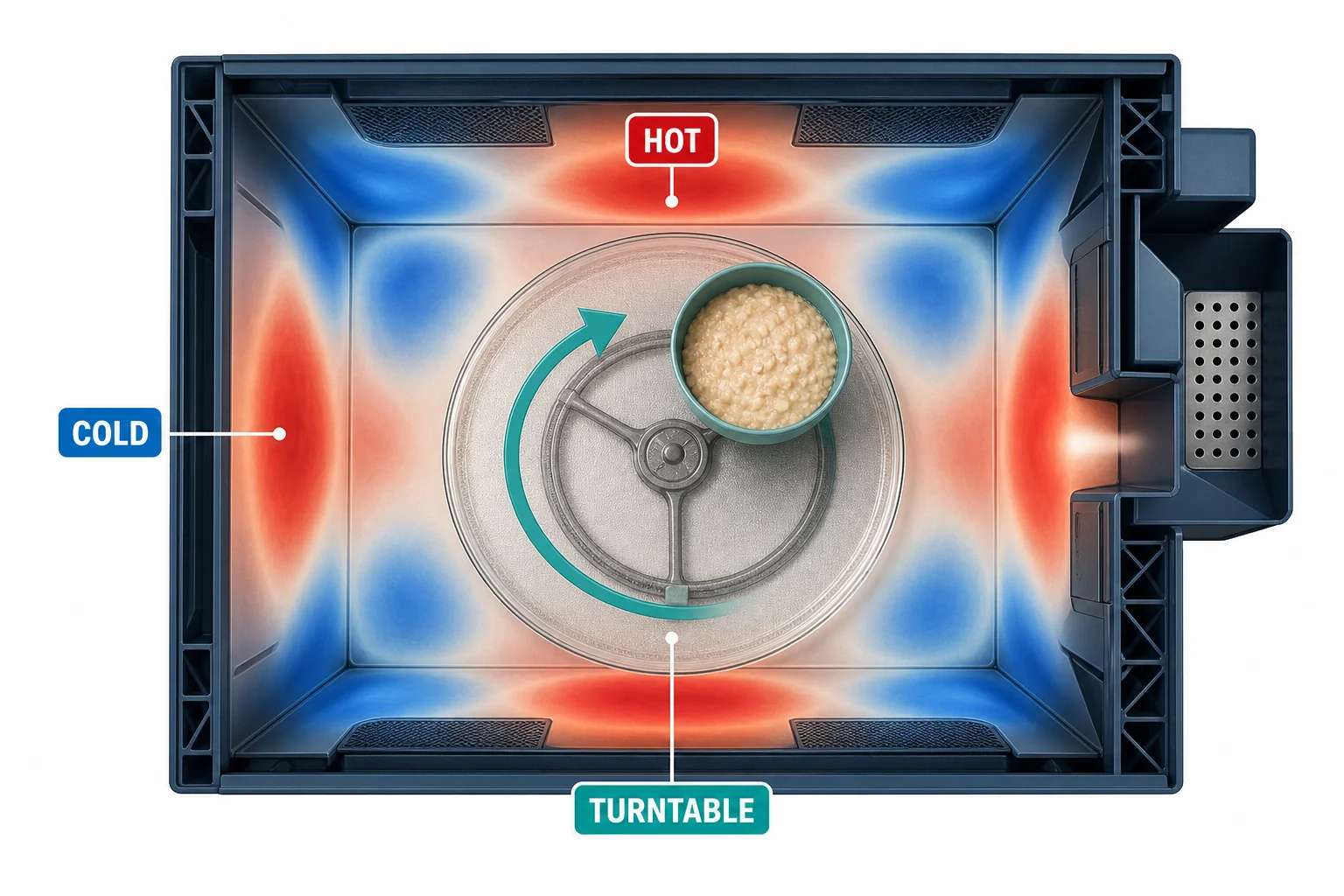
Top view of a microwave turntable moving food through hot and cold spots created by overlapping waves
Turntables move food through the wave pattern
Microwave ovens often heat unevenly. The waves reflect from the metal walls and overlap with one another. In some places, the electric fields add together and more energy is available. In other places, they partly cancel and less energy is available. This creates a pattern of hot spots and cold spots inside the oven. A turntable helps by moving the food through different parts of the wave pattern. Stirring and resting also help. When food sits for a minute after cooking, heat moves from warmer regions to cooler regions by conduction. That is why cooking directions often say to stir and let food stand. Uneven heating is not a sign that the microwave is broken. It is a normal result of waves interacting inside a small metal chamber.

Moving, stirring, and resting make heating more even.

Energy changes form
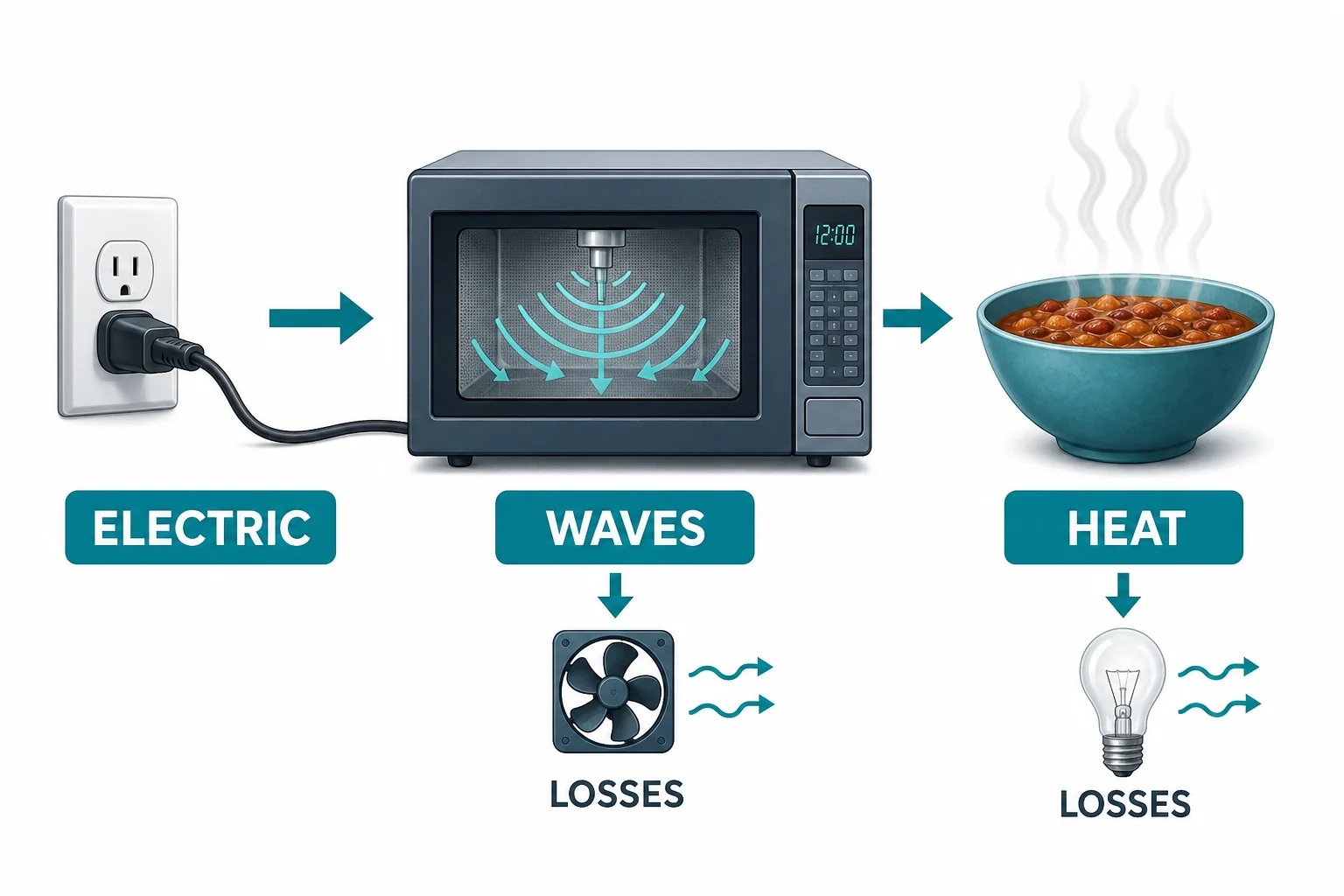
Energy flow diagram showing electrical energy becoming microwave energy and then thermal energy in food
Energy is transferred and transformed
A microwave oven is an energy transfer system. Electrical energy from the outlet powers the magnetron and other parts of the oven. The magnetron changes some of that electrical energy into electromagnetic wave energy. The waves move through the cooking chamber and enter the food. In the food, some wave energy becomes thermal energy through molecular motion. Not all the input energy becomes heat in the food. Some energy warms oven parts, runs the fan, lights the bulb, or is lost in other ways. The important physics idea is that energy is not created inside the food. It is transferred and transformed. A microwave oven gives students a real example of waves carrying energy and matter absorbing that energy.

Microwave cooking is wave energy turning into thermal energy.

Vocabulary

Microwave
An electromagnetic wave with a wavelength longer than visible light and shorter than many radio waves.
Electromagnetic radiation
Energy that travels as changing electric and magnetic fields.
Dipole
A molecule or object with a positive side and a negative side.
Dielectric heating
Heating that happens when a changing electric field makes molecules or charges move inside a material.
Conduction
Heat transfer through direct contact between warmer and cooler matter.

In the Classroom

Map heating with marshmallows

20 minutes | Grades 6-8

Remove the turntable only if the oven design allows safe operation without it, and follow all school safety rules. Place marshmallows on a microwave-safe plate and heat briefly to see where they soften first. Students sketch the pattern and connect it to hot spots and cold spots.

Compare water and dry materials

25 minutes | Grades 6-8

Students predict which microwave-safe samples will warm most, such as a small cup of water and an empty ceramic plate. The teacher heats samples briefly and measures temperature changes safely. Students use evidence to explain absorption by different materials.

Energy transfer storyboard

15 minutes | Grades 6-8

Students draw a four-step storyboard from wall outlet to waves to moving molecules to warm food. Each panel must show where energy is transferred or transformed. This supports NGSS work on waves and energy.

Key Takeaways

  • Microwave ovens use electromagnetic waves to transfer energy into food.
  • Water molecules respond strongly because they have a positive side and a negative side.
  • Molecular motion spreads through food and raises its temperature.
  • Uneven heating happens because waves overlap and create hot and cold spots.
  • Turntables, stirring, and resting help heat food more evenly.