Run a Business, Profit and Loss Lab
Run a simple business like a lemonade stand or a bake sale. You pick the price and how many items to make. The lab shows how many you sell, the money you take in, what it costs you, and your profit. Raise the price too far and customers walk away. Find the price that earns the most profit and the number of sales you need to break even.
Pick a business to run
Fixed cost (paid once per day)
$10.00
Cost to make each cup
$0.50
cups you decide to make
30
Set your price and how many to make
When you raise the price, fewer customers buy. When you lower it, more customers buy. Try to find the price that earns the most profit.
Today's Results
20
cups sold
$40.00
Revenue
$25.00
Total cost
$15.00
Profit
Money in vs. money out
You made a profit of $15.00 today. Revenue $40.00 minus total cost $25.00.
You made 10 extra cups that did not sell. You still paid to make them, so they added to your cost.
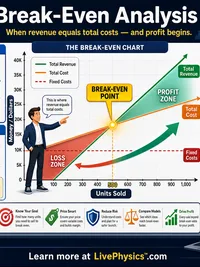
Break-even point. You need to sell 7 cups to cover your $10.00 fixed cost. You made 30 and sold 20.
Controls
Running the Lemonade Stand
Pick a price and a number to make, look at your profit, then record the day. Run a few days at different prices to find the best one.
Data Table
(0 rows)| # | Day | Price | Made | Sold | Revenue | Total Cost | Profit | Break-Even (units) |
|---|
Reference Guide
Revenue
Revenue is all the money a business takes in from selling its products. It is sometimes called sales or income.
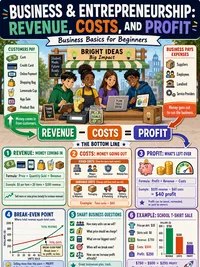
You find revenue by multiplying the price of one item by the number of items sold. Revenue equals price times units sold.
For example, if you sell 20 cups of lemonade for 2 dollars each, your revenue is 20 times 2, which is 40 dollars.
Revenue is not the same as profit. Revenue is only the money coming in. You still have to subtract your costs to find out how much you actually keep.
Costs, Fixed and Variable
Costs are the money a business spends. There are two main kinds.
- Fixed cost. Money you pay once no matter how many items you make, like the cost of a stand, a booth fee, or a sign.
- Variable cost. Money you pay for each item you make, like the lemons, sugar, and cup for one drink.
Total cost is the fixed cost plus the variable cost of every item you make. If your stand costs 10 dollars and each cup costs 50 cents to make, making 30 cups costs 10 plus 30 times 0.50, which is 25 dollars.
You pay the variable cost for every item you make, even the ones that do not sell. Making too many is wasteful.
Profit and Loss
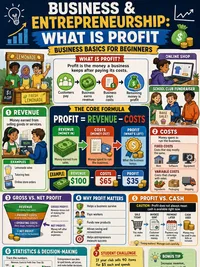
Profit is the money a business keeps after paying all its costs. You find it by subtracting total cost from revenue. Profit equals revenue minus total cost.
If revenue is 40 dollars and total cost is 25 dollars, the profit is 40 minus 25, which is 15 dollars.
When total cost is larger than revenue, the answer is a negative number. That is called a loss. The business spent more than it earned.
Raising the price does not always raise profit. A higher price earns more on each item but scares away customers, so fewer sell. The best price is usually somewhere in the middle.
The Break-Even Point
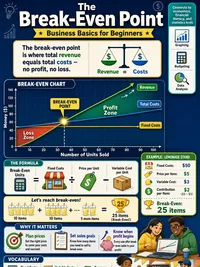
The break-even point is the number of items you must sell so that revenue exactly covers total cost. At break-even, profit is zero. You have not lost money, and you have not made any yet.
Each item earns a little extra above what it costs to make. That extra is the margin, found by subtracting the variable cost from the price. You need enough sales for the total margin to cover the fixed cost.
Break-even units equals fixed cost divided by the margin per item. With a 10 dollar fixed cost and a 1.50 dollar margin, you break even at 10 divided by 1.50, which is about 7 items.
If the price is not higher than the variable cost, every item loses money and you can never break even. The first step is always to set a price above the cost to make each item.