Ecological Succession Simulator
Watch a community rebuild itself after a disturbance. Pioneers colonize bare ground, grasses and shrubs build soil, and trees eventually take over. Choose primary or secondary succession, set the moisture, temperature, and disturbance regime, then run the simulation to see whether the site reaches a climax forest or stalls at grassland or shrubland.
Guided ExperimentHow does fire frequency change the climax community?
If a temperate site burns over and over, will it still reach a climax forest, or will repeated fire hold it back at an earlier stage? Think about how each fire resets the soil and the community.
Write your hypothesis in the Lab Report panel, then click Next.
Community Composition Over Time
Controls
Bare rock or glacial till, no soil to start.
Current Readings
Data Table
(0 rows)| # | Disturbance | Moisture | Temp | Final year(yr) | Dominant group | Richness | Shannon | Outcome |
|---|
Reference Guide
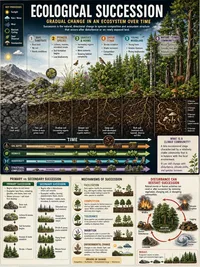
Primary vs Secondary Succession
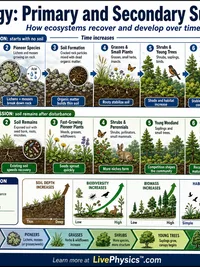
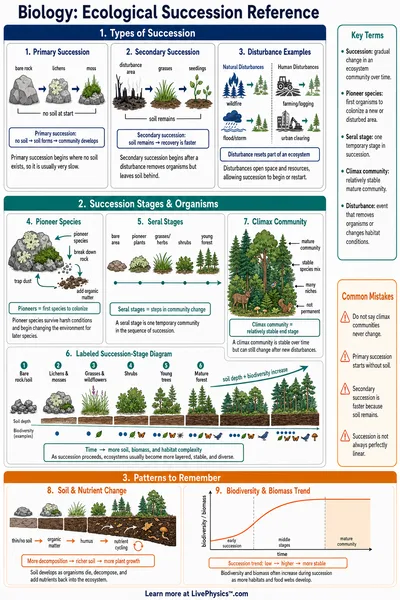
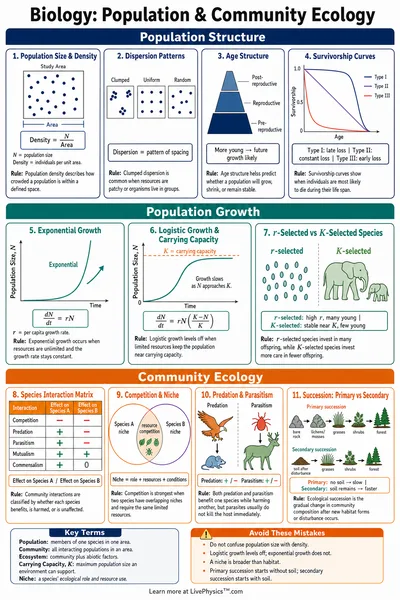
Primary succession begins where there is no soil at all, such as a fresh lava flow or land newly exposed by a retreating glacier. Pioneers like lichens and mosses must build soil from bare rock before anything else can grow, so the process is slow.
Secondary succession begins after a disturbance that leaves the soil and a seed bank intact, such as a fire, a flood, or an abandoned field. Because the soil is already there, recovery is much faster than primary succession.
Seral Stages and Pioneer Species
Succession moves through a series of stages called seral stages. Each stage changes the site in ways that make it suitable for the next group. Lichens and mosses break down rock and trap dust. Grasses and forbs add organic matter when they die.
Nitrogen fixing shrubs, such as alders and certain legumes, host bacteria that pull nitrogen from the air and enrich the soil. This nitrogen lets larger plants grow, so the shrubs prepare the ground for the trees that follow them.
Climax Communities
If a site is left undisturbed for long enough, succession reaches a relatively stable endpoint called a climax community. In many temperate regions this is a forest of shade tolerant trees that can grow up under their own canopy.
Fast growing pioneer trees often establish first because they tolerate full sun, but they cannot regenerate in deep shade. Shade tolerant climax trees slowly replace them, which is why the final forest looks different from the first trees to arrive.
Climate and Disturbance as Drivers
Time and soil push succession forward, but climate sets the ceiling. A site that is too dry can never support a forest no matter how long it is left, so it arrests at grassland or shrubland. This is why arid regions stay open even over centuries.
Repeated disturbance also holds a community at an early stage. Grasslands and prairies are often maintained by frequent fire that kills tree seedlings. The intermediate disturbance idea notes that diversity is often highest at moderate disturbance, not at extremes.