Understanding Food Chain & Food Web Builder
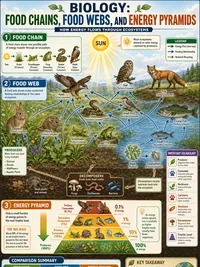
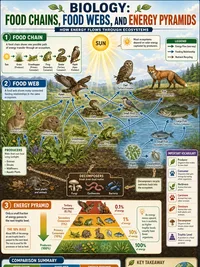
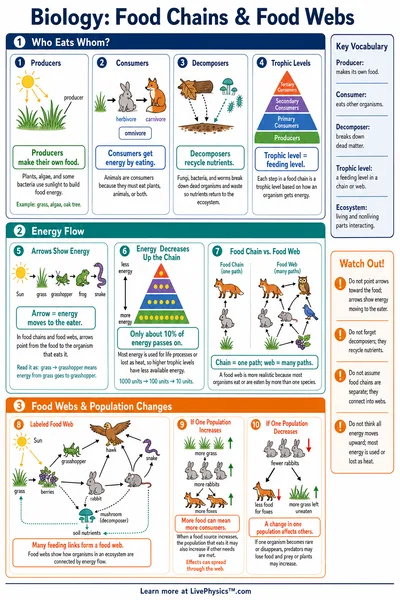
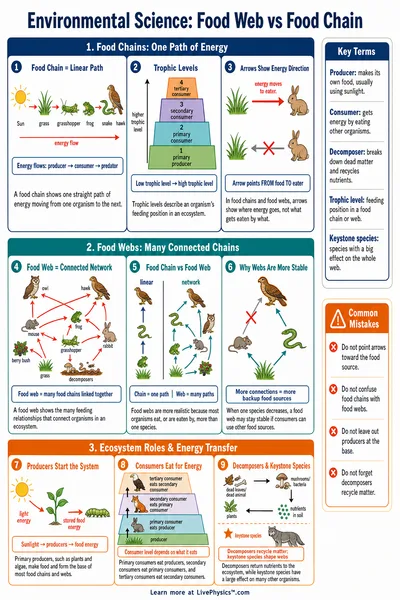
A food chain is a model of feeding relationships, not a list of organisms that happen to live in one place. Each link shows a transfer of stored chemical energy from one organism to another. The arrow points from the food source toward the organism that receives that energy.
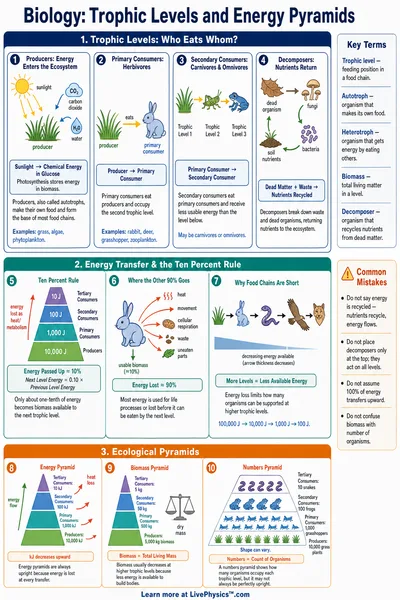
Plants, algae, and some bacteria form the base because they capture energy from sunlight or chemicals. They use that energy to make sugars, which become material for growth and repair. Without this starting supply, most ecosystems could not support animals.
Herbivores eat producers, while carnivores eat other animals. Omnivores can feed at more than one level, depending on what is available. A fox may eat berries in one season and small mammals in another.
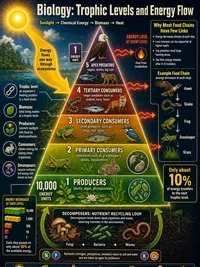
Energy becomes less available at every feeding step. Organisms use much of their food energy for movement, body temperature, and life processes. Only a small portion becomes new body tissue that a predator can eat.
This energy loss helps explain why ecosystems usually contain many plants, fewer plant eaters, and still fewer large predators. A field can support many grasshoppers but only a limited number of hawks. Population size depends on food supply, space, disease, and competition as well.
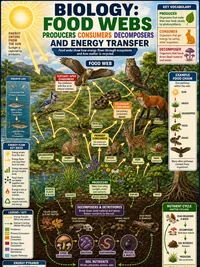
Real habitats are rarely neat single chains. A bird may eat seeds, insects, and fruit, while several predators may hunt that bird. A food web shows these overlapping pathways and gives a more realistic picture of an ecosystem.
Connections in a web can make a system more stable when one food source becomes scarce. An animal with several prey choices may survive a seasonal change more easily. However, strong dependence on one species can make a population vulnerable.
Removing a species can cause effects that spread through the web. If a predator disappears, some prey populations may rise and consume more plants. The result can change shelter, soil conditions, and the survival of species that were not directly connected to the predator.
Decomposers work on dead organisms and waste from every feeding level. Fungi, bacteria, and many small animals break complex materials into simpler substances. Those nutrients return to soil or water, where producers can use them again.
Energy and matter behave differently in ecosystems. Energy enters, moves through feeding relationships, and eventually leaves as heat. Matter such as carbon, nitrogen, and water is reused through natural cycles.
When building a model, check each arrow by saying the energy comes from the organism at its tail. Do not place a predator before its prey just because the predator seems more powerful. Use evidence about actual diets, since names like carnivore do not describe every meal an organism eats.
Students meet food web ideas in gardens, farms, ponds, forests, and even compost bins. Pesticides can reduce insect populations, which may affect birds that feed on insects. Protecting habitats often means protecting many relationships rather than focusing on one familiar animal.