Understanding Electric Potential 3D Surface Lab
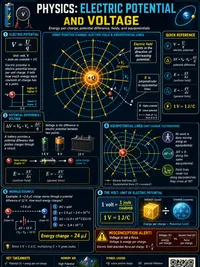
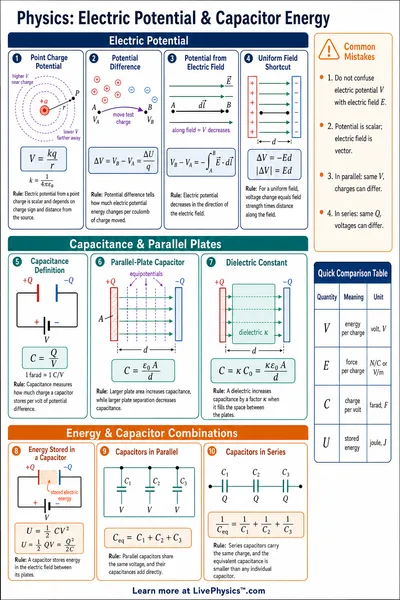
Potential is best understood as electric potential energy per unit positive charge. It tells how much energy would be available or required for a tiny positive test charge at a location.
A high value does not mean a charge would necessarily move upward in physical space. The height is a visual code for energy landscape, like a map in which altitude represents potential rather than actual elevation.
A positive source charge creates a high peak because bringing a positive test charge close to it requires work against repulsion. A negative source creates a deep well because attraction lowers the test charge's potential energy.
The surface becomes extremely steep near an ideal point charge. This happens because the point-charge model treats the charge as concentrated in zero space, while real charged objects have size and cannot produce truly infinite values at their surfaces.
When several charges are present, their potentials add as ordinary signed numbers. This is called superposition, and it differs from combining field arrows, which requires direction as well as size.
A positive charge can raise the surface while a negative charge lowers it. At places where their contributions cancel, the potential can be zero even though the electric field there is not zero.
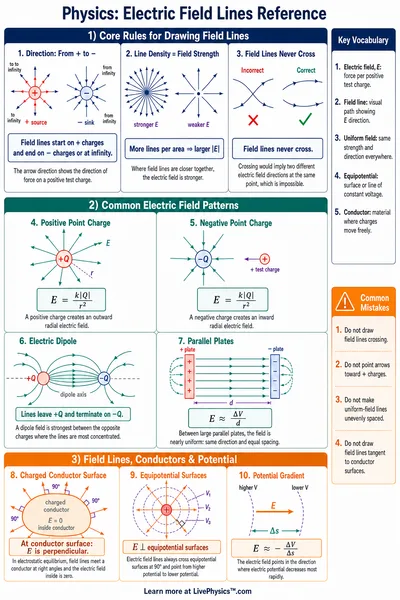
Equipotential lines join locations with the same potential. Moving along one of these lines requires no work by the electric force, because there is no change in potential energy for a chosen test charge.
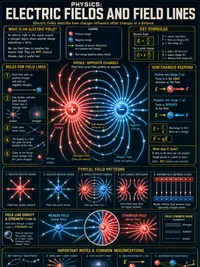
The electric field points across these lines, not along them, toward decreasing potential for a positive test charge. Closely spaced contours signal a rapid potential change over a short distance, so the field is strong there.
A dipole shows why potential and field cannot be treated as the same thing. Between equal opposite charges, the potential may be zero along a central line, yet the field can be large because both charges push or pull a positive test charge in the same general direction. This pattern matters in molecules, where separated positive and negative regions affect nearby charges.
When using the lab, move one charge at a time and watch for saddle-shaped regions, flattened areas, and sharp slopes. These features reveal cancellation, reinforcement, and field strength more clearly than memorizing a diagram.