Understanding Gauss's Law & Electric Flux Visualizer
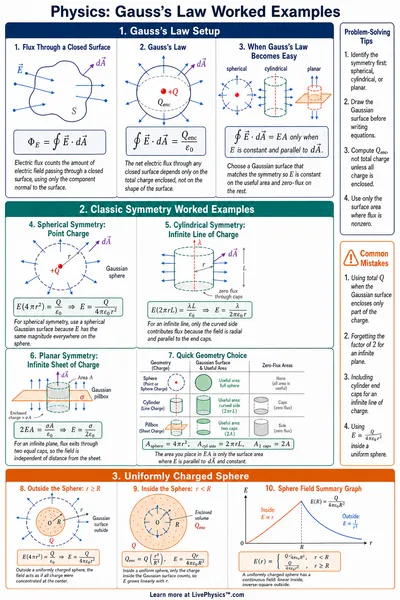
Electric flux measures how much electric field passes through a surface. A stronger field produces more flux, while a surface turned sideways to the field receives less because fewer field lines cross it.
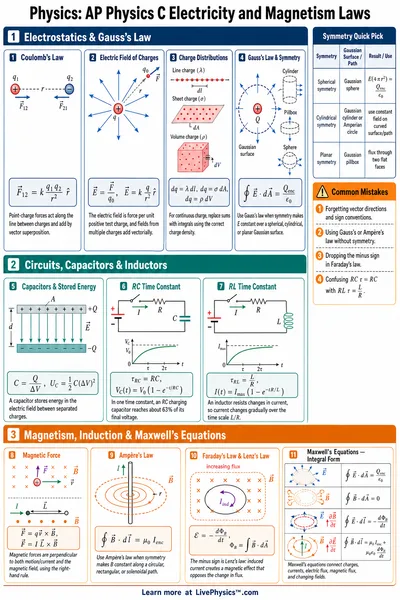
Gauss's law connects the total flux through a closed surface to the charge enclosed by that surface. Charges outside the surface can create fields on the surface, but their inward and outward contributions balance in the total flux.
The closed surface used for the calculation is called a Gaussian surface. It is an imaginary tool, so its shape can be chosen for convenience without changing the enclosed charge.
Symmetry is the reason this law becomes useful for finding electric fields. When every point on part of a Gaussian surface has the same field strength and field direction, the flux calculation becomes simple.
For a single point charge, a sphere centered on the charge has perfect spherical symmetry. The field points outward everywhere, and its strength falls as the square of the distance from the charge.
An extremely long charged line has cylindrical symmetry. A cylinder placed around the line gives an electric field that falls only in proportion to distance, which is slower than the point charge case.
An ideal infinite charged plane produces the same field strength at every distance from the plane. This surprising result depends on the plane being treated as endless, since real plates have edges where the pattern changes.
A uniformly charged solid sphere behaves differently inside and outside its radius. Outside, it acts like all its charge were concentrated at its center, while inside the field grows steadily from zero at the center.
A uniformly charged cylinder has a similar inside and outside pattern, but its geometry changes the distance dependence. Students should notice that the amount of enclosed charge grows with the volume inside the chosen Gaussian cylinder.
The graph of electric field against distance reveals these changes clearly. Sharp changes in slope often mark a boundary, such as the surface of a charged sphere or cylinder, even when the field itself stays continuous.
The direction of the electric field matters as much as its size. Positive charge sends field outward and negative charge pulls field inward, so signs must be handled carefully when describing flux and field direction.
These models appear in capacitors, charged wires, insulating spheres, electron beams, and shielding problems. The main learning habit is to identify the symmetry first, choose a matching closed surface, then check whether the surface really makes the field constant where it is needed.