Smart Spending and Comparison Shopping Lab
Make smart shopping choices one round at a time. Compare the price per unit to pick the better value, work out the final price after a discount, and learn to buy your needs before your wants while staying inside a budget. Each decision is checked, explained, and recorded in your data table.
Smart Shopping Score
Pick a Round
Cereal box sizes
Two boxes of the same cereal. Which box is the better value per ounce?
Controls
Current round Cereal box sizes
Compare unit prices, work out the sale price, or buy your needs first within a budget, then check your choice.
Data Table
(0 rows)| # | Scenario | Decision Type | My Choice | Smart Choice | Result |
|---|
Reference Guide
Comparing Unit Price
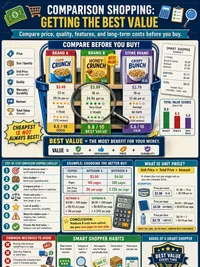
The unit price is how much you pay for one single unit, such as one ounce, one roll, or one bar. It lets you compare two packages of different sizes fairly.
To find it, divide the total price by the quantity. A $6 box with 30 ounces is $6 divided by 30, which equals $0.20 per ounce.
The package with the lower unit price is the better value. A bigger package is often cheaper per unit, but not always, so check the math before you decide.
Working Out a Discount
A discount is a percent taken off the original price. To find the amount saved, multiply the price by the percent written as a decimal.
For a 25% discount on a $20 shirt, 25% of $20 is $5. The sale price is $20 minus $5, which equals $15.
A faster way is to multiply by the part you still pay. If 25% is taken off, you pay 75%, so $20 times 0.75 equals $15. Both methods give the same answer.
Needs Versus Wants
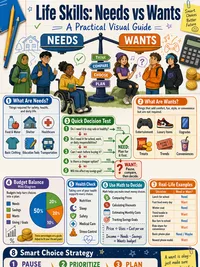
A need is something you must have, such as food, school supplies, or care for a pet. A want is something nice to have but not necessary, such as candy or a toy.
When you have a set budget, buy your needs first. Add up their cost and subtract it from your budget to see how much money is left.
Then add a want only if it still fits in the money that remains. Spending on a want before a need can leave you short on the things you really require.
Checking Total Cost
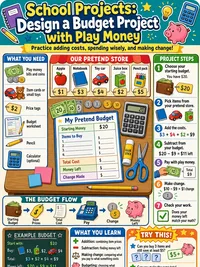
Total cost is the sum of everything in your cart. Always add it up before you decide, and compare it to the money you have.
The cheapest single item is not always the smart choice. A small low-price box can cost more per unit than a larger box that costs more up front.
Smart shoppers build two habits, compare the price per unit between options, and add up the total cost so they never spend more than their budget allows.