Soil Layers and Permeability Lab
Build a soil column with four layers of sand, silt, clay, or loam. Adjust each layer's thickness, then pour water to see how permeability changes based on Darcy's Law. Discover why a single clay layer can control drainage for the entire column.
Guided ExperimentDarcy's Law Investigation
If you include a clay layer in the soil column, how do you predict it will affect the overall drainage time compared to a pure sand column?
Write your hypothesis in the Lab Report panel, then click Next.
Soil Column
Controls
Presets
Soil Layers (top to bottom)
Results
Data Table
(0 rows)| # | Trial | Layer Config | Water Depth(cm) | K_eff(cm/hr) | Drainage Time(hr) | Darcy Velocity(cm/hr) | Permeability Class |
|---|
Reference Guide
Darcy's Law
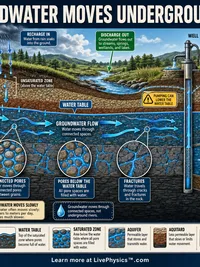
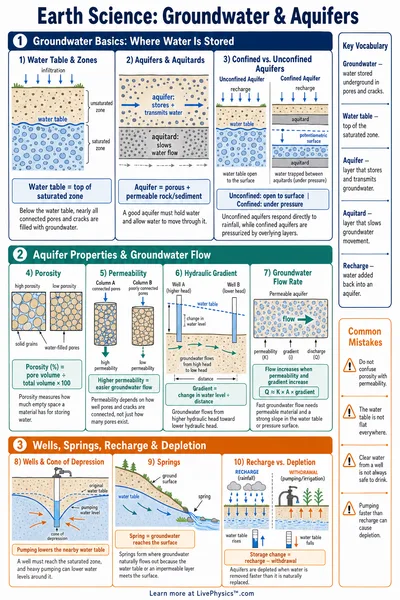
Water flow through soil is proportional to the hydraulic gradient and the hydraulic conductivity K of the material.
Where q is the Darcy flux (cm/hr), K is hydraulic conductivity (cm/hr), and the ratio is the hydraulic gradient (head difference over distance).
Soil Permeability
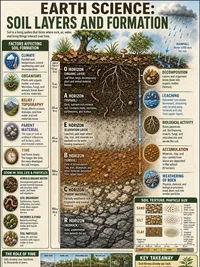
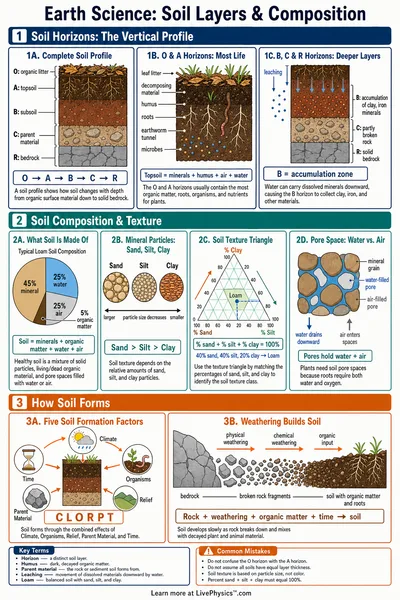
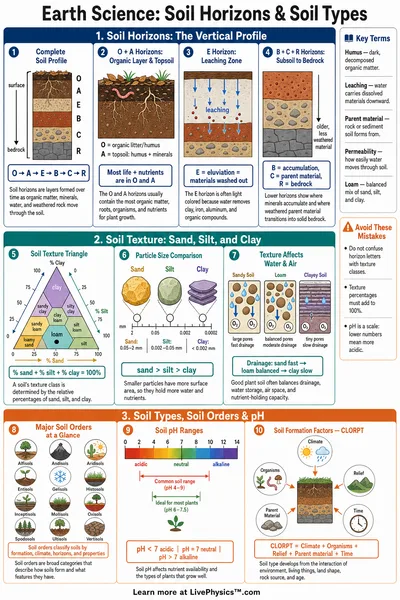
Permeability depends on pore size and connectivity. Larger pores in sand allow rapid flow; tiny pores in clay resist it.
- Sand K = 50 cm/hr (Rapid)
- Loam K = 5 cm/hr (Moderate)
- Silt K = 1.5 cm/hr (Slow)
- Clay K = 0.2 cm/hr (Very Slow)
Multi-Layer Effective K
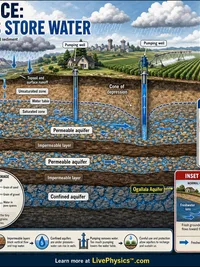
For layers in series, water must flow through each one. The effective K uses the harmonic mean weighted by thickness.
A single slow layer dominates the result. This is why a clay hardpan makes the entire soil profile drain slowly.
Runoff vs. Infiltration
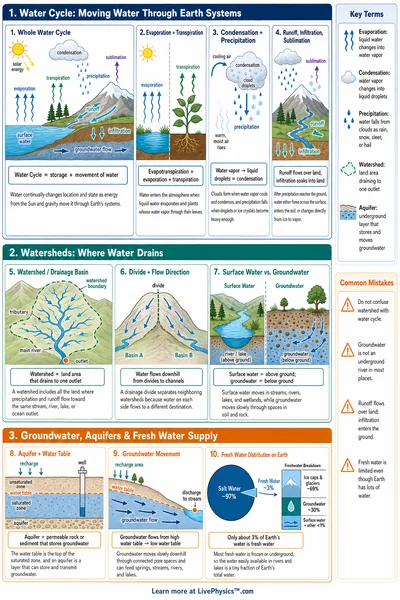
When rainfall intensity exceeds soil permeability, water cannot infiltrate fast enough and runs off the surface instead.
- High permeability water infiltrates, recharges groundwater
- Low permeability water ponds on surface, increasing flood risk
- Clay soils high runoff potential even with light rain
Impermeable surfaces like parking lots mimic clay soils at extreme scale, increasing urban flooding.