Thermal Expansion Calculator
Choose a material and its linear expansion coefficient, set an initial length, area, or volume, and apply a temperature change. The calculator returns the change and the final dimension, with a diagram that exaggerates the effect so you can see it.
Inputs
Results
Substituting the values
Diagram
Change is exaggerated for visibility. The number shown is the real change.
The Science of Thermal Expansion
What Thermal Expansion Is and Why It Happens
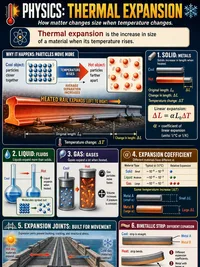
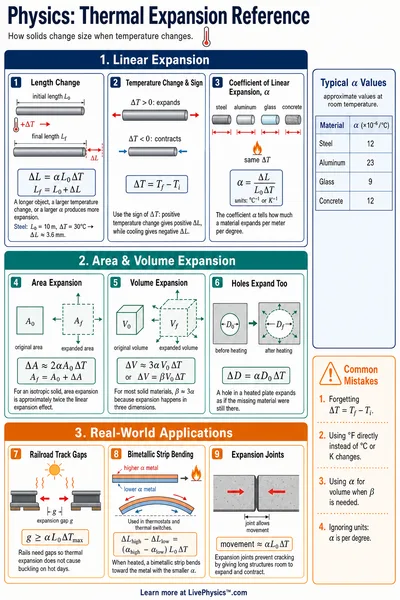
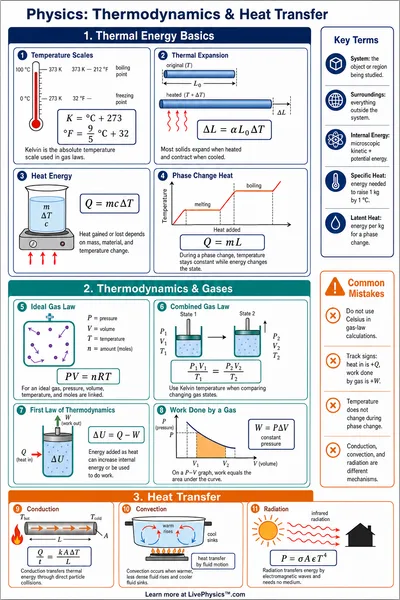
Most solids get larger when heated and smaller when cooled. Atoms in a solid vibrate around fixed positions. Raising the temperature gives them more energy, so they vibrate with a larger amplitude and the average spacing between them grows. The whole object stretches in proportion to that spacing.
The size of the effect is set by the linear expansion coefficient α, a property of the material. A larger α means a material that expands more for the same temperature change. Aluminum (23 × 10⁻⁶ /°C) expands about twice as much as steel (12 × 10⁻⁶ /°C) over the same heating.
Linear, Area, and Volume Formulas
For a change in length, the expansion is proportional to the original length, the coefficient, and the temperature change.
Area expands in two directions at once, and volume in three, so the area coefficient is about 2α and the volume coefficient β is about 3α.
ΔV = 3α V₀ ΔT
These factors of 2 and 3 come from expanding each dimension by the same small fraction and keeping only the leading terms.
Bridges, Rails, and Expansion Joints
Long structures move noticeably as the seasons change. A 100 m steel bridge deck warming by 30 °C grows about 3.6 cm. Engineers build expansion joints, the toothed metal gaps you drive over, so the deck can lengthen without buckling.
Railroad tracks are laid with small gaps or welded under controlled tension for the same reason. Without room to expand, rails can warp into a sun kink on a hot day and force a slow order or a track closure.
Power lines sag more in summer heat, and a metal lid loosens on a glass jar when you run it under hot water because the metal expands faster than the glass.
Why Pyrex Resists Thermal Shock
Thermal shock happens when one part of an object heats or cools faster than another. The hot part wants to expand while the cold part holds its size, and the resulting stress can crack the material.
Ordinary glass has a coefficient near 9 × 10⁻⁶ /°C. Pyrex, a borosilicate glass, has a much smaller coefficient near 3.3 × 10⁻⁶ /°C, so the same temperature difference produces far less internal stress. That is why it survives a move from a hot oven to a cool counter that would shatter ordinary glass.
Invar, a nickel iron alloy with a coefficient near 1.2 × 10⁻⁶ /°C, barely expands at all. It is used in precision instruments and clock pendulums where size must stay constant.