Communication Device Builder
Pick a flashlight, drum, or cup phone, then design a pattern of pulses to send a message. Watch and listen to what the receiver picks up. Learn how light, sound, and vibration carry signals over distance.
Score 0
Choose your device
Flashlight. Shine pulses of light to send messages far away. Range Across a dark room.
Light receiver
Pattern length5
Tap each cell to turn the signal on or off.
Receiver hears 1 flash, pause, 1 flash, pause, 1 flash
That is the pattern for "Hello"
Try a preset message
Reference Guide
How Devices Send Messages
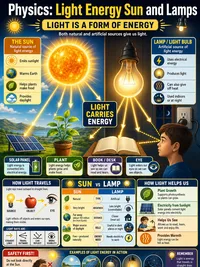
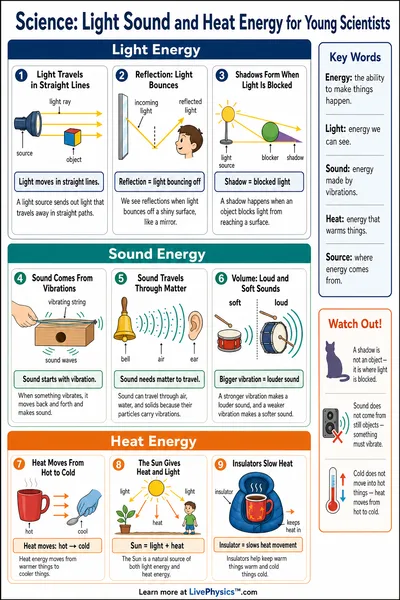
- Flashlight. Sends flashes of light. Light travels very fast and works best in dark places.
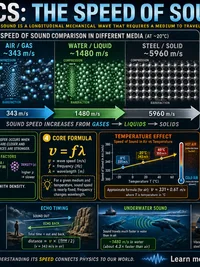
- Drum. Makes loud beats. Sound travels through the air as invisible waves.
- Cup Phone. Two paper cups joined by string. Your voice shakes the bottom of one cup, and that shaking travels as vibration along the string to the other cup.
- Pattern. The order of pulses and pauses is what carries meaning.
Light, Sound, and Vibration
- Light travels in straight lines and moves very fast.
- Sound is a vibration that spreads through air, water, or solid objects.
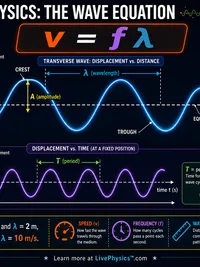
- Vibration is a tiny back and forth wiggle that can carry a signal.
- People can plan patterns so others understand the message.
- Standard covered. 1-PS4-4.
Example Patterns
- Hello. Three quick pulses. Works on any device.
- Come Here. Two pulses, a pause, then two more.
- SOS. Three short, three long, three short. A famous call for help sent by flashlights or drums.
- Yes. Two quick pulses. Best for drums and cup phones.
- No. Three pulses in a row. Easy to drum or tap.
Try This
- Design your own pattern and tell a friend what it means.
- Try sending the same message with two different devices. Which travels farthest?
- Switch to Challenge mode. Match the target message exactly.
- Long signals feel different from short ones. Plan your pattern so the receiver can tell them apart.
Related Content
Related Tools
Projectile Motion Calculator
Calculate trajectory, range, max height, and time of flight for projectile motion. Visualize the parabolic path with an interactive time slider and velocity vectors.
Circuit Calculator
Calculate voltage, current, resistance, and power with Ohm's law. Build series and parallel resistor networks with step-by-step equivalent resistance.
Lens & Mirror Calculator
Visualize image formation with interactive ray diagrams for lenses and mirrors.
Kinematics Solver
Solve constant-acceleration problems with step-by-step solutions and motion graphs.
Related Labs
Communication Device Lab
Investigate how light patterns, drum beats, and cup-phone vibrations send messages over distance. Record patterns and decode signals across three device types. Grades K-1.
Light, Shadows & Materials Lab
Investigate how transparent, translucent, and opaque materials change the shadows they cast. Record shadow strength for glass, water, wood, fabric, and more. Grades K-1.
Waves & Secret Messages Lab
Explore wave amplitude and wavelength, discover which materials waves travel through, and decode secret flash-code messages. NGSS 4-PS4-3. Grades 3–5.