Calculus
Treating dy/dx as an Ordinary Fraction
Students cancel the in and replace the derivative with .
Quick check
Why students make it
The notation looks like a fraction, so it is tempting to treat and as ordinary factors. This hides the fact that represents a limit and a rate of change.
The rule done right
means the derivative of with respect to , defined by a limit. Fraction-like moves are valid only when justified by rules such as the chain rule, the inverse function rule, or separation of variables.
Related resources
-
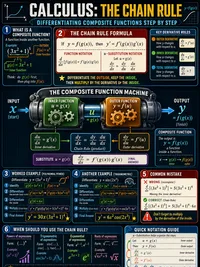 The Chain Rule Infographic
-
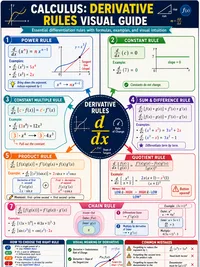 Derivative Rules Visual Guide Infographic
-
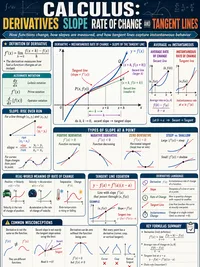 Derivatives Infographic
-
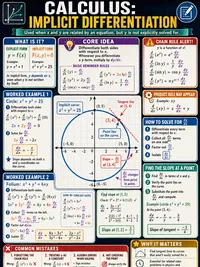 Implicit Differentiation Infographic
-
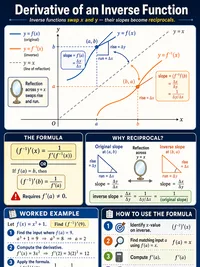 Calculus, The Derivative of an Inverse Function Infographic
- Derivatives & Differentiation Rules Cheat Sheet
- Chain Rule Worked Examples Cheat Sheet
- Implicit Differentiation Reference Cheat Sheet
- Tangent Lines & The Derivative as a Limit Cheat Sheet
- Common Derivatives & Integrals Table Cheat Sheet
- Calculus, Derivatives Worksheet
- Calculus, Derivative Rules, Power, Chain, Product, Quotient Worksheet
- Derivatives and Differentiation Rules Worksheet
- Calculus, Related Rates Worksheet
- Calculus, Limits and Continuity Worksheet
- Derivative Rules Step-by-Step Tool
- Implicit Differentiation Step-by-Step Solver Tool
- Limits & Continuity Explorer Tool
- Derivative & Integral Visualizer Tool
- Related Rates Visual Solver Tool
- Derivatives & Tangent Lines Lab Lab
- Optimization & Related Rates Lab Lab
- Limits & Continuity Lab Lab