Chemical Bonding Intro
Select two elements from the periodic table and watch how electrons move between them. See ionic bonds form through electron transfer, and covalent bonds through electron sharing. Based on Pauling electronegativity values.
Select one element from each picker above, then click Show Bond Formation.
Reference Guide
Electronegativity
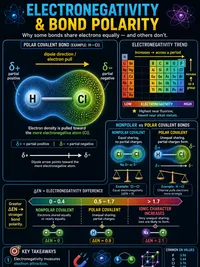
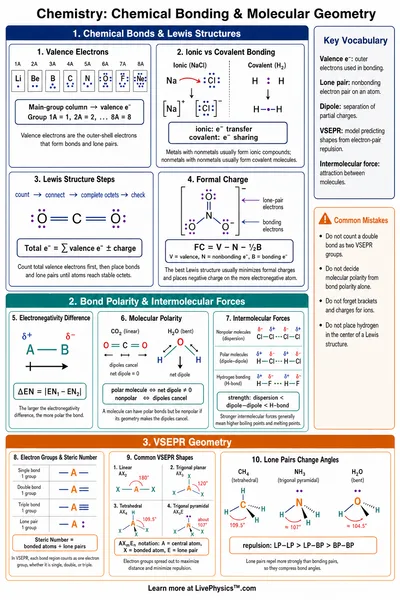
Electronegativity (EN) measures how strongly an atom attracts shared electrons in a bond. The Pauling scale runs from 0.7 (francium) to 3.98 (fluorine).
- Fluorine (F) is highest at 3.98
- Oxygen (O) is 3.44
- Nitrogen (N) is 3.04
- Carbon (C) is 2.55
- Sodium (Na) is only 0.93
EN increases across a period (left to right) and decreases down a group in the periodic table.
Ionic vs Covalent Bonds
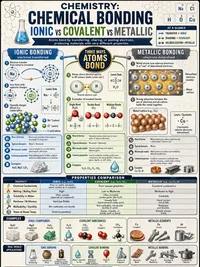
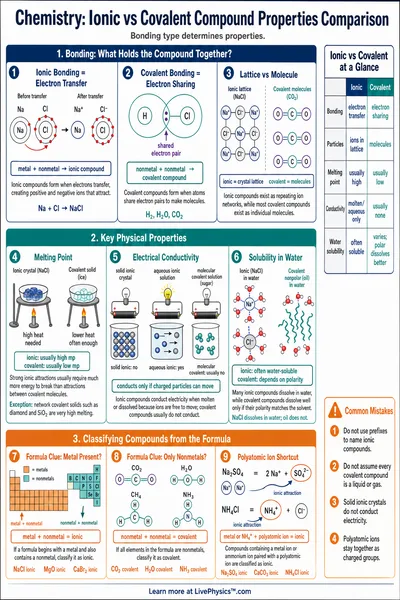
The electronegativity difference (DeltaEN) between two atoms determines the bond type.
- DeltaEN < 0.4 - Nonpolar covalent (equal sharing)
- 0.4 to 1.7 - Polar covalent (unequal sharing)
- DeltaEN >= 1.7 - Ionic (electron transfer)
- Metal + metal - Metallic bond
Metal-nonmetal pairs always tend toward ionic bonding regardless of the exact EN difference.
Lewis Dot Structures
Lewis dot structures show valence electrons as dots around an element symbol. Bonding pairs are shown as lines between atoms.
- Each bond line represents two shared electrons
- Lone pairs remain on individual atoms
- Most atoms follow the octet rule (8 valence electrons)
- Hydrogen follows the duet rule (2 electrons)
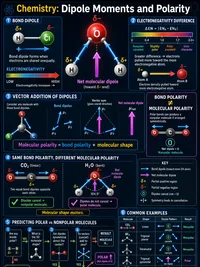
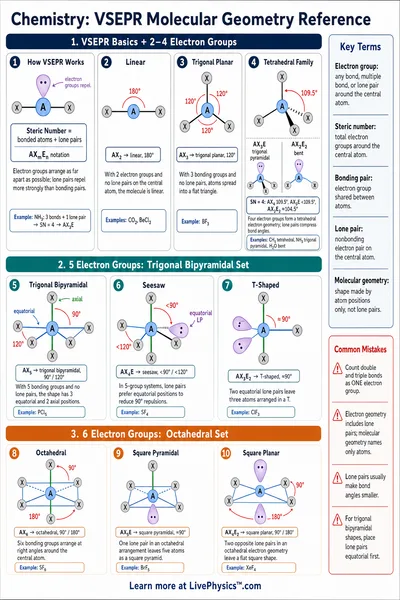
In water (H-O-H), oxygen forms two polar covalent bonds and keeps two lone pairs, giving it a bent shape.