Color Mixing Light
Toggle colored spotlights to see how light blends into new colors. Switch to Paint mode and discover why mixing paints works differently from mixing light.
Light adds colors together. Red + Green = Yellow!
Colored Spotlights
Mixed Color Result
Reference Guide
Primary Colors of Light
Red, Green, and Blue (RGB)
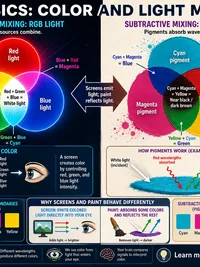
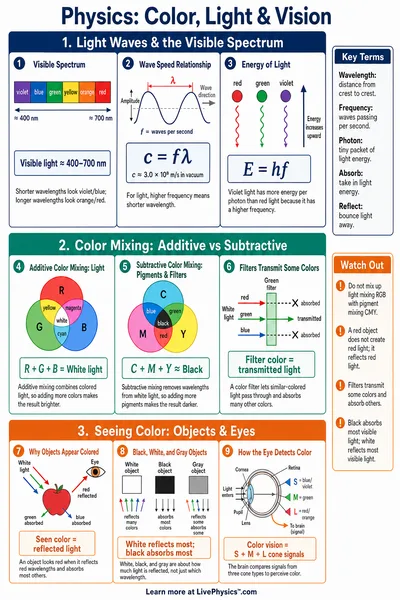
Light uses three primary colors, red, green, and blue. Every color you see on a TV or phone screen is made by mixing these three colors of light.
Adding Light Together
When you mix colored lights, you add brightness. Red + Green = Yellow. Red + Blue = Magenta. Green + Blue = Cyan. All three together = White.
No Light = Black
Black is not a color of light. It is simply the absence of light. A dark room looks black because no light reaches your eyes.
Additive vs Subtractive
Additive Mixing (Light)
Colored lights add together. Mixing all colors of light makes white. This is called additive mixing because you are adding more light each time.
Subtractive Mixing (Paint)
Paints and pigments absorb, or subtract, some colors of light. The color you see is the light that was NOT absorbed. Mixing all paint colors makes black.
Paint Primaries, CMY
Cyan, Magenta, and Yellow are the primary colors for paint. Printers use these three colors plus black (CMYK) to print every color in a picture.
How Screens Work
Every pixel on a phone, tablet, or TV screen contains three tiny lights, one red, one green, and one blue. They are so small you cannot see them separately.
To show yellow, the screen turns on the red and green tiny lights in each pixel and leaves the blue ones off. Your brain sees red + green and reads it as yellow.
- A full-HD screen has over 2 million pixels
- Each pixel has 3 subpixels (RGB)
- That is over 6 million tiny colored lights
- They mix together to show any color