Concentration Units Converter
Enter the mass and molar mass of the solute, the mass and molar mass of the solvent, and the density of the solution. The tool computes molarity, molality, mole fraction, mass percent, ppm, and ppb at once, with the formula shown for each unit.
Describe the Solution
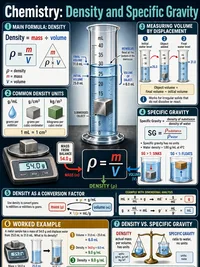
Water molar mass is 18.015 g/mol. Density relates molarity (per liter of solution) to molality (per kilogram of solvent), so an accurate density is needed to convert between them.
All Concentration Units
Reference Guide to Concentration Units
Molarity (mol/L)
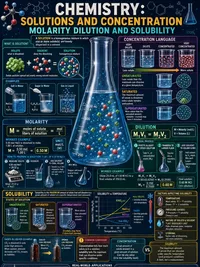
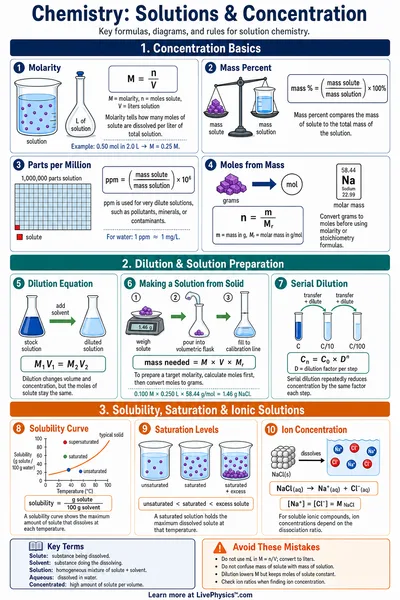
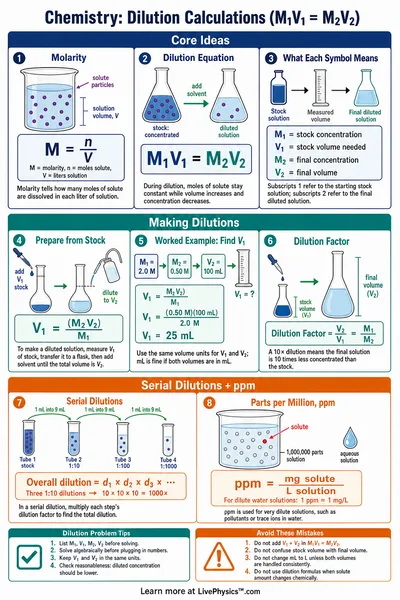
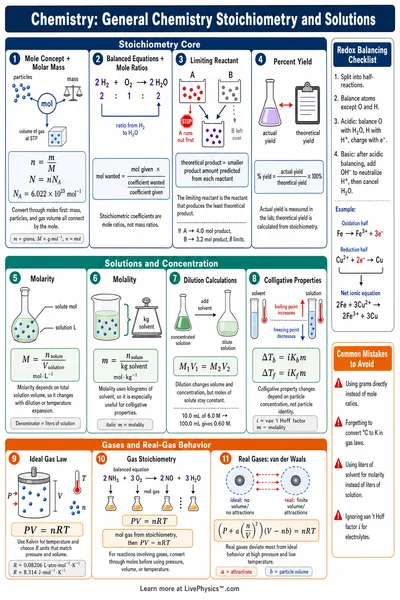
Molarity is the number of moles of solute divided by the volume of the whole solution in liters. It is the most common unit in titrations and stoichiometry because reactions are measured by volume in the lab.
Molarity changes slightly with temperature because the volume of a liquid expands when warmed, so the same amount of solute sits in a larger volume.
Molality (mol/kg)
Molality is the number of moles of solute divided by the mass of the solvent in kilograms. Because it depends on mass rather than volume, it does not change with temperature.
Molality is used for colligative properties such as boiling point elevation and freezing point depression, where the temperature independence matters.
Why Density Is Needed
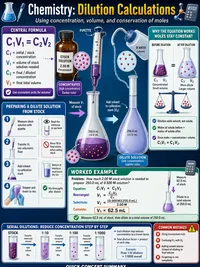
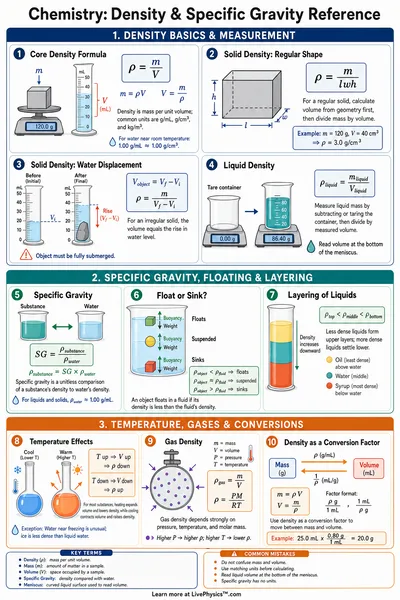
Molarity is measured per liter of solution, but molality is measured per kilogram of solvent. To move between a volume and a mass you need the density of the solution.
Mass percent, ppm, and ppb depend only on masses and never need the density. Mole fraction depends only on the moles. Density is the single bridge that lets molarity be compared to all the mass-based units.
Mass Percent and Mole Fraction
Mass percent (% w/w) is the mass of solute divided by the mass of the solution, times 100. Total mass is solute mass plus solvent mass.
Mole fraction is the moles of one component divided by the total moles of all components. The mole fractions of every component in a solution add up to exactly 1.
ppm and ppb for Trace Amounts
Parts per million (ppm) and parts per billion (ppb) describe very dilute solutions where mass percent would be an awkward fraction of a percent. They are common in water quality, environmental testing, and toxicology.
For dilute aqueous solutions where the density is close to 1 g/mL, 1 ppm by mass is roughly 1 milligram of solute per liter of solution. ppb is one thousand times finer than ppm.
Molarity vs Molality
Use molarity when you are dispensing solution by volume, as in a titration or when preparing a reagent to a target volume in a flask. Use molality when temperature changes or when working with colligative properties.
For dilute aqueous solutions near 1 g/mL, molarity and molality are nearly equal. As the solution becomes more concentrated or its density moves away from 1 g/mL, the two values diverge, and that is exactly when the density term matters most.