Dichotomous Key & Classification Explorer
Use the Identify mode to walk a dichotomous key and name an organism step by step. Switch to Classify mode to see the full eight-rank taxonomy for any organism and compare two species to find where their classification diverges.
Mode
Key
Common Vertebrates Key
Choose the statement that best describes your organism
View full key tree
Reference Guide
What a Dichotomous Key Is
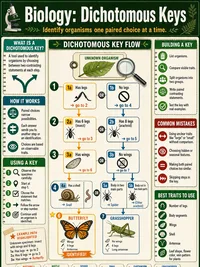
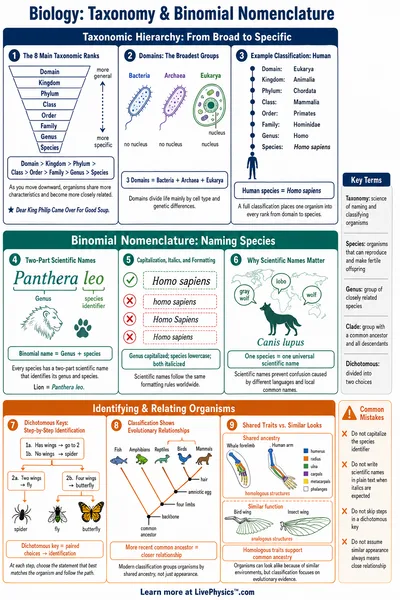
A dichotomous key is a tool biologists use to identify unknown organisms. The word dichotomous comes from the Greek for "cut in two," which describes exactly how the key works. At each step, you are given two mutually exclusive statements, and you choose the one that matches your organism. Each choice leads you to the next step or to a final identification.
Dichotomous keys can be written as numbered couplets in a book or shown as a branching tree. The tree view in this tool shows the complete structure at a glance, with the current node highlighted so you always know where you are.
Keys are built by taxonomists who identify the most useful distinguishing features at each fork. A good key uses features that are easy to observe, such as the number of legs, the presence of fur, or the shape of leaves, rather than features that require laboratory analysis.
The Science of Classification
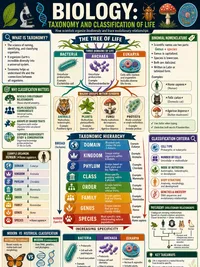
Taxonomy is the science of naming, describing, and grouping organisms. It was formalized by Carl Linnaeus in the 18th century, who introduced the binomial naming system still used today. Modern taxonomy uses both physical characteristics and DNA evidence to determine how organisms are related.
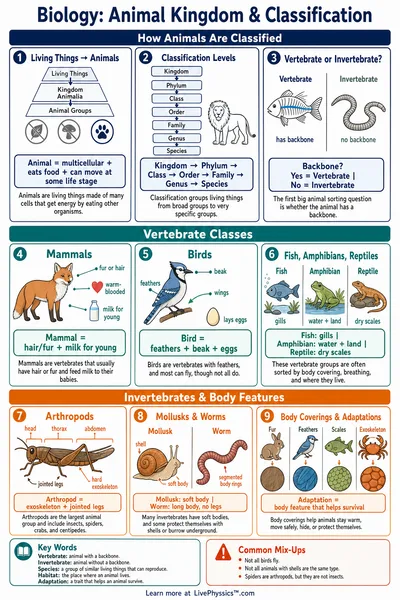
Organisms are grouped together because they share a common ancestor. A group at any rank is called a taxon (plural taxa). The broader the taxon, the more distant the shared ancestry. All animals share a common ancestor, but only cats and lions share the family Felidae.
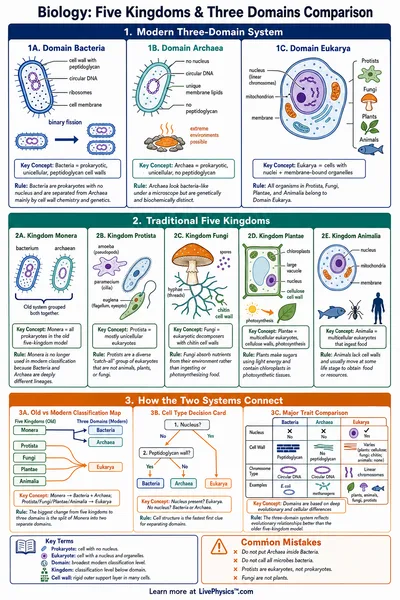
The current system uses three domains as the broadest division, Bacteria, Archaea, and Eukarya. Bacteria and Archaea are prokaryotes. All familiar plants, animals, fungi, and protists are eukaryotes in the domain Eukarya.
The Eight Taxonomic Ranks
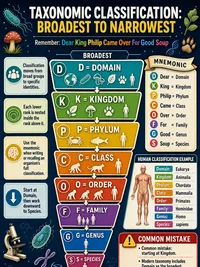
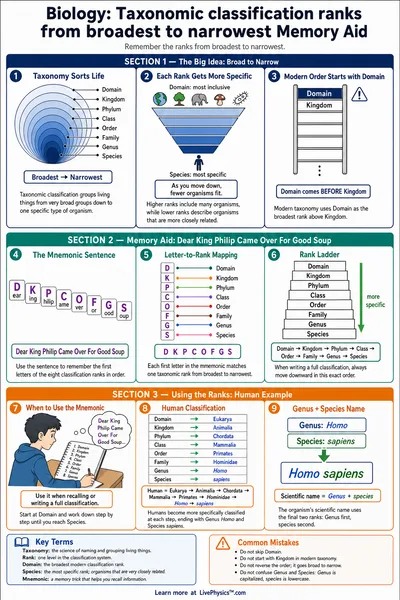
The standard classification system uses eight main ranks from broadest to most specific. Each level is nested inside the one above it. The mnemonic "Dear King Philip Came Over For Good Soup" helps students remember the order.
| Rank | Human example | Mnemonic word |
|---|---|---|
| Domain | Eukarya | Dear |
| Kingdom | Animalia | King |
| Phylum | Chordata | Philip |
| Class | Mammalia | Came |
| Order | Primates | Over |
| Family | Hominidae | For |
| Genus | Homo | Good |
| Species | Homo sapiens | Soup |
Binomial Nomenclature
Every known species has a two-part scientific name in the binomial system introduced by Linnaeus. The first part is the genus name and the second part is the specific epithet. Together they form the species name. For example, Homo sapiens means "wise human" in Latin.
Scientific names are written in Latin or latinized Greek because Latin was the international language of science when the system was created. Using a single universal language prevents confusion across the many different everyday names an organism may have in different countries and languages.
In print, scientific names are italicized. The genus is capitalized and the species epithet is lowercase. After the full name has been written once in a document, the genus may be abbreviated to its first letter, such as H. sapiens.
Shared Classification and Evolutionary Relatedness
When two organisms share a classification rank, it means they descended from a common ancestor at that level. The deeper the shared rank, the more recently those two lineages diverged. Dogs and wolves share the genus Canis, meaning they share a very recent common ancestor. Dogs and cats share only the order Carnivora, a more distant relationship.
The compare feature in this tool finds the most recent common classification between any two organisms. Organisms in different domains (for example, a human and a bacterium) share no rank at all, which reflects billions of years of separate evolutionary history.
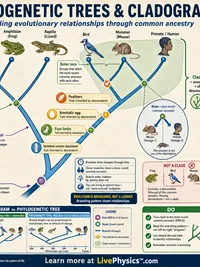
Modern phylogenetics uses DNA sequence data to build evolutionary trees called cladograms. These trees often revise older classifications that were based only on body shape, revealing that some groups that look alike are not closely related at all.