Pedigree Chart & Inheritance Pattern Analyzer
Select a family pedigree and the tool draws it with standard genetics symbols, then checks each of the five inheritance patterns. It reports which patterns are consistent and which are ruled out, with the reason for every verdict.
Autosomal Recessive Family
The trait skips generations and appears in a male child of two unaffected parents. Affected individuals can come from unaffected parents, which is the hallmark of a recessive allele.
Pattern analysis
2 patterns are consistent with this pedigree. A single family tree often cannot distinguish between them. The textbook intended answer is highlighted.
- Autosomal DominantRULED OUT
An affected individual has two unaffected parents. A dominant trait cannot skip a generation.
- Autosomal RecessiveIntended answerCONSISTENT
No two affected parents produce an unaffected child, so a recessive autosomal allele fits.
- X-Linked DominantRULED OUT
An affected individual has two unaffected parents. A dominant trait cannot skip a generation.
- X-Linked RecessiveCONSISTENT
No rule is violated. Affected females trace to affected fathers and there is no male-to-male transmission.
- Y-LinkedRULED OUT
An affected male has an unaffected father. A Y-linked affected male must inherit the Y from an affected father.
Reference Guide
How to read a pedigree
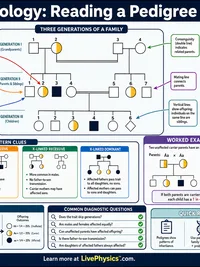
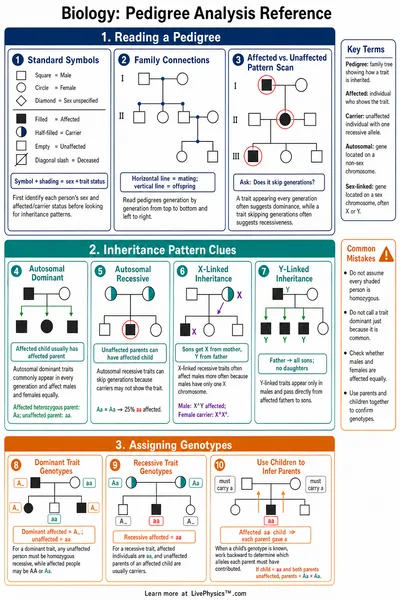
A pedigree is a family tree that tracks one trait across generations. A square is a male and a circle is a female. A filled symbol means the individual is affected, an outline means unaffected. A horizontal line between two symbols is a mating, and vertical lines drop down from a mating to the children. Roman numerals on the left label each generation as I, II, and III.
Rules for each pattern
Each pattern is ruled out when a specific rule is broken.
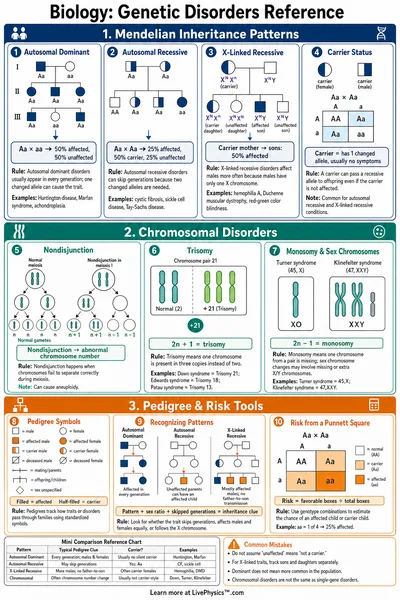
- Autosomal dominant. An affected child must have an affected parent, so the trait never skips a generation.
- Autosomal recessive. Two affected parents can only have affected children.
- X-linked dominant. An affected father passes the trait to all daughters and there is no father-to-son transmission.
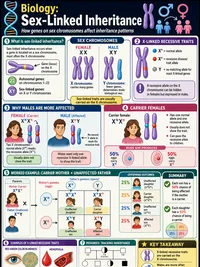
- X-linked recessive. An affected female needs an affected father, and there is no father-to-son transmission.
- Y-linked. Only males are affected and every son of an affected father is affected.
Why one pedigree fits many patterns
A single family tree rarely has enough informative matings to point to one answer. A pedigree with affected males of carrier mothers, for example, fits both autosomal recessive and X-linked recessive inheritance. Reporting every consistent pattern is the honest result. Distinguishing them needs a key mating, such as an affected father with several daughters, or a larger family.
Autosomal vs X-linked vs Y-linked clues
Male-to-male transmission rules out every X-linked and Y-linked recessive doubt for a trait that also reaches females, since a father gives his son a Y, not an X. An affected father with all affected daughters but no affected sons signals X-linked dominant. A trait that appears only in males and passes father to son in every generation points to Y-linkage.