Understanding Digestive System Journey
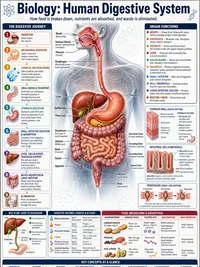
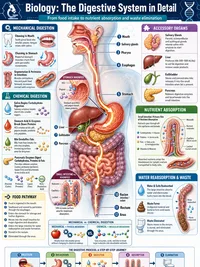
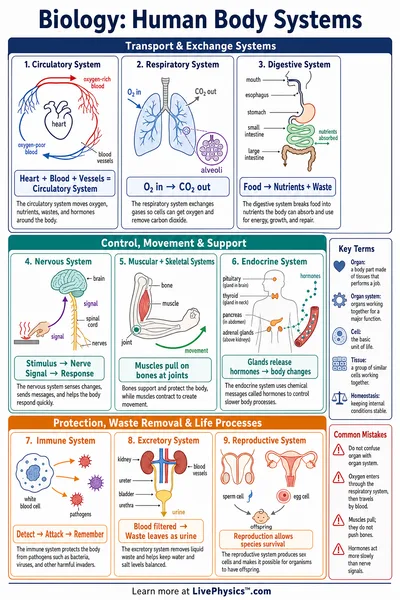
Digestion begins as a physical process before most chemical breakdown occurs. Teeth cut, tear, and grind food into smaller pieces, giving digestive chemicals more surface to work on. Saliva moistens the food into a soft bolus that can be swallowed safely.
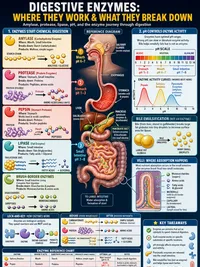
An enzyme called amylase starts breaking some starch into smaller sugars in the mouth. The tongue pushes the bolus backward, while a flap called the epiglottis helps keep it out of the airway.
Muscular waves called peristalsis move the bolus through the esophagus. Food does not travel by gravity alone, so swallowing can work even when a person is lying down.
The stomach is a muscular mixing chamber, not just a storage bag. Its contractions churn food with acid, mucus, and protein-digesting enzymes. The acid kills many microbes that arrive with food and helps unfold protein molecules, making them easier for enzymes to cut apart.
The stomach lining must protect itself from this acid with a thick mucus layer. After mixing, the food becomes a soupy material called chyme.
A meal high in fat often remains in the stomach longer because fat slows stomach emptying. This helps explain why different meals can leave a person feeling full for different lengths of time.
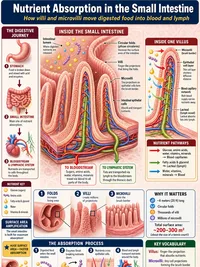
Most nutrient absorption takes place in the small intestine because its inside surface is highly folded. Tiny fingerlike villi cover the lining, and even smaller structures cover each villus. Together, these features create a very large area for nutrients to cross into the body.
Sugars and amino acids usually enter the blood, while most fat enters lymph vessels before reaching the blood. The pancreas sends enzymes that break down carbohydrates, proteins, and fats. The liver makes bile, which is stored in the gallbladder and released into the small intestine.
Bile is not an enzyme. It breaks fat into small droplets so fat-digesting enzymes can work more effectively.
The large intestine mainly recovers water and minerals from material that the body cannot digest. Helpful bacteria live there and feed on some fiber, producing substances that can support the cells of the gut. Fiber is not absorbed like sugar or fat, yet it matters because it helps add bulk to waste and supports regular bowel movements.
Transit time varies widely between people and between meals. It can change with meal size, fiber intake, water intake, activity, stress, illness, and some medicines.
When studying a nutrient tracker, pay attention to where each nutrient decreases most sharply. That pattern shows which organs are doing the main work, rather than suggesting that every food is processed at exactly the same speed.