Understanding Metre Rule Reading Simulator
A metre rule measures length by comparison. You lay a scale of equal steps beside an object and see which marks its two ends reach. It is the first instrument in almost every physics course.
The scale is 100 cm long and its smallest division is 1 mm, so that is the least count. A reading is taken to the nearest millimetre and written in centimetres with one decimal place. A mark seven small divisions past 34 cm is written 34.7 cm.
A length is never one reading. It is the difference between the readings at the two ends of the object, even when one of them is zero. Seeing it that way removes the most common fault of a rule.
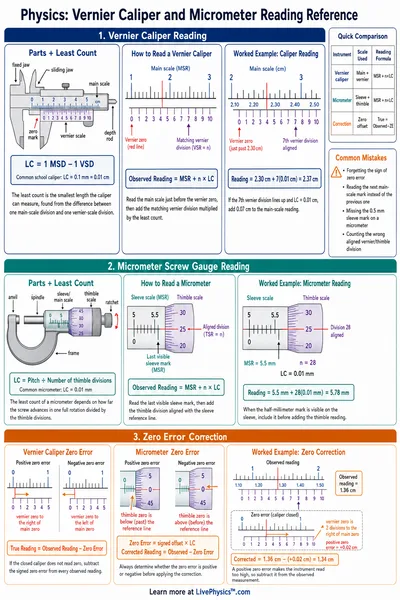
The ends of a rule get knocked and worn, so the zero mark is often not where the wood or plastic stops. If 2 mm has worn away, a length measured from the end comes out 2 mm too large. This is a zero error, and it shifts every measurement by the same amount.
The cure is to start from a clear mark further along. Place the 10.0 cm mark at one end of a rod and suppose the other end reaches 34.7 cm. The length is 34.7 minus 10.0, which is 24.7 cm, and the worn end has played no part.
The second fault comes from the thickness of the rule. When it lies flat, its marks sit a few millimetres above the object. Your eye, the end of the object and the mark you read lie on one straight line, and if that line leans, it meets the scale at the wrong place.
This shift is called parallax error. Similar triangles show that it equals the thickness of the rule multiplied by the sideways distance of the eye, divided by the height of the eye. With a rule 6 mm thick and the eye 30 cm up and 15 cm to one side, the shift is 6 times 15 divided by 30, which is 3 mm.
Three millimetres is three whole divisions, far more than the rule should be wrong by. There are two ways to remove it. Look straight down on each mark in turn, or stand the rule on its edge so that the marks touch the object and no gap is left.
Even a careful reading is only good to about half a division, or 0.5 mm. A length uses two readings, and in the worst case both are off in directions that add. The length is therefore quoted to plus or minus 1 mm, so the rod is 24.7 cm give or take 0.1 cm.
What that uncertainty means depends on the size of the object. For the 24.7 cm rod it is about 0.4 percent, which is good enough for most experiments. For a coin 2 cm across it is 5 percent, and for the diameter of a thin wire it is useless.
That is why short lengths are measured with a vernier caliper or a micrometer screw gauge. The metre rule is the right choice for anything from a few centimetres up to a metre, such as the length of a pendulum or of a wire on a resistance board.