Projectile Motion on Earth Map
Pick two cities and a launch angle to see how far, how high, and how long a projectile travels between them. Real WGS84 gravity, great-circle distances, and Coriolis deflection are all computed client-side.
For short ranges (under 500 km), the flat-Earth parabolic approximation is used. Coriolis deflection shown is approximate and does not account for Earth curvature.
New York to London
Physics Background
Projectile Motion Basics
Range equals v² sin(2θ) / g. Maximum range occurs at exactly 45°. Doubling launch speed quadruples the range. A steeper angle trades range for altitude while keeping flight time long.
The Coriolis Effect
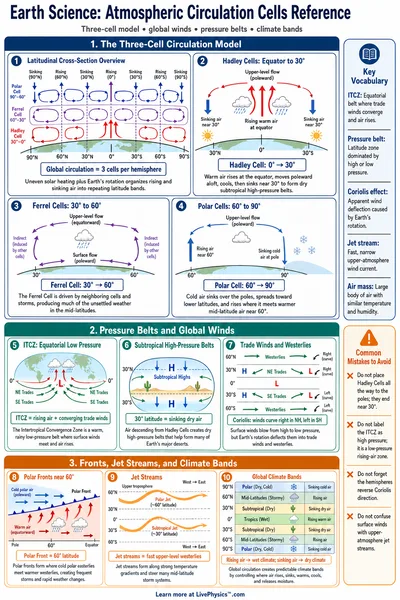
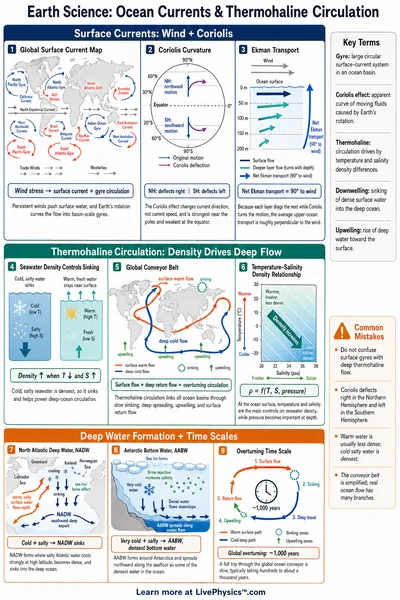
Earth's rotation deflects moving objects sideways. In the Northern Hemisphere the deflection is rightward; in the Southern Hemisphere it is leftward. The effect grows with speed, flight time, and latitude.
Gravity Varies by Latitude
Equatorial g is roughly 9.78 m/s² while polar g is about 9.83 m/s². The difference comes from Earth's equatorial bulge and the centrifugal effect of rotation. This tool uses the WGS84 formula to compute g at each city's latitude.
Speed in Context
New York to London (about 5571 km) requires roughly 7.4 km/s at a 45° angle, equivalent to Mach 21.5. That is why intercontinental ballistic missiles need rocket propulsion and cannot use a simple ballistic arc from the ground.
The Karman Line
The Karman line at 100 km altitude is the boundary of space. Long-range ballistic trajectories pass through or above this line. Any path flagged as suborbital in the results crosses into space and would require a rocket, not a gun.
Flat-Earth Approximation
The flat-Earth parabolic equations are accurate for ranges up to roughly 1000 km. Beyond that, Earth curvature becomes significant and full ballistic trajectory equations would be needed. This tool uses the flat-Earth model for the altitude profile, with great-circle distance as the true range.
WGS84 Gravity Formula
The tool uses the Somigliana formula from the World Geodetic System 1984 standard
− 0.0000058 sin²(2φ))
where φ is the geodetic latitude.
Great-Circle Distance
The shortest path between two cities on a sphere uses the Haversine formula
d = 2R · atan2(√a, √(1−a))
R = 6371 km (mean Earth radius).