Nervous System Signal Speed Lab
Trigger an action potential and watch it travel along a nerve fiber to the brain. Control myelination level to see how the myelin sheath dramatically increases conduction speed through saltatory conduction. Compare voluntary pathways with reflex arcs to understand why reflexes happen before conscious thought.
Guided ExperimentMyelination and Conduction Speed
How do you predict myelination will affect the speed at which a nerve signal travels? Will a fully myelinated fiber be faster or slower than an unmyelinated one?
Write your hypothesis in the Lab Report panel, then click Next.
Axon Signal Propagation
60.3 m/sControls
Signal Metrics
Voluntary Pathway
Data Table
(0 rows)| # | Trial | Fiber Type | Myelination | Pathway | Velocity(m/s) | Reaction Time(ms) |
|---|
Reference Guide
Action Potential
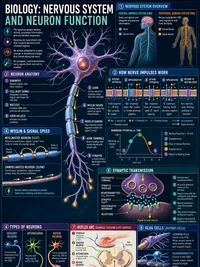
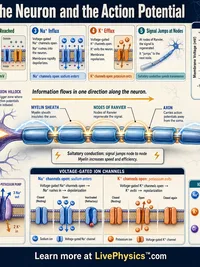
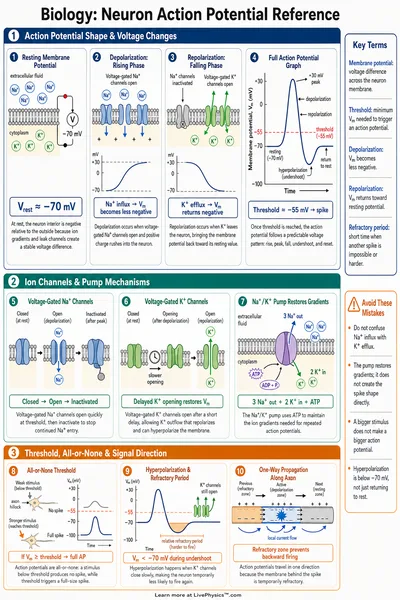
An action potential is a brief electrical signal that travels along a neuron. It begins when a stimulus causes voltage-gated sodium channels to open, allowing Na+ ions to rush into the cell, rapidly depolarizing the membrane from -70 mV to about +40 mV.
- Resting potential (-70 mV) maintained by Na/K pumps
- Depolarization Na+ rushes in, membrane reaches +40 mV
- Repolarization K+ exits, membrane returns to negative
- Refractory period brief window when the axon cannot fire again
The all-or-nothing principle means an action potential either fires at full amplitude or does not fire at all. Signal strength is encoded by firing frequency, not amplitude.
Myelination and Saltatory Conduction
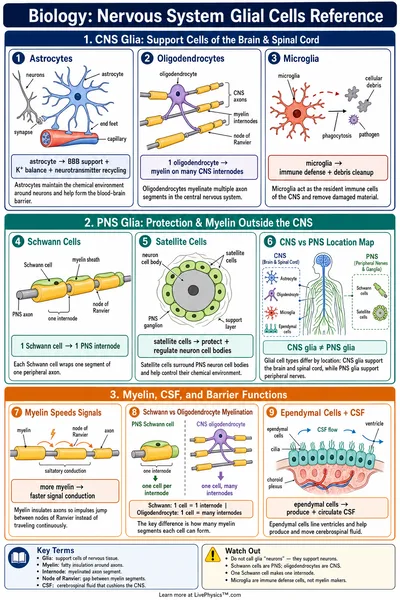
The myelin sheath is a fatty insulating layer wrapped around axons by Schwann cells (in the peripheral nervous system) or oligodendrocytes (in the brain and spinal cord). It dramatically speeds up signal transmission.
- C fibers (unmyelinated), 0.5-2 m/s, pain and temperature
- A-delta fibers (thin myelin), 5-30 m/s, sharp pain, touch
- A-alpha fibers (thick myelin), 70-120 m/s, motor commands
Saltatory conduction lets the action potential jump between nodes of Ranvier, gaps in the myelin sheath. This is both faster and more energy-efficient than continuous conduction along the entire membrane.
Multiple sclerosis (MS) is a disease where the immune system attacks the myelin sheath, slowing or blocking nerve conduction.
Reflex Arc
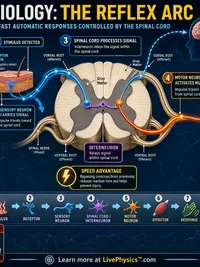
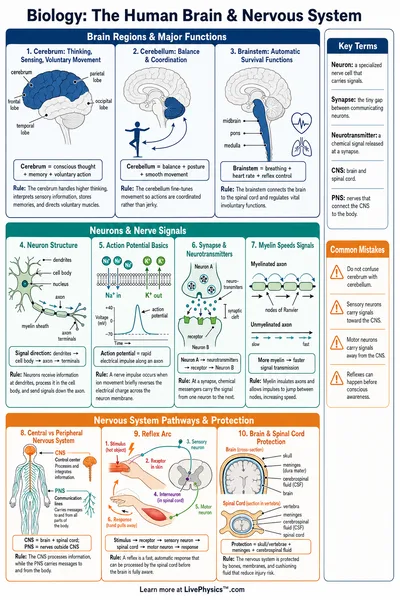
A reflex arc is an automatic neural pathway that produces a fast response without involving conscious thought. The signal travels from a receptor to the spinal cord and directly back to a muscle, bypassing the brain.
- Receptor detects stimulus (e.g. heat, pain)
- Sensory neuron carries signal to spinal cord
- Interneuron in spinal cord processes signal
- Motor neuron carries signal to effector muscle
- Muscle contracts before conscious awareness
Because reflex arcs use only 2 synapses and cover a shorter distance, they respond 3-10x faster than voluntary movements. This is why you pull your hand away from heat before feeling pain consciously.
Synaptic Transmission
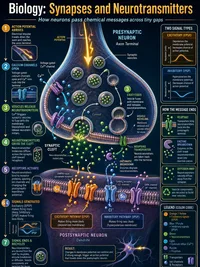
When an action potential reaches the end of an axon, it triggers neurotransmitter release into the synapse. The signal must chemically cross the synaptic cleft and bind to receptors on the next neuron.
Each chemical synapse introduces about 1 ms of delay. Voluntary movements require 4 synapses (receptor, spinal interneuron, thalamus, cortex), adding 4 ms total synapse delay. Reflex arcs use 2 synapses (receptor, spinal interneuron), adding only 2 ms.
At high myelination levels, the total signal travel time can be so short that synapse delay becomes the dominant factor in reaction time. This explains why reaction times below about 5 ms are physiologically impossible regardless of myelination.