Understanding Tape Measure Reading Simulator
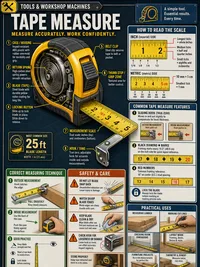
The marks on an inch tape come from cutting things in half. Halve an inch and you get two halves. Halve again and again and you get quarters, eighths and sixteenths.
That is why every fraction on the blade has 2, 4, 8 or 16 on the bottom. It is also why the lines have different lengths. Each round of halving adds a new set of shorter lines between the ones already there, so the length of a line tells you which round it belongs to.
Count how the lines build up inside one inch. There is 1 half inch line, then 2 quarter lines, 4 eighth lines and 8 sixteenth lines. Those 15 lines divide the inch into 16 equal spaces.
You can always count sixteenths one at a time, but the longer lines are quicker landmarks. The half inch line is 8 sixteenths, the quarter lines are 4 and 12, and the eighth lines are 2, 6, 10 and 14. A point one short line past the three quarter mark is 13 sixteenths.
A count of sixteenths is not yet a finished answer. If the top and the bottom are both even, divide both by 2 and repeat until the top is odd. So 12 sixteenths becomes 6 eighths and then 3 quarters.
Suppose the pointer is past the 14 inch mark and 12 short spaces further on. The reading is 14 and 12/16, which reduces to 14 3/4 inches. Since 12 inches make a foot, that is also 1 foot 2 3/4 inches.
An odd count cannot be reduced. A point 9 spaces past 31 inches is 31 9/16 inches and stays that way. Every shortest line on the blade is an odd number of sixteenths, so a reading on a shortest line is already in lowest terms.
The setting for the smallest mark changes how much the blade can say. With eighths as the smallest mark, a length of 14 13/16 inches falls between two lines and you round to the nearer one. Finer marks give a closer answer but more lines to sort out.
The metric blade works in tens instead of halves. Ten millimetres make a centimetre, so 37 cm and 5 mm is written 37.5 cm with no fraction to reduce. This is one reason science uses metric units.
The two systems are joined by an exact number, 1 inch = 2.54 cm. A sixteenth of an inch is about 1.6 mm, so a millimetre blade is slightly finer than a sixteenth inch blade. The 14 3/4 inch reading above is about 37.5 cm.
The loose end hook puzzles many people, but it is loose on purpose. It slides by exactly its own thickness. Pulled over an edge, the inside face of the hook is the zero, and pushed against a wall, the outside face is.
Tape measures appear in woodwork, building, sewing and sport, and reading one is a practical test of fraction skills. Adding 3/8 and 5/16 is easier when you can see both on a blade. Three eighths is 6 sixteenths, so adding 5 sixteenths gives 11/16.
When you record a length, always write the unit. A bare 23 could be inches or centimetres.